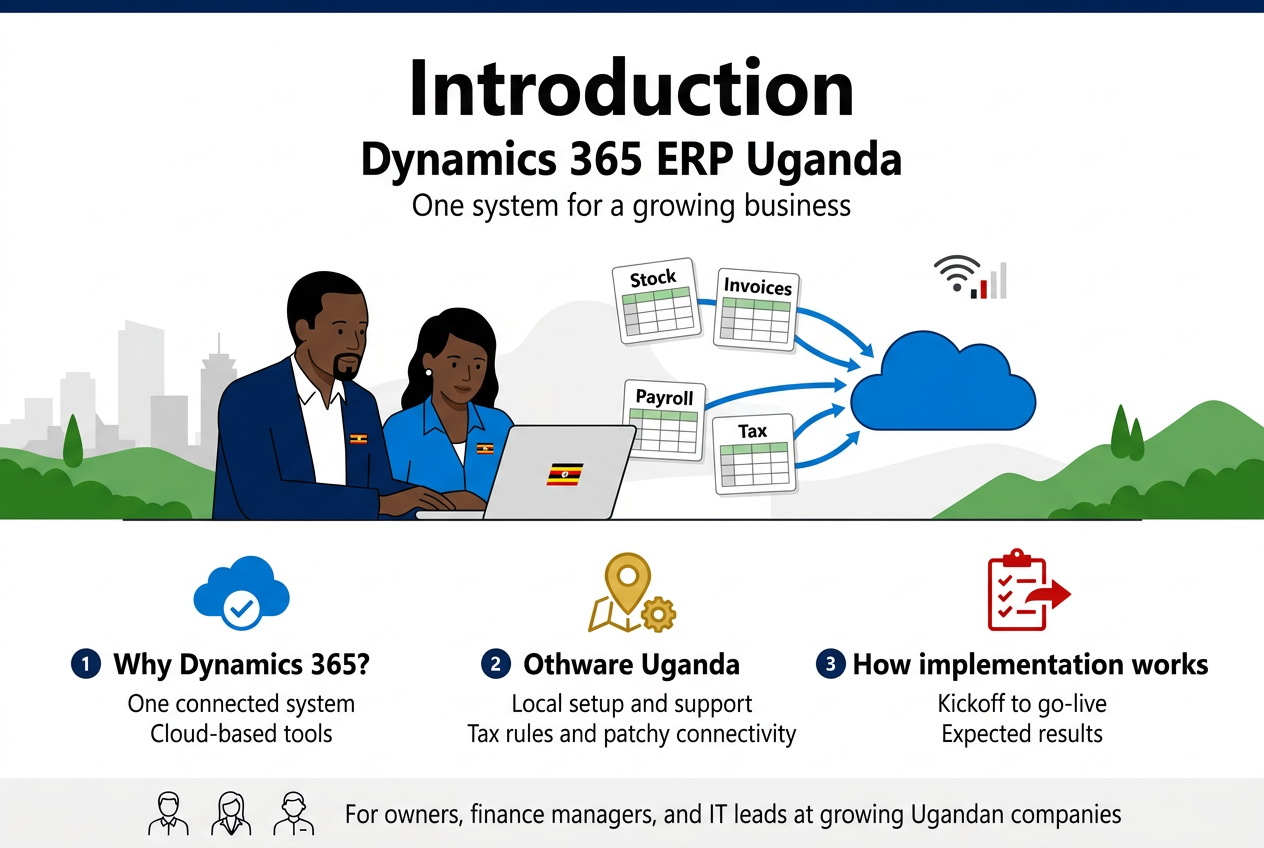
Running a business in Uganda means juggling stock, invoices, payroll, and tax, often across spreadsheets that don’t talk to each other. If that sounds familiar, Dynamics 365 ERP Uganda might be the fix you’re after, and Othware Uganda is the local team that can set it up for you.
This guide is for owners, finance managers, and IT leads at growing Ugandan companies who want one system to run the whole business. Here’s what we’ll cover:
- Why Dynamics 365 fits Ugandan businesses: what it does, and why cloud-based tools make sense here.
- What Othware Uganda offers: the core solutions, plus how they handle local challenges like tax rules and patchy connectivity.
- How implementation works: the steps from kickoff to go-live, and the results you can expect.
Let’s get into it.
Why Dynamics 365 ERP Fits Ugandan Businesses
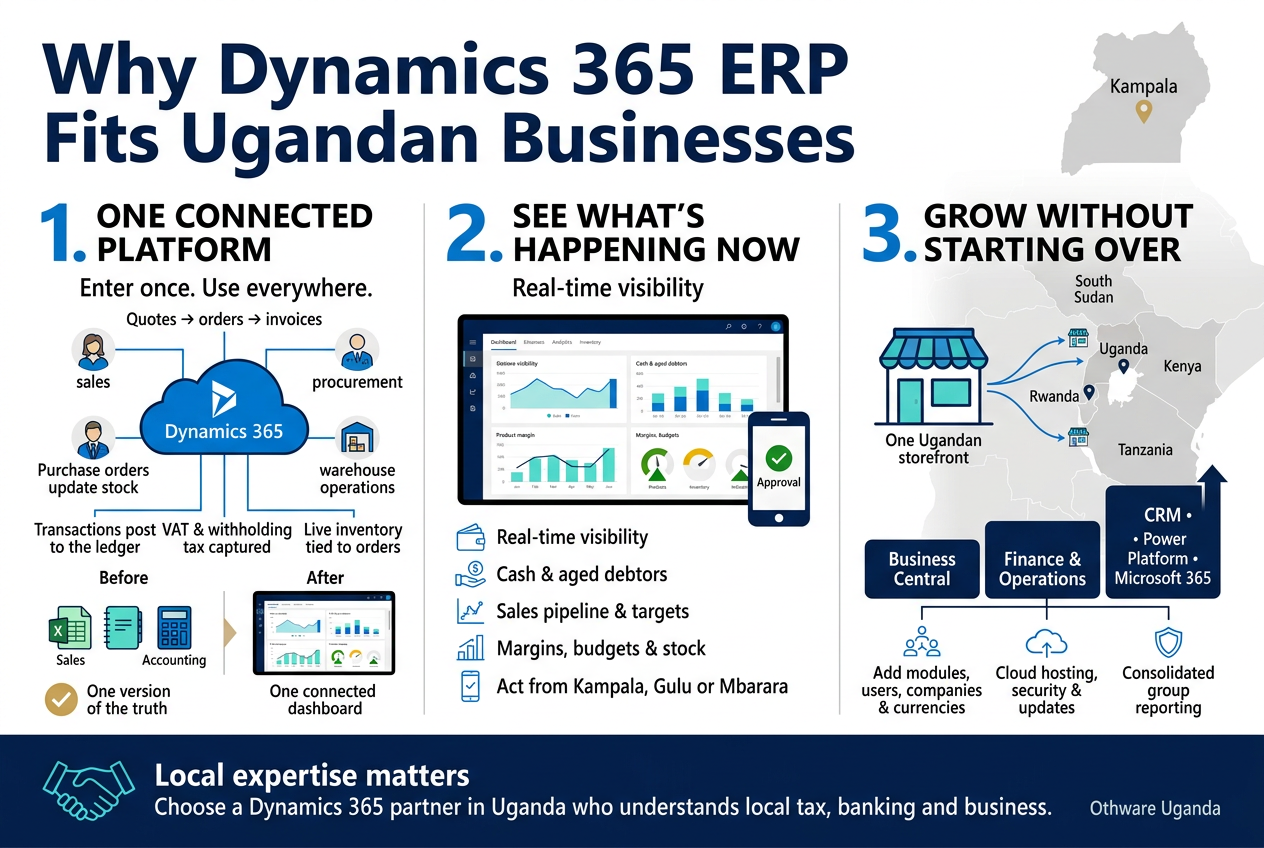
Unify Finance, Sales, and Operations on One Platform
Walk into many Ugandan offices and you’ll find the same setup: accounting in one package, stock in an Excel sheet, sales orders in a notebook or WhatsApp thread. It works until it doesn’t. Numbers don’t match, month-end takes two weeks, and nobody agrees on what’s actually in the warehouse.
Microsoft Dynamics 365 ERP fixes this by putting everything in one system. With Microsoft Dynamics 365 Business Central Uganda, every team works from the same data.
Here’s what that looks like day to day:
- Sales raises a quote, and it flows into an order, an invoice, and a receivable entry without anyone retyping it.
- Procurement places a purchase order, and stock updates the moment goods are received.
- Finance sees every transaction posted to the general ledger automatically, with VAT and withholding tax captured as they happen.
- Operations checks live stock levels before promising a delivery date to a customer.
The result is one version of the truth. No more chasing colleagues for the “latest” spreadsheet.
What disconnected tools cost you
| Problem | What it looks like | What one platform does |
|---|---|---|
| Duplicate data entry | Same invoice typed 2–3 times | Enter once, use everywhere |
| Stock mismatches | Sales sells what you don’t have | Live inventory tied to orders |
| Slow month-end | Days spent reconciling files | Automated postings and bank reconciliation |
| Tax errors | Missed or late URA filings | Tax set up once and applied consistently |
For companies searching for ERP software Uganda can rely on, this joined-up approach is usually the biggest reason to switch. It also cuts the risk of errors and fraud, since every entry has a user, a date, and an audit trail.
Gain Real-Time Visibility for Faster Decisions
Ask most business owners how last month went, and the honest answer is “I’ll know next week.” By then, the chance to act has passed.
A cloud ERP system Uganda businesses can access from anywhere changes that. Because data is captured as transactions happen, your dashboards show where things stand right now, not where they stood three weeks ago.
Questions you can answer in seconds
- Which customers are late on payment, and by how much?
- What’s my cash position across all bank accounts and currencies?
- Which products make money, and which are quietly eating margin?
- Which branch or project is over budget?
- Do I need to reorder before the next shipment lands?
Built-in Power BI dashboards and role-based views mean each person sees what matters to them. The CFO tracks cash flow and aged debtors. The sales head watches pipeline and targets. The warehouse manager keeps an eye on fast-moving items.
Why this matters locally
Uganda’s business environment moves quickly. Exchange rates swing, supplier prices shift, and customers expect fast turnaround. When you can see a margin squeeze or a cash crunch building, you can renegotiate with suppliers, chase receivables, or adjust prices before it hurts.
Cloud access also helps if you manage multiple sites. Whether you’re in Kampala and your branch is in Gulu or Mbarara, you work in the same live system. Approvals can happen from a phone, so a purchase order doesn’t sit on someone’s desk for a week while they travel.
Scale Confidently as Your Company Grows
Plenty of Ugandan businesses start small with basic accounting software, then outgrow it within a couple of years. New branches, more staff, new product lines, regional expansion: each one adds pressure on systems that were never built for it. Switching platforms mid-growth is painful and expensive.
Dynamics 365 is designed to grow with you, so you aren’t forced to start over.
Start where you are, expand when you’re ready
- Business Central suits small and mid-sized companies that need finance, supply chain, sales, and project management in one package.
- Dynamics 365 Finance and Operations suits larger or more complex organizations with heavy manufacturing, multi-entity, or advanced supply chain needs.
- Add-ons like CRM, Power Platform, and Microsoft 365 connect to the same data, so you add capability without rebuilding.
You can begin with the modules you need today and switch on more later. Add users as you hire. Add companies as you open new entities. Add currencies as you trade across the region.
Built for growth beyond Uganda
If you’re eyeing Kenya, Rwanda, Tanzania, or South Sudan, the platform supports multiple currencies, languages, and legal entities. Consolidated reporting gives you a group-wide view without a month of manual spreadsheet work.
Less IT headache
With cloud deployment, you don’t buy servers, hire a data-center crew, or worry about power outages taking down your system. Microsoft handles hosting, security, and updates. Your team focuses on running the business.
Choosing the right partner matters
Software is only half the story. A good Dynamics 365 partner in Uganda understands local tax rules, banking habits, and business culture, and can tailor the system accordingly. That’s where working with a local Business Central partner Kampala companies trust, like Othware Uganda, makes ERP implementation Uganda projects smoother and keeps the system useful long after go-live.
Meet Othware Uganda, Your Local Dynamics 365 Partner
Local Market Expertise That Speeds Up Results
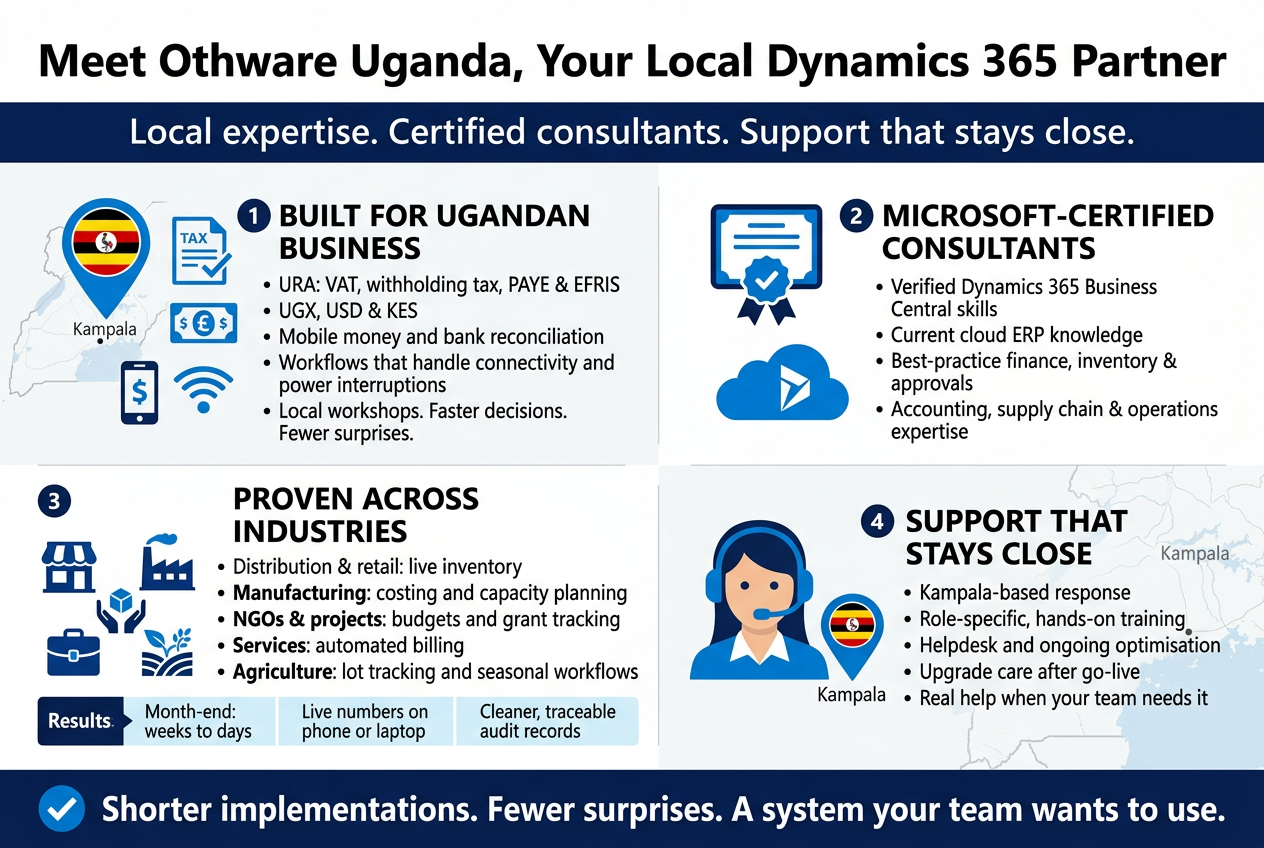
Uganda doesn’t run like a textbook market, and your ERP shouldn’t pretend it does. Othware Uganda builds Dynamics 365 ERP around the way Ugandan businesses actually work day to day.
That means the team already knows things a foreign vendor would need months to learn:
- URA compliance: VAT, withholding tax, and PAYE setups that match Uganda Revenue Authority rules, plus EFRIS e-invoicing needs.
- Multi-currency reality: UGX, USD, and KES transactions, with exchange rate handling that doesn’t turn month-end into a headache.
- Mobile money and bank workflows: Reconciliation that fits how your customers and suppliers really pay.
- Infrastructure quirks: Setups that cope with patchy connectivity and power interruptions, so your team keeps working.
Because the consultants sit in your time zone and speak your business language, workshops happen faster, decisions get made sooner, and nobody waits three days for an email from another continent. The result is shorter ERP implementation in Uganda, fewer surprises, and a system your team actually wants to use.
Certified Microsoft Consultants You Can Trust
Choosing a Dynamics 365 partner in Uganda comes down to one question: who’s actually going to touch your system? With Othware Uganda, it’s trained, Microsoft-certified people, not a rotating cast of juniors.
What certification means for you
- Verified skills: Consultants hold Microsoft credentials across Dynamics 365 Business Central and related Microsoft tools.
- Current knowledge: Microsoft updates its cloud ERP twice a year. Certified teams stay on top of new features, so you get the benefit without having to chase them.
- Best-practice setups: Your chart of accounts, inventory, and approval flows are configured the way Microsoft intends, which keeps upgrades smooth.
- Backed by Microsoft: As an official partner, Othware Uganda works with Microsoft’s resources, licensing channels, and escalation paths.
Business plus tech know-how
Good Dynamics 365 consultants in Uganda don’t just click through settings. They understand accounting, supply chain, and operations. When your finance manager says, “I need to see cost per project by region,” they know how to turn that into a working report rather than a vague promise.
A Proven Track Record Across Ugandan Industries
Talk is cheap. What counts is how many businesses have gone live and stayed happy. Othware Uganda has delivered ERP solutions for Ugandan businesses of different sizes and sectors, from growing SMEs to established multi-branch organisations.
| Sector | Typical challenge | How Dynamics 365 helps |
|---|---|---|
| Distribution & retail | Stock mismatches across outlets | Real-time inventory and automated replenishment |
| Manufacturing | Unclear production costs | Bills of materials, costing, and capacity planning |
| NGOs & projects | Donor reporting and grant tracking | Dimension-based budgets and project accounting |
| Services | Slow invoicing and weak cash flow visibility | Automated billing and live financial dashboards |
| Agriculture | Seasonal swings and traceability | Lot tracking and flexible purchasing workflows |
What clients usually notice first
- Month-end close drops from weeks to days.
- Spreadsheets stop being the “real” system.
- Owners and managers see live numbers from their phone or laptop.
- Audits become less stressful because records are clean and traceable.
Those wins come from repeat experience. The team has seen similar problems before, so it skips the trial-and-error and goes straight to what works.
Dedicated Support Close to Your Business
Go-live is the start, not the finish. Plenty of ERP projects stumble after launch because nobody’s around when the first real questions pop up. Othware Uganda stays in the room.
Support that feels like part of your team
- Local response: Based in Kampala, the team can reach your office quickly when remote help isn’t enough.
- Hands-on training: Sessions for finance, sales, warehouse, and management users, tailored to their daily tasks rather than generic demos.
- Helpdesk access: Clear channels for raising issues and getting answers, with sensible response times.
- Ongoing optimisation: Regular check-ins to tweak workflows, add reports, or roll out new modules as you grow.
- Upgrade care: Help with Microsoft updates and cloud ERP system changes so nothing breaks in the background.
Why proximity matters
When month-end hits and a report won’t balance, you want a real person who knows your setup, not a ticket number in a queue overseas. Being a nearby Business Central partner in Kampala means problems get fixed in hours, your team builds confidence quickly, and your investment keeps paying off long after launch.
Core Dynamics 365 Solutions That Drive Efficiency
A. Finance and Accounting for Accurate Reporting
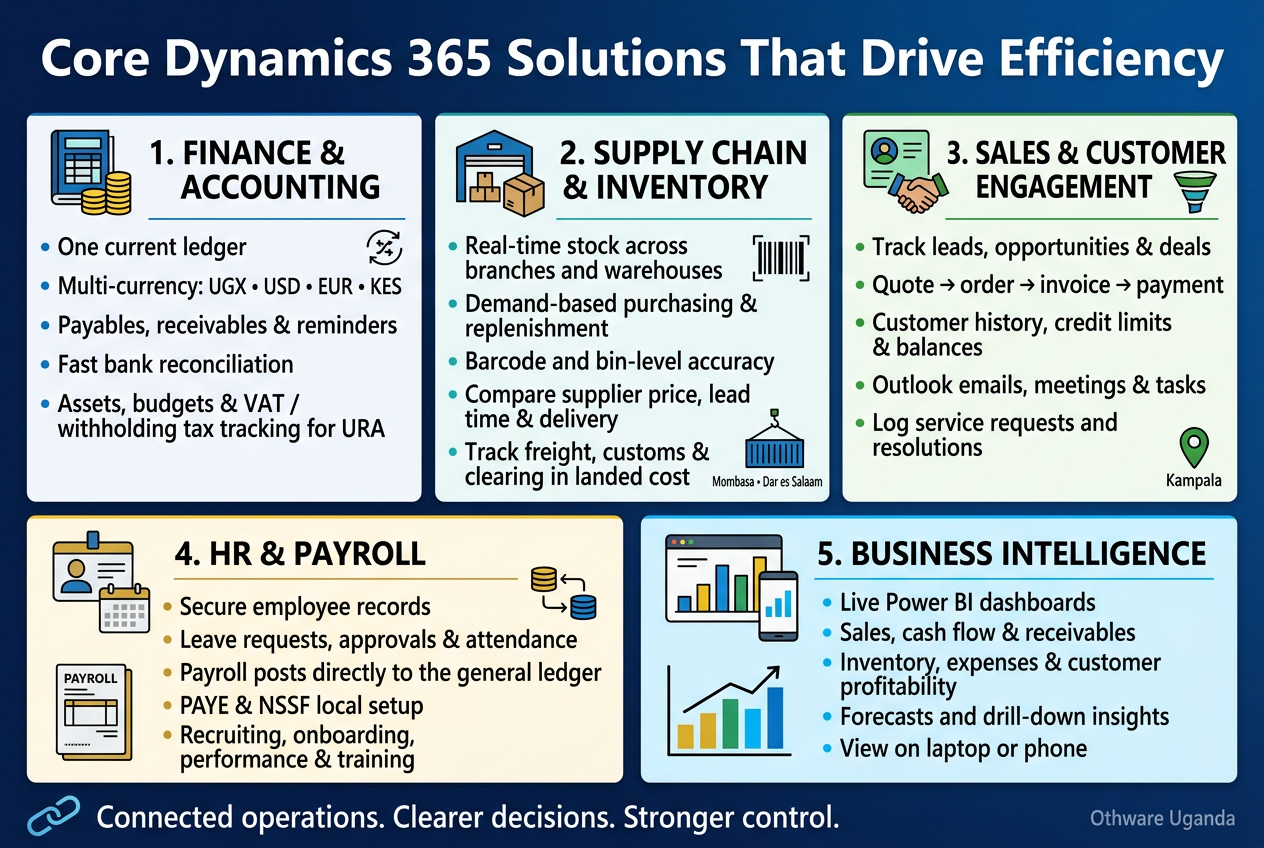
Spreadsheets and disconnected accounting packages work until the month-end close hits. Then you’re chasing numbers across five files. Dynamics 365 Business Central puts everything in one ledger, so your books stay current without the scramble.
What you get:
- General ledger and multi-currency support: Handle UGX, USD, EUR, and KES in the same system, with exchange rates updated and gains or losses posted automatically.
- Accounts payable and receivable: Track supplier bills, customer invoices, and payment due dates, and send reminders before cash gets stuck.
- Bank reconciliation: Match bank statements to ledger entries in minutes instead of hours.
- Fixed assets and budgeting: Depreciation runs on schedule, and you can compare budgets with actuals at any time.
- VAT and tax tracking: Keep transactions organized so VAT and withholding tax returns are easier to prepare for URA.
For larger groups with several entities or complex operations, a Dynamics 365 Finance and Operations partner in Uganda like Othware can scale you up to Finance and Operations, with consolidation and advanced financial controls.
B. Supply Chain and Inventory Management for Lower Costs
Stock sitting on shelves ties up cash. Stockouts lose sales. Business Central helps you find the middle ground with real-time visibility across warehouses, branches, and suppliers.
Where the savings come from
- Smarter purchasing: Reorder points and demand-based planning suggest what to buy and when, so you stop over-ordering “just in case.”
- Accurate stock counts: Barcode scanning and bin-level tracking cut down on shrinkage and counting errors.
- Supplier management: Compare vendor prices, lead times, and delivery performance in one place.
- Landed cost tracking: Freight, customs duties, and clearing charges get added to item cost, so your margins reflect reality. This matters for any business importing through Mombasa or Dar es Salaam.
- Warehouse and order flow: Receive, pick, and ship with fewer manual steps.
| Common Problem | How Business Central Helps |
|---|---|
| Overstocking slow-moving items | Inventory reports flag aging stock |
| Frequent stockouts | Automated replenishment suggestions |
| Hidden import costs | Landed cost allocation per item |
| Stock mismatches between branches | Single, real-time inventory view |
C. Sales and Customer Engagement for Stronger Relationships
Repeat customers pay your bills. Keeping them happy takes more than a good product. Your team needs to know who bought what, who’s overdue, and who’s ready for a follow-up.
Dynamics 365 Sales and Business Central work together to give you one customer view:
- Lead and opportunity tracking: See every deal in your pipeline and where it’s stuck.
- Quotes to cash: Turn a quote into an order, an invoice, and a payment record without retyping anything.
- Customer history: Sales reps can check past orders, credit limits, and outstanding balances before they pick up the phone.
- Outlook integration: Emails, meetings, and tasks sync with the tools your team already uses daily.
- Customer service tools: Log requests and track resolutions so nothing falls through the cracks.
When a distributor in Kampala can see a client’s payment history while quoting a new order, decisions get faster and credit risk drops.
D. Human Resources and Payroll for Streamlined Workforce Management
People costs are usually your biggest expense, yet many companies still manage staff records on paper or in scattered files. Dynamics 365 brings HR data into the same system as your finance and operations.
- Employee records: Contracts, qualifications, emergency contacts, and employment history in one secure place.
- Leave and attendance: Staff request leave, managers approve it, and balances update automatically.
- Payroll processing: Salaries, allowances, and deductions flow straight into the general ledger. Local setups can account for PAYE and NSSF contributions, which Othware configures to match Ugandan requirements.
- Recruitment and onboarding: Track candidates and get new hires started faster.
- Performance and training: Set goals, record reviews, and plan development.
Payroll that ties directly to your accounts means fewer reconciliation headaches and a cleaner audit trail.
E. Business Intelligence with Power BI for Smarter Insights
Data is only useful if you can read it. Power BI connects to Business Central and turns raw transactions into dashboards you can actually act on.
What you can see at a glance
- Daily and monthly sales by branch, product, or salesperson
- Cash flow trends and aging receivables
- Inventory turnover and best-selling items
- Expense patterns against budget
- Customer profitability
Because the reports pull live data, you’re not waiting on someone to build a spreadsheet at month-end. Managers open a dashboard on a laptop or phone and see where the business stands right now.
Power BI also supports forecasting and drill-downs. Click a dip in revenue and trace it to the exact region, product, or customer behind it.
Othware Uganda builds dashboards around the questions your team asks most, so reports fit how you run the business instead of forcing you into generic templates.
Solving Uganda-Specific Business Challenges
Meet URA Tax and Compliance Requirements with Ease
Tax season shouldn’t mean weeks of spreadsheet chaos. If you run a business in Uganda, you already know the drill: VAT returns, PAYE, withholding tax, and the push toward EFRIS (the Electronic Fiscal Receipting and Invoicing Solution). Miss a filing or get a figure wrong, and penalties follow fast.
Microsoft Dynamics 365 Business Central takes most of that pain away. Othware Uganda sets it up around local rules, so your system works the way URA expects.
What this looks like in practice
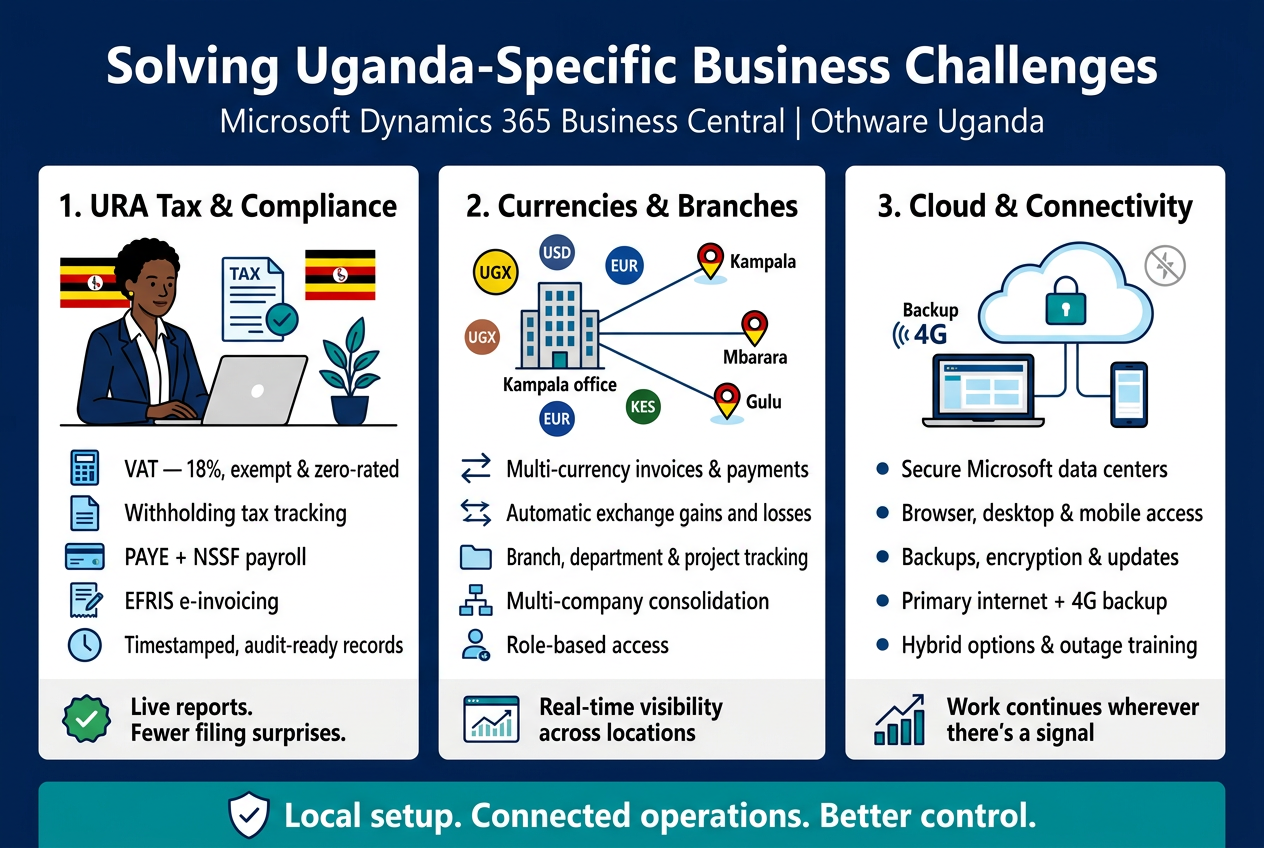
- VAT handled automatically: Set up the 18% VAT rate, exempt and zero-rated items, and let the system calculate it on every sale and purchase.
- Withholding tax tracking: Deduct and record withholding tax at the point of payment, then pull clean reports when it’s time to file.
- Payroll and PAYE: Calculate PAYE and NSSF contributions correctly for every employee, with a clear audit trail.
- EFRIS integration: Issue compliant e-invoices straight from the system rather than re-keying data into a separate portal.
- Audit-ready records: Every transaction is timestamped, linked to a user, and easy to trace if URA comes asking.
Because everything lives in one system, your finance team stops chasing numbers across files. Reports come from live data, so what you file matches what’s in your books.
A good Dynamics 365 partner in Uganda also keeps you current. Tax rules change, and Othware Uganda helps you update configurations and reports so you’re not caught off guard by a new finance act.
Manage Multiple Currencies and Branches Seamlessly
Many Ugandan businesses don’t operate in just one currency or one location. You might buy stock in US dollars, sell in shillings, pay a supplier in euros, and run branches in Kampala, Mbarara, and Gulu. Doing that on basic accounting software gets messy quickly.
Multi-currency without the headache
Business Central handles foreign currency natively. You can:
- Record invoices and payments in UGX, USD, EUR, KES, or any other currency.
- Update exchange rates manually or through automated feeds.
- Calculate realized and unrealized exchange gains and losses automatically.
- Revalue open balances at month-end with a few clicks.
Exchange rate swings hit Ugandan importers and exporters hard. When the system tracks gains and losses for you, you see the real margin on each deal instead of finding surprises at year-end.
Branches and companies under one roof
Growing businesses need a clear view across locations. With ERP software Uganda teams can rely on, you get:
| Challenge | How Business Central helps |
|---|---|
| Separate branch books | Dimensions let you tag every transaction by branch, department, or project |
| Multiple legal entities | Manage several companies in one environment |
| Inter-branch stock movements | Transfer inventory between locations with full tracking |
| Group reporting | Consolidate results across entities and currencies |
Head office can see how each branch is performing in real time. A branch manager in Jinja only sees what’s relevant to them, thanks to role-based permissions. That means tighter control without slowing anyone down.
For larger groups with more complex operations, Othware Uganda can also guide you toward Dynamics 365 Finance and Operations when you need deeper capabilities across many entities and countries.
Overcome Connectivity Challenges with Cloud Flexibility
Let’s talk about the internet. Power cuts and patchy connections are a reality across Uganda, and they make a lot of business owners nervous about moving to the cloud. It’s a fair worry. The good news is that a well-planned cloud ERP system Uganda businesses can trust works around these problems rather than ignoring them.
Why cloud still makes sense
- No server to babysit: Your data sits in Microsoft’s secure data centers, so a power outage at your office doesn’t wipe out your records.
- Work from anywhere: Sales teams in the field, finance staff at home, and managers on the road all log in through a browser, desktop, or mobile app.
- Built-in backups and security: Microsoft handles encryption, updates, and disaster recovery, which most local server rooms can’t match.
- Pay as you grow: Subscription pricing replaces big upfront hardware costs. Add users when you hire, not before.
How Othware Uganda tackles the connectivity gap
Cloud doesn’t have to mean “always online or nothing.” Othware Uganda plans around your real conditions:
- Bandwidth check: We review your internet setup and recommend a reliable primary line with a backup, like fiber plus 4G.
- Lean workflows: Business Central is light enough to run smoothly on modest connections.
- Mobile access: Staff can approve orders or check stock from a phone when the office connection drops.
- Hybrid options: If your situation calls for it, we can design a setup that mixes cloud and on-premises components.
- Team training: We show your people what to do during an outage so work keeps moving and data syncs once you’re back online.
Businesses that make this move usually find they’re more resilient, not less. When your data lives safely off-site and your team can log in from anywhere with a signal, a bad day at the office doesn’t turn into a bad week for the business.
If you’re looking for a Business Central partner in Kampala who understands these day-to-day realities, Othware Uganda builds solutions around how Ugandan businesses actually operate.
Industries Othware Uganda Empowers
Manufacturing and Distribution
Running a factory or distribution business in Uganda means juggling a lot: raw material costs that swing with the exchange rate, power interruptions, long supply routes, and stock spread across depots from Kampala to Gulu. Dynamics 365 Business Central gives you one place to see all of it.
Here’s what Othware Uganda typically sets up for manufacturers and distributors:
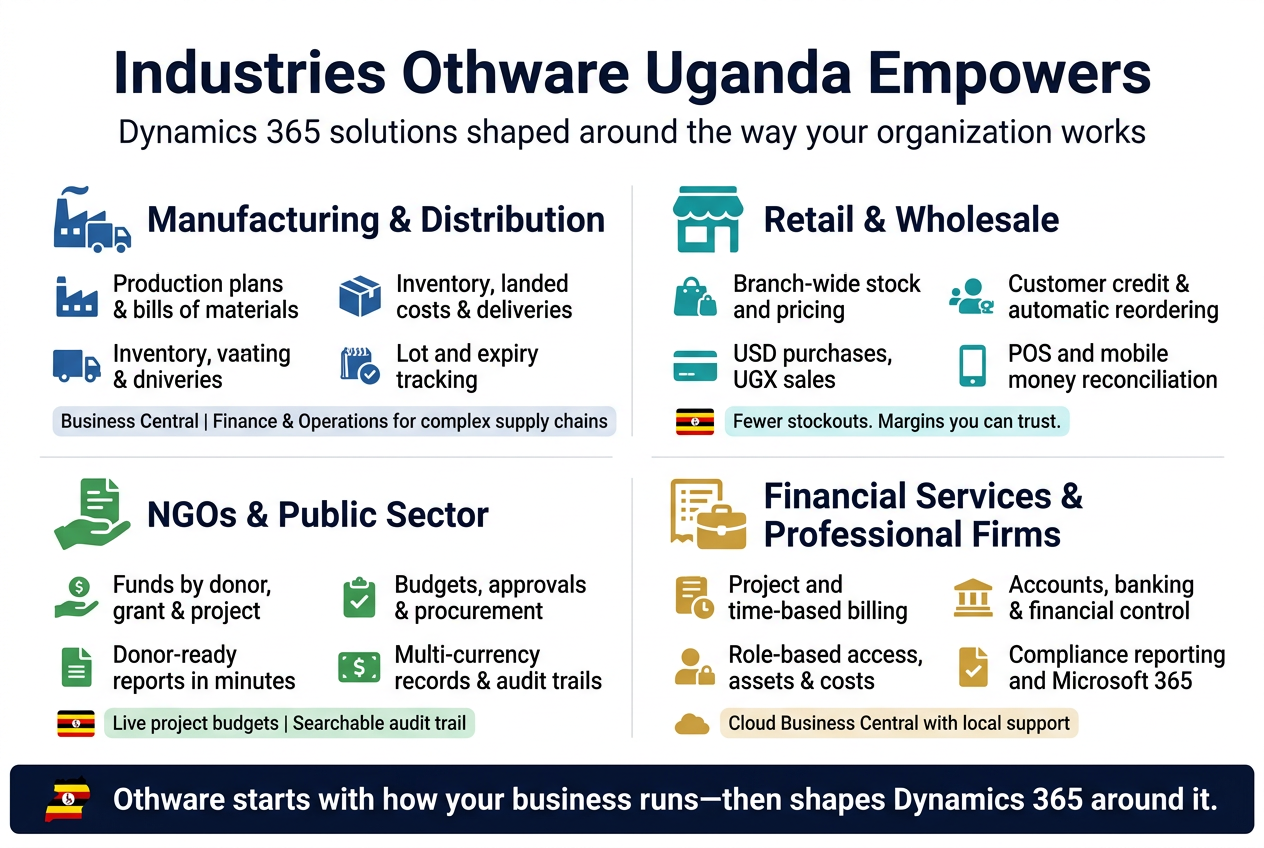
- Production planning and bills of materials: Know exactly what goes into each product and what it costs to make.
- Inventory by location: Track stock across warehouses, vans, and depots in real time.
- Purchasing and landed costs: Add freight, import duties, and clearing fees to the true cost of every item.
- Route and delivery tracking: See which orders are out, which are delivered, and which are stuck.
- Lot and expiry tracking: Handy for food, beverages, and pharmaceuticals.
For larger operations with complex supply chains, Othware can also bring in Dynamics 365 Finance and Operations for deeper planning and multi-entity control.
Retail and Wholesale
Retailers and wholesalers live and die by stock accuracy and cash flow. When a fast-moving item runs out, you lose sales. When slow stock piles up, you lose cash. A cloud ERP system in Uganda helps you stay on top of both.
With Business Central, Ugandan retail and wholesale teams can:
- Sync every branch: Prices, stock levels, and sales data update across all shops and warehouses.
- Manage customer credit: Set limits, track overdue balances, and chase payments before they get out of hand.
- Handle multiple currencies: Buy in USD, sell in UGX, and see the real margin.
- Reorder automatically: Set minimum stock levels and get purchase suggestions.
- Connect to point of sale and mobile money: Reconcile daily takings without piles of paper.
The result is fewer stockouts, tighter margins you can trust, and owners who can check performance from their phone instead of waiting for month-end reports.
NGOs and Public Sector Organizations
Donors want proof of where every shilling and dollar went. That’s a tall order when you’re running several grants, projects, and field offices at once. Spreadsheets break down fast here.
Othware Uganda configures Dynamics 365 so NGOs, development agencies, and public sector bodies can:
- Track funds by donor, grant, and project: Keep each budget separate and clean.
- Control spending with budgets and approvals: Stop overspending before it happens, not after.
- Produce donor-ready reports: Generate financial reports in the format funders expect, without weeks of manual work.
- Manage multiple currencies: Receive grants in USD or EUR and report in UGX.
- Keep audit trails: Every transaction, approval, and change is recorded, which makes audits far less painful.
- Manage assets and procurement: Track vehicles, equipment, and purchase requests from start to finish.
Here’s a quick look at how the day-to-day changes:
| Task | Before (spreadsheets) | With Dynamics 365 |
|---|---|---|
| Donor reporting | Days of manual compiling | Reports in minutes |
| Budget tracking | Updated monthly, if at all | Live view by project |
| Audit prep | Hunting for paperwork | Searchable audit trail |
| Multi-currency grants | Manual conversions | Automatic handling |
Financial Services and Professional Firms
Accounting firms, law practices, consultancies, microfinance institutions, and SACCOs all sell time, trust, or money. They need tight financial control and clear records, but not a bulky system that eats up the team’s week.
Business Central works well here because it’s flexible and sits in the cloud. Othware Uganda helps these firms with:
- Project and time-based billing: Track hours against clients and projects, then invoice accurately.
- Financial management: General ledger, bank reconciliation, accounts payable and receivable, all in one place.
- Fixed asset and cost tracking: Know what you own and what each service line really costs.
- Role-based access: Partners see everything, staff see only what they need.
- Reporting and compliance: Produce VAT and other statutory figures from clean, reliable data.
- Integration with Microsoft 365: Work in Excel, Outlook, and Teams while your ERP data stays connected.
For firms in Kampala that want a nearby Business Central partner, having Othware’s consultants close by means quicker support, on-site training, and someone who understands local tax and reporting needs.
Whatever the industry, the approach is the same: Othware Uganda starts with how your business actually runs, then shapes Dynamics 365 around it. That’s what separates a smooth ERP implementation in Uganda from a costly software headache.
Smooth Implementation from Start to Finish
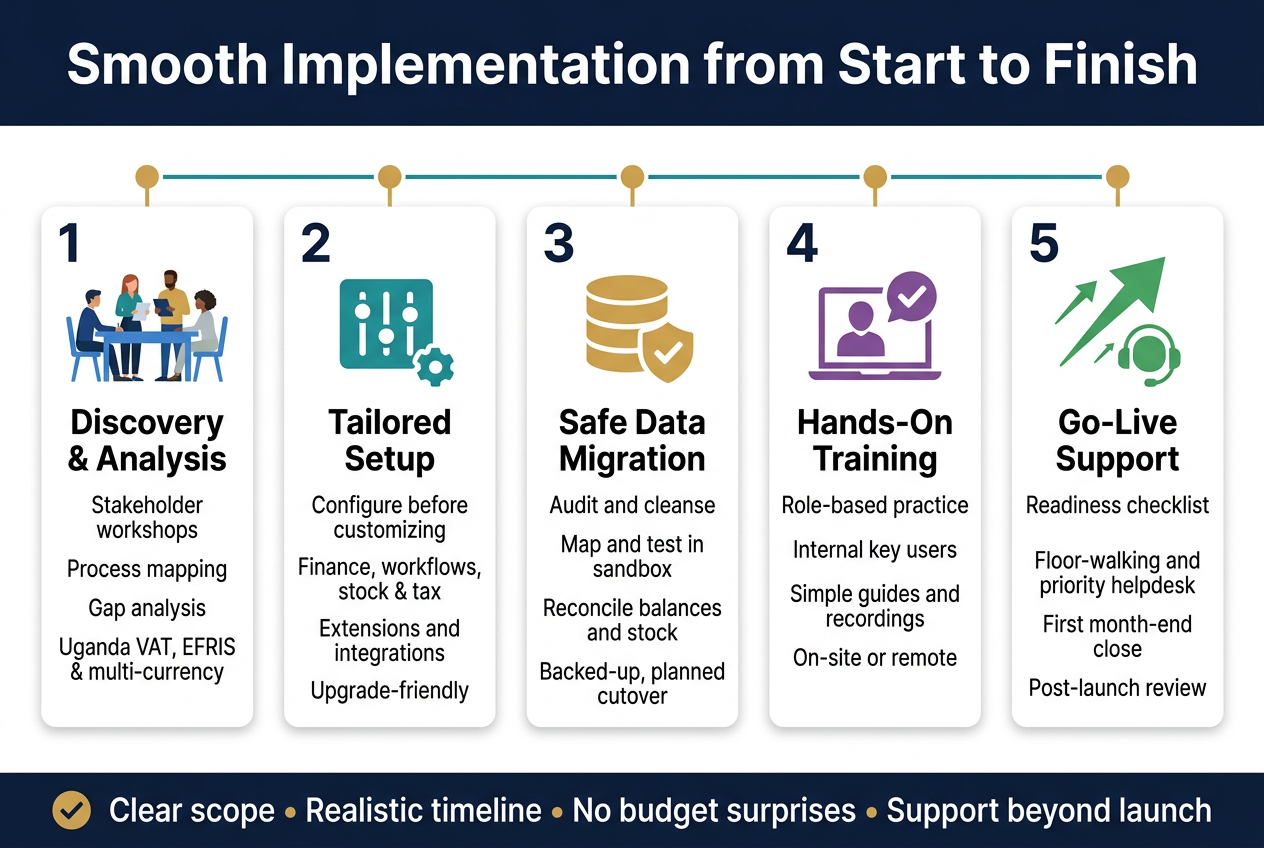
Discovery and Business Process Analysis
Every good ERP rollout starts with listening. Before anyone touches Dynamics 365 Business Central, the Othware Uganda team sits down with your people to see how work really gets done, not just how the org chart says it does.
Here’s what that looks like:
- Stakeholder workshops: Finance, sales, stores, HR and operations each get a say.
- Process mapping: We trace how an order moves from quote to cash, or how stock moves from supplier to shelf.
- Gap analysis: We compare what you do today with what Business Central handles out of the box.
- Local requirements check: VAT, withholding tax, EFRIS-style e-invoicing needs, and multi-currency (UGX, USD, KES) are flagged early.
You end up with a clear scope, a realistic timeline, and a budget with no surprises. For anyone searching for an ERP implementation partner in Uganda, this step alone separates a smooth project from a messy one.
Tailored Configuration and Customization
No two Ugandan businesses run the same way. A Kampala distributor, a Jinja manufacturer and an NGO in Gulu all need different setups. So we configure first and customize only when it truly adds value.
Configure Before You Customize
Business Central covers a lot straight out of the box. We set up:
- Chart of accounts and financial dimensions
- Approval workflows and user roles
- Inventory, pricing and purchasing rules
- Tax setups and local statutory reports
Customize Where It Matters
When your process is unique, we build extensions rather than rewriting core code. That keeps your cloud ERP system in Uganda upgrade-friendly, so Microsoft’s regular updates don’t break anything.
| Approach | Best For | Upgrade Risk |
|---|---|---|
| Standard configuration | Most finance, sales and stock needs | Very low |
| Extensions (apps) | Unique workflows, custom reports | Low |
| Integrations | Mobile money, banks, e-commerce, tax portals | Low to medium |
Safe Data Migration Without Disruption
Moving years of records into a new system makes people nervous, and fair enough. One wrong customer balance can cause real headaches. That’s why we treat migration as its own mini-project.
Our approach:
- Data audit: We identify what you actually need. Old, duplicate or dead records stay behind.
- Cleansing: Customer names, item codes, supplier details and opening balances get tidied up.
- Mapping: Each field from your old system or Excel sheets is matched to its Business Central home.
- Test migration: We run a trial load in a sandbox and your team checks the numbers.
- Reconciliation: Trial balances, stock counts and aged debtors must match to the shilling before we go further.
- Final cutover: We load the final data during a quiet window, such as a weekend or month-end, so trading carries on.
Your old data stays backed up throughout. If something looks off, we fix it before go-live, not after.
Hands-On User Training for Quick Adoption
The best ERP in the world fails if staff don’t use it. We train people on their actual daily tasks, using your data, not generic demo screens.
- Role-based sessions: Accountants learn ledgers and bank reconciliation. Store keepers learn receipts and stock counts. Sales teams learn quotes and invoicing.
- Key user coaching: We build a few internal champions who can answer day-to-day questions fast.
- Practice in a test environment: People can click, make mistakes and learn without risking live records.
- Simple guides: Quick reference sheets and recorded walkthroughs help when the trainer has left.
- On-site or remote: Sessions run at your Kampala office or online, whichever suits your team.
When people feel confident, resistance fades fast. Staff start asking for new reports instead of avoiding the system.
Go-Live Support for a Confident Launch
Go-live day should feel like flipping a switch, not jumping off a cliff. Before launch, we run a final readiness checklist: data balanced, users trained, permissions set, integrations tested.
Then we stay close:
- Floor-walking support: Our consultants stay alongside your team during the first days, fixing small issues on the spot.
- Priority helpdesk: Questions get quick answers through phone, email or chat.
- First month-end close: We guide your finance team through their first close in the new system.
- Post-launch review: After a few weeks, we check what’s working, tune workflows and plan next steps, such as extra modules or advanced reporting.
As a Dynamics 365 partner in Uganda, Othware doesn’t disappear after launch. We stick around until your team runs the system with ease and your business sees real value from day one.
Measurable Benefits and Return on Investment
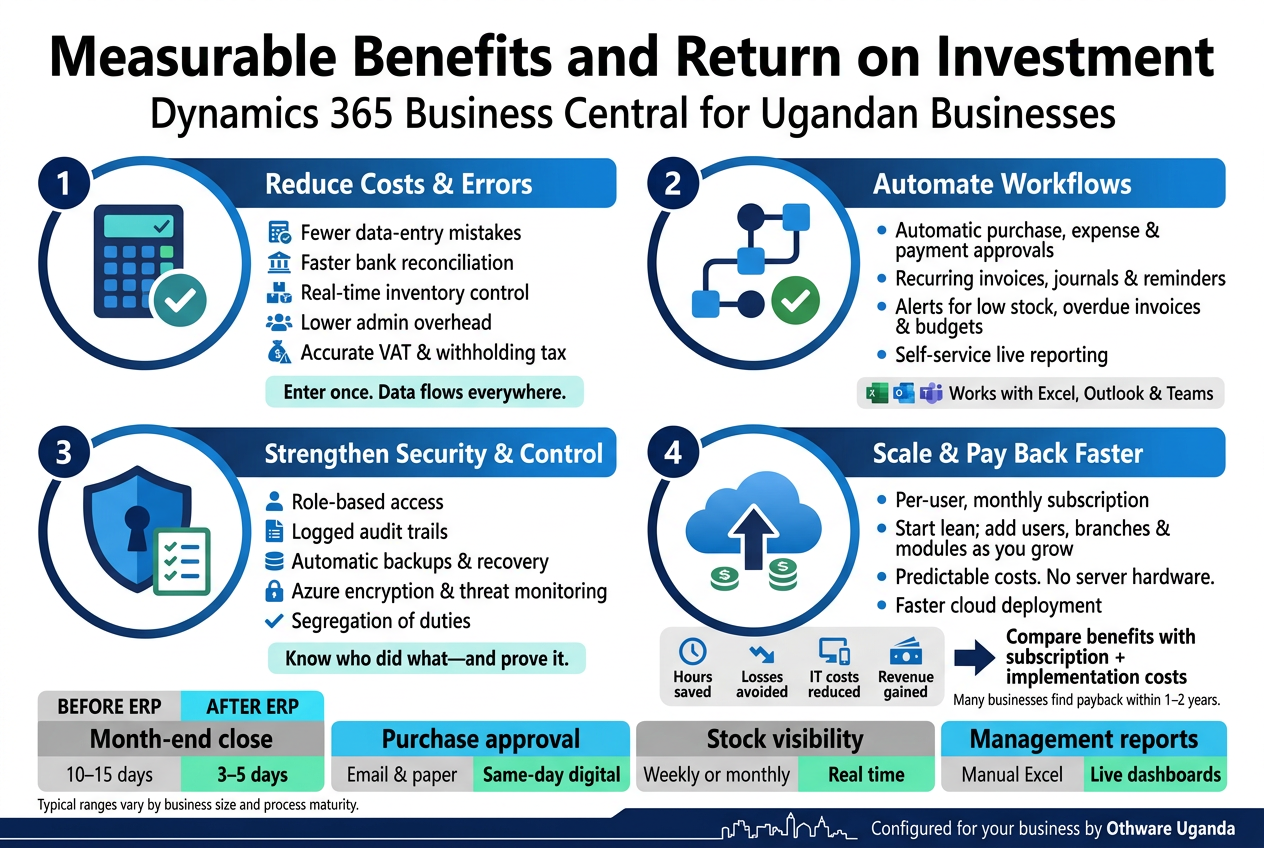
Reduce Operational Costs and Manual Errors
Spreadsheets, paper invoices, and disconnected accounting tools quietly drain money. A mistyped figure here, a duplicate payment there, and suddenly your month-end close takes two weeks. With Dynamics 365 Business Central, data gets entered once and flows everywhere it’s needed.
Here’s where Ugandan businesses usually see savings first:
- Fewer data-entry mistakes: Purchase orders, invoices, and payments link automatically, so no one retypes the same numbers.
- Faster bank reconciliation: Bank feeds and matching rules cut hours of manual checking.
- Tighter inventory control: Real-time stock levels mean less overstocking, fewer stockouts, and less shrinkage.
- Lower admin overhead: Teams spend less time chasing figures and more time on work that grows the business.
- Accurate tax reporting: VAT and withholding tax calculations stay consistent, which helps you avoid penalties during URA reviews.
An experienced Dynamics 365 partner in Uganda like Othware Uganda configures these controls around your actual processes, so the savings show up fast instead of staying on paper.
Boost Productivity with Automated Workflows
Think about how many times a day someone in your office asks, “Has this been approved yet?” Automated workflows end that guessing game.
With Business Central and the Power Platform, you can set up:
- Approval chains for purchases, expenses, and payments that route to the right person automatically
- Recurring tasks like monthly invoicing, journal entries, and payment reminders
- Alerts and notifications when stock runs low, invoices go overdue, or budgets are exceeded
- Self-service reporting so managers pull their own numbers instead of waiting on finance
Here’s a quick before-and-after picture:
| Task | Before ERP | After ERP |
|---|---|---|
| Month-end close | 10–15 days | 3–5 days |
| Purchase approval | Email and paper trail | Same-day digital approval |
| Stock count visibility | Weekly or monthly | Real time |
| Management reports | Built manually in Excel | Live dashboards |
Typical ranges vary by business size and process maturity.
Because Business Central works with Excel, Outlook, and Teams, your staff aren’t learning a completely foreign system. That familiarity shortens the learning curve, and adoption sticks.
Strengthen Security and Data Control
If your financial records live in a dozen spreadsheets on different laptops, you’ve got a security problem, even if you haven’t felt it yet. A lost device, a disgruntled employee, or one wrong click on a phishing email can expose sensitive data.
A cloud ERP system in Uganda built on Microsoft’s platform gives you much stronger protection:
- Role-based access: Each person sees only what their job requires. Your sales rep doesn’t need payroll data.
- Audit trails: Every change is logged with who made it and when, which makes internal audits and fraud detection far easier.
- Automatic backups and disaster recovery: Your data stays safe even if your office loses power or a server fails.
- Enterprise-grade protection: Microsoft Azure provides encryption, threat monitoring, and compliance certifications that most local businesses couldn’t afford to build themselves.
- Segregation of duties: The person who raises a payment can’t also approve it, which closes common loopholes.
For owners and finance directors, this means real confidence. You know who did what, and you can prove it.
Achieve Faster Payback with Scalable Licensing
Big upfront IT spending scares off many growing companies. Business Central’s subscription model takes that pressure off. You pay per user, per month, so costs match your actual team size.
What that means for your return on investment:
- Low entry cost: Start with the users and modules you need today, with no heavy server hardware to buy.
- Room to grow: Add users, branches, or modules like manufacturing and warehouse management as the business expands.
- Predictable budgeting: Monthly fees are easy to plan around, and Microsoft handles updates and infrastructure.
- Quicker time to value: Cloud deployment is typically faster than traditional on-premises installs, so benefits start sooner.
To estimate your own payback period, add up the following:
- Hours saved per week on manual work, multiplied by staff cost
- Losses avoided from errors, stock shrinkage, or late payments
- Reduced spending on IT hardware and maintenance
- Extra revenue from faster invoicing and better customer follow-up
Compare that total to your annual subscription and implementation costs. Many businesses find the numbers add up within the first year or two.
Working with a local Business Central partner in Kampala like Othware Uganda helps you license only what you need and avoid paying for features that sit unused. Your ERP investment stays lean, and it grows when you do.
Getting Started with Othware Uganda – Official Microsoft Dynamics 365 Business Central Partner in Uganda
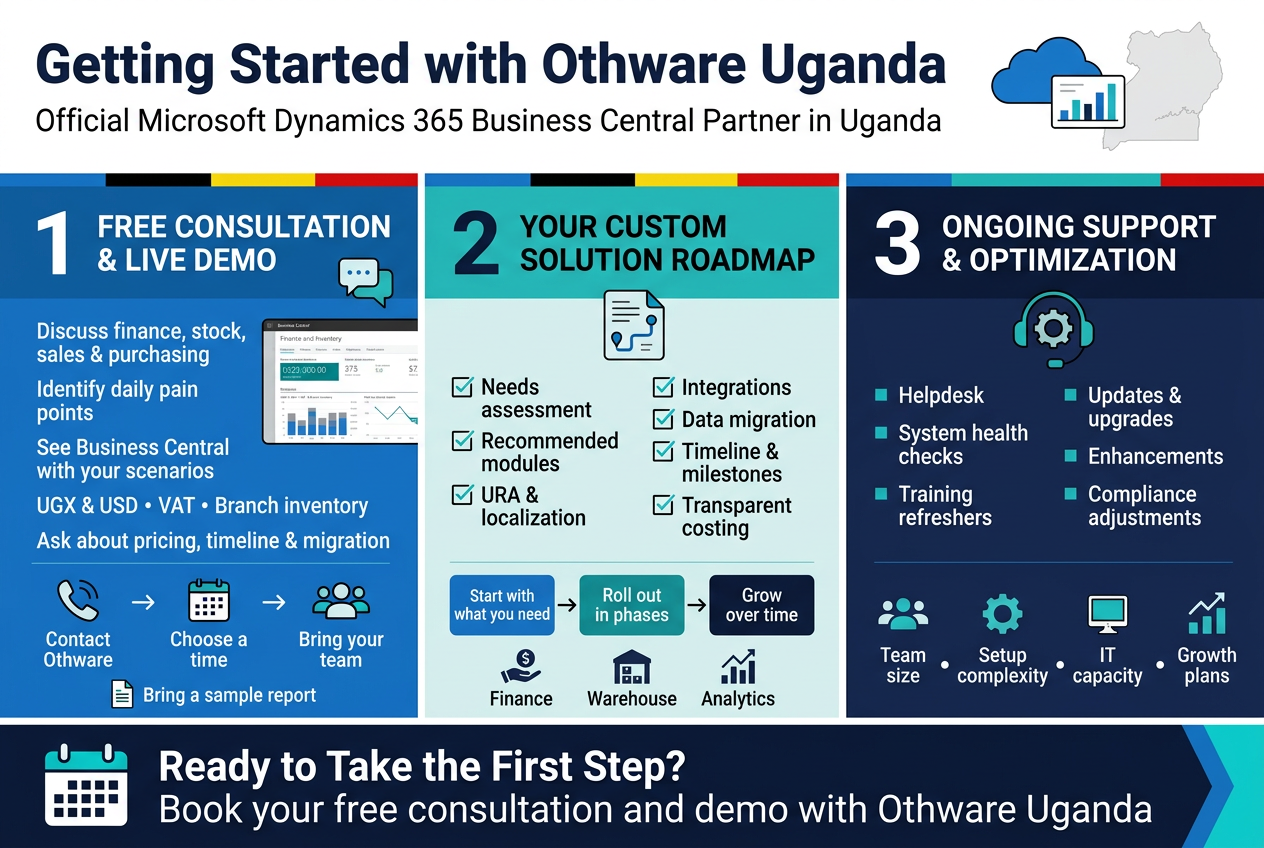
Book a Free Consultation and Demo
The easiest way to find out if Dynamics 365 fits your business is to see it running with your own scenarios. Othware Uganda, an official Microsoft Dynamics 365 Business Central partner in Uganda, offers a free consultation and live demo with no strings attached.
What happens in the session:
- A short chat about your business. Our Dynamics 365 consultants in Uganda ask how you handle finance, stock, sales, purchasing, and reporting today.
- A look at your pain points. Maybe month-end close drags on for two weeks, or your stock counts never match the books. We’ll note what’s slowing you down.
- A live Business Central demo. You’ll see the cloud ERP system in action, using examples close to your own operations, such as multi-currency invoicing, UGX and USD reporting, VAT handling, and inventory tracking across branches.
- Honest answers. Ask about pricing, timelines, data migration, and whether Business Central or Dynamics 365 Finance and Operations suits your size.
How to book:
- Contact Othware Uganda by phone, email, or the website form.
- Pick a time that works, either at your Kampala office or online.
- Bring one or two people who live in the daily work, like your finance lead, operations manager, or store keeper.
Tip: Bring a sample of a report you wish you could pull in one click. It’s the fastest way to show what’s possible.
Receive a Customized Solution Roadmap
After the demo, you won’t get a generic brochure. Every business in Uganda runs a little differently, so Othware builds a roadmap around how you actually work.
What your roadmap covers:
| Roadmap Element | What You Get |
|---|---|
| Needs assessment | A clear list of processes to improve, ranked by impact |
| Recommended modules | Finance, supply chain, sales, purchasing, projects, or other Business Central features that fit your needs |
| Localization plan | Setup for URA tax requirements, multi-currency, and local reporting |
| Integration points | Links to your bank, mobile money, e-commerce, or existing tools |
| Data migration approach | How customer, vendor, item, and ledger data move over cleanly |
| Timeline and milestones | Realistic phases, from setup to go-live |
| Transparent costing | Licensing, implementation, training, and support, laid out upfront |
Why a roadmap beats a one-size-fits-all package:
- You pay only for what you need now, and add more as you grow.
- Your team knows what’s coming and when, so there are fewer surprises.
- Phased rollouts keep daily operations running while the system goes in.
- You can show management a clear plan with expected results.
A distributor in Kampala, for example, might start with finance and inventory, then add warehouse management and sales analytics later. A growing services firm might begin with project accounting and billing. The roadmap puts those choices on paper before you commit.
Choose Ongoing Support and Optimization Plans
Go-live is the start, not the finish. Staff change, regulations shift, and your business grows. A good ERP implementation in Uganda keeps improving after launch, and that’s where Othware stays involved.
Support options to pick from:
- Helpdesk support. Quick help from people who already know your setup, for questions, errors, and user issues.
- Proactive system health checks. Regular reviews to catch slow performance, messy data, or unused features before they cause trouble.
- Training refreshers. Sessions for new hires and for teams who want to get more from reporting, dashboards, and automation.
- Updates and upgrades. Business Central releases regular updates. Othware helps you test and apply them without disrupting work.
- Enhancements and customization. New workflows, extra reports, Power BI dashboards, or Power Automate flows as your needs change.
- Compliance adjustments. Updates when tax rules or reporting requirements change locally.
How to choose the right plan:
- Size of your team. More users usually means more training and support requests.
- Complexity of your setup. Multiple branches, currencies, or integrations call for closer monitoring.
- Internal IT capacity. If you don’t have an in-house IT person, a fuller support plan makes sense.
- Growth plans. Opening new locations or adding product lines? Build optimization time into your plan.
Your support plan isn’t locked forever. Many clients start with essential helpdesk coverage, then move to a more hands-on plan once they see what else the system can do.
Ready to Take the First Step?
Reach out to Othware Uganda, your local Dynamics 365 partner in Uganda, and book your free consultation and demo. You’ll leave with a clearer picture of how ERP software in Uganda can cut the busywork, tighten your numbers, and give you room to grow.
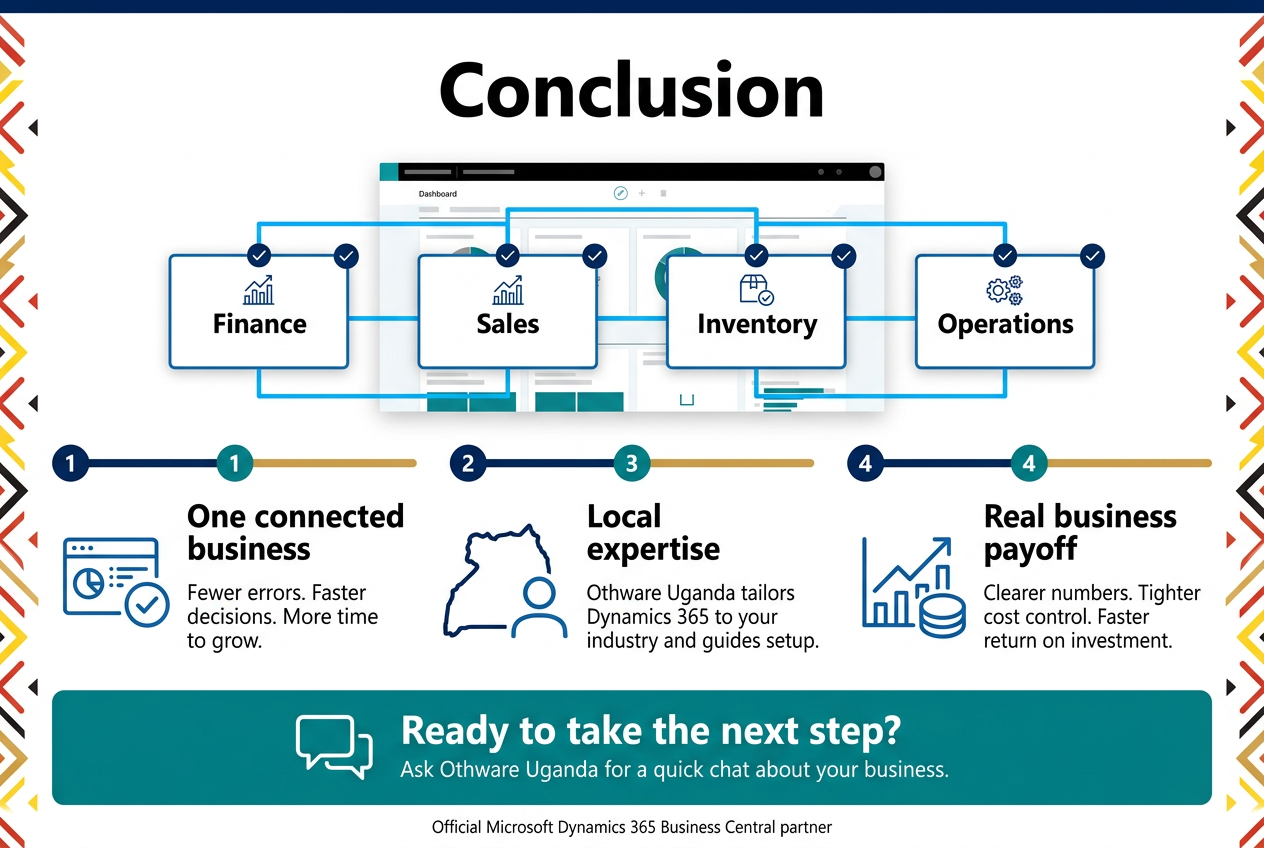
Running a business in Uganda is hard enough without juggling spreadsheets, disconnected tools, and guesswork. Dynamics 365 brings your finance, sales, inventory, and operations into one place. That means fewer errors, faster decisions, and more time to focus on growth. Othware Uganda knows the local market, from tax rules to everyday challenges. They tailor each solution to your industry and guide you through setup, so the switch feels smooth instead of stressful.
The payoff is real. Businesses see clearer numbers, tighter control over costs, and a quicker return on their investment. With a trusted Microsoft partner on your side, you’re not figuring it out alone.
Ready to take the next step? Reach out to Othware Uganda, an official Microsoft Dynamics 365 Business Central partner, and ask for a quick chat about your business. You might be surprised how much easier things can get.

Tech Evangelist and Business Developer.
I love connecting with nature