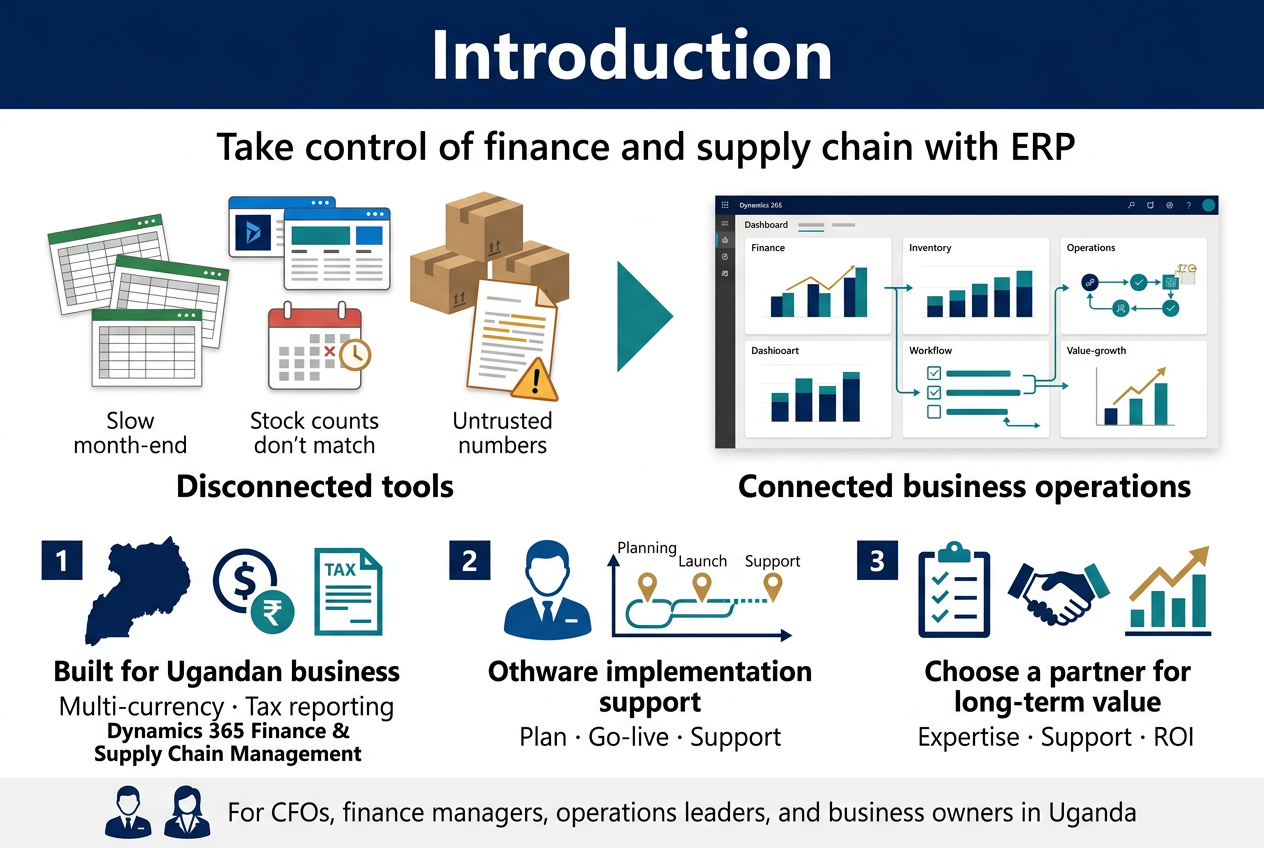
Running finance and supply chain on spreadsheets and disconnected tools gets old fast. Month-end drags, stock counts never match, and you can’t trust the numbers. If that sounds familiar, you’re in the right place.
This guide is for CFOs, finance managers, operations heads, and business owners in Uganda who are exploring ERP software Uganda companies can rely on. Othware Uganda, an Official Microsoft Dynamics 365 F&O Partner in Othware Uganda, offers Dynamics 365 SCM partner services and Dynamics 365 Finance and Operations implementation to help local businesses get control of their money, stock, and processes.
Here’s what we’ll cover:
- Why it fits Ugandan businesses: How Dynamics 365 Finance Uganda and Dynamics 365 Supply Chain Management handle local needs, from multi-currency to tax reporting.
- How Othware helps: What our Dynamics 365 consultants Uganda do, from planning to go-live and support.
- How to choose a partner: What to look for in a Microsoft Dynamics 365 partner Uganda, plus tips to get long-term value and ROI from your financial management ERP for Ugandan businesses and supply chain management software Uganda.
Let’s get into it.
Why Dynamics 365 Finance and SCM Fits Ugandan Businesses
Streamlining Finance and Supply Chain in One Platform
Many Ugandan companies run on a patchwork: QuickBooks or Tally for accounts, Excel for stock, a separate tool for payroll, and WhatsApp for approvals. It works for a while. Then the business grows, and the cracks show. The warehouse says one thing, the finance team says another, and the monthly close drags on for weeks.
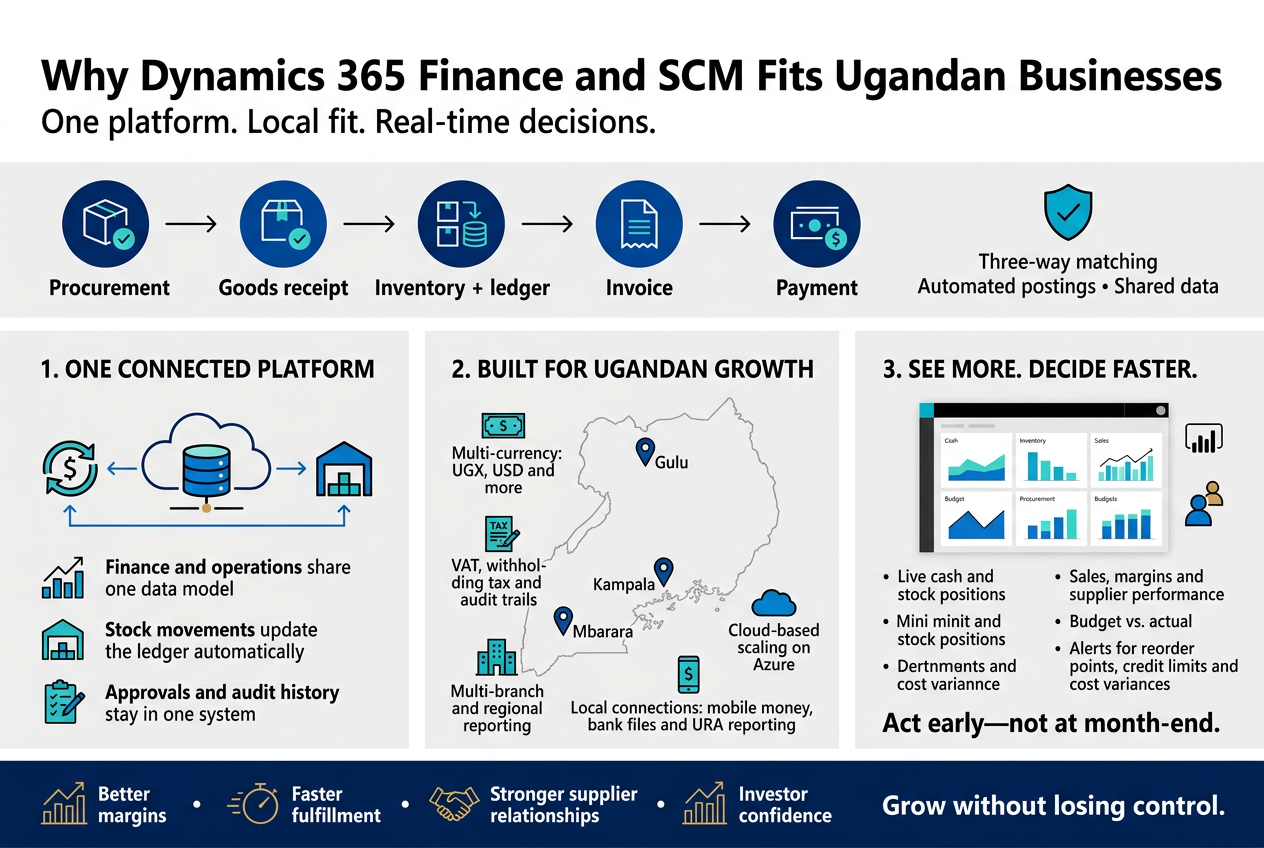
Dynamics 365 Finance and Dynamics 365 Supply Chain Management (SCM) fix this by putting both functions on one data model. When a goods receipt is posted in the warehouse, the inventory value, the accrual, and the vendor liability update in the same system. Nobody re-keys anything.
What “one platform” actually means day to day
- Procurement to payment: A purchase requisition becomes a purchase order, then a goods receipt, then a vendor invoice, then a payment. Three-way matching catches mismatches before money leaves your account.
- Order to cash: Sales orders flow through picking, packing, shipping, invoicing, and collections. Customer credit limits are checked before the order is confirmed.
- Inventory to ledger: Every stock movement posts to the general ledger automatically, so your balance sheet reflects what’s on the shelf.
- Planning to production: Master planning looks at demand, stock, and lead times and suggests what to buy or make, and when.
Why a disconnected setup costs more than it looks
| Problem with separate tools | What it causes | How Dynamics 365 F&O handles it |
|---|---|---|
| Manual stock reconciliation | Stock-outs, overstocking, month-end arguments | Real-time inventory tied to financial postings |
| Duplicate data entry | Errors, delays, extra staff hours | Single record shared by finance and operations |
| Slow month-end close | Late reports, late decisions | Automated postings and consolidated ledgers |
| Weak approval trails | Fraud risk, audit queries | Workflow-based approvals with full audit history |
| Spreadsheets owned by individuals | Knowledge loss when staff leave | Centralized, role-based system |
For a business searching for ERP software in Uganda, this is the main draw: you’re not buying separate modules that need gluing together. You’re getting one system that already speaks the same language across departments.
Built to connect with the tools you already use
Dynamics 365 sits inside the Microsoft ecosystem. It connects with Excel, Outlook, Teams, Power BI, and Power Automate. Your finance team can open a ledger in Excel straight from the system, and your buyers can approve purchase orders from Teams or email. Adoption is easier because people aren’t learning an entirely foreign environment.
A good Microsoft Dynamics 365 partner in Uganda will also connect the system to local realities, such as mobile money payments, bank file formats, and URA-related reporting needs, so the platform fits how you actually trade.
Meeting the Needs of Local Growth and Competition
Uganda’s business scene is moving fast. The economy is growing, regional trade across the East African Community is expanding, and sectors like agribusiness, manufacturing, distribution, oil and gas, and NGOs are all scaling up. Competition is tougher too. Customers compare prices quickly, and suppliers expect to be paid on time.
Growth puts pressure on the back office. Systems that handled 50 invoices a week struggle with 500.
Local challenges the platform helps address
- Multi-currency trading: Many businesses buy in US dollars, sell in Ugandan shillings, and deal with shilling-denominated costs. Dynamics 365 handles multiple currencies, exchange rate tables, and revaluation, so FX gains and losses are tracked properly instead of being guessed at the end of the quarter.
- Tax compliance: VAT, withholding tax, and other statutory requirements need clean records. Configurable tax setups and audit trails make filing and responding to queries far less stressful.
- Multi-branch operations: Companies with outlets in Kampala, Mbarara, Gulu, or across borders in Kenya, Rwanda, or South Sudan can manage all entities in one environment, with consolidated reporting.
- Donor and grant reporting: NGOs and development organizations can use financial dimensions to track spending by project, donor, or program, which makes donor reporting more accurate.
- Supply disruptions: Long lead times on imported goods and unpredictable logistics mean you need accurate forecasting and safety stock rules. SCM supports both.
Scaling without rebuilding
Dynamics 365 is cloud-based, which suits Uganda for a practical reason: you don’t need to buy and maintain heavy servers or worry about on-premises hardware failing during a power outage. Microsoft runs the infrastructure on Azure, and you pay for the users and modules you need. When you open a new branch, add a product line, or launch a new legal entity, you extend the system rather than replace it.
Staying competitive against bigger players
Larger regional and multinational competitors already run enterprise-grade systems. With Dynamics 365, a mid-sized Ugandan company gets access to similar tools:
- Better margins: Accurate landed cost calculations show what each product really costs once freight, duties, and handling are added.
- Faster fulfillment: Warehouse management features guide pickers, reduce errors, and shorten delivery times.
- Stronger supplier relationships: Paying vendors on schedule and giving them clear forecasts builds trust and often better terms.
- Investor and lender confidence: Banks and investors take you more seriously when your financial statements come from a controlled, auditable system.
When companies look for a Dynamics 365 Finance and Operations implementation in Uganda, they’re usually not chasing technology for its own sake. They want to grow without losing control. That’s the real fit.
Gaining Real-Time Visibility for Faster Decisions
Ask most managers a simple question, such as “How much stock do we have of this item across all stores, and what’s it worth?” and the answer is often “Give us until Friday.” That delay costs money. Prices change, orders get missed, and cash gets tied up in the wrong places.
Real-time visibility is where Dynamics 365 Finance Uganda deployments often pay off first.
What you can see, and when
- Cash position: Live bank balances, outstanding receivables, and upcoming payables, so you know whether you can take on that big order or need to chase collections first.
- Inventory levels: On-hand, reserved, in-transit, and available stock by warehouse and location.
- Sales and margin: Performance by product, customer, region, or salesperson, updated as transactions post.
- Procurement status: Open purchase orders, late deliveries, and supplier performance.
- Budget vs. actual: Spending against budgets as it happens, not weeks later.
Dashboards and analytics that people actually use
Role-based workspaces give each person a home screen with what matters to them. A finance manager sees pending approvals, aging balances, and cash flow. A warehouse supervisor sees today’s picks and receipts. A CEO sees high-level KPIs.
Power BI integration takes this further. You can build reports that combine financial and supply chain data, such as:
| Question | Report view |
|---|---|
| Which customers pay late and cost us the most in working capital? | Receivables aging with sales volume |
| Which products tie up the most cash? | Inventory turnover and days on hand |
| Which suppliers deliver late most often? | Vendor performance scorecard |
| Which branches are most profitable? | Income statement by business unit |
From reactive to proactive
Real-time data changes how teams work. Instead of explaining last month’s problems, they spot trouble early:
- A fast-moving item hits its reorder point, and the system flags it before shelves go empty.
- A customer nears their credit limit, so sales gets an alert before shipping another order.
- A cost variance shows up on a production run, and the team investigates that week rather than at quarter-end.
- A budget line is trending over, so the department head adjusts while there’s still time.
Better decisions across the whole business
Visibility also reduces internal friction. When finance and operations look at the same numbers, there’s less back-and-forth about whose spreadsheet is right. Meetings shift from debating data to making decisions.
For companies evaluating supply chain management software in Uganda, this shared, current view is often the deciding factor. It’s the difference between running the business by instinct and running it with facts, while still keeping the judgment and local knowledge that make your team good at what they do.
Core Finance Capabilities That Strengthen Control
Automating General Ledger and Financial Reporting
Month-end close in many Ugandan companies still means exporting five spreadsheets, matching them by hand, and hoping nobody changed a formula. Dynamics 365 Finance replaces that routine with a single ledger that updates as transactions happen.
What changes in daily work:
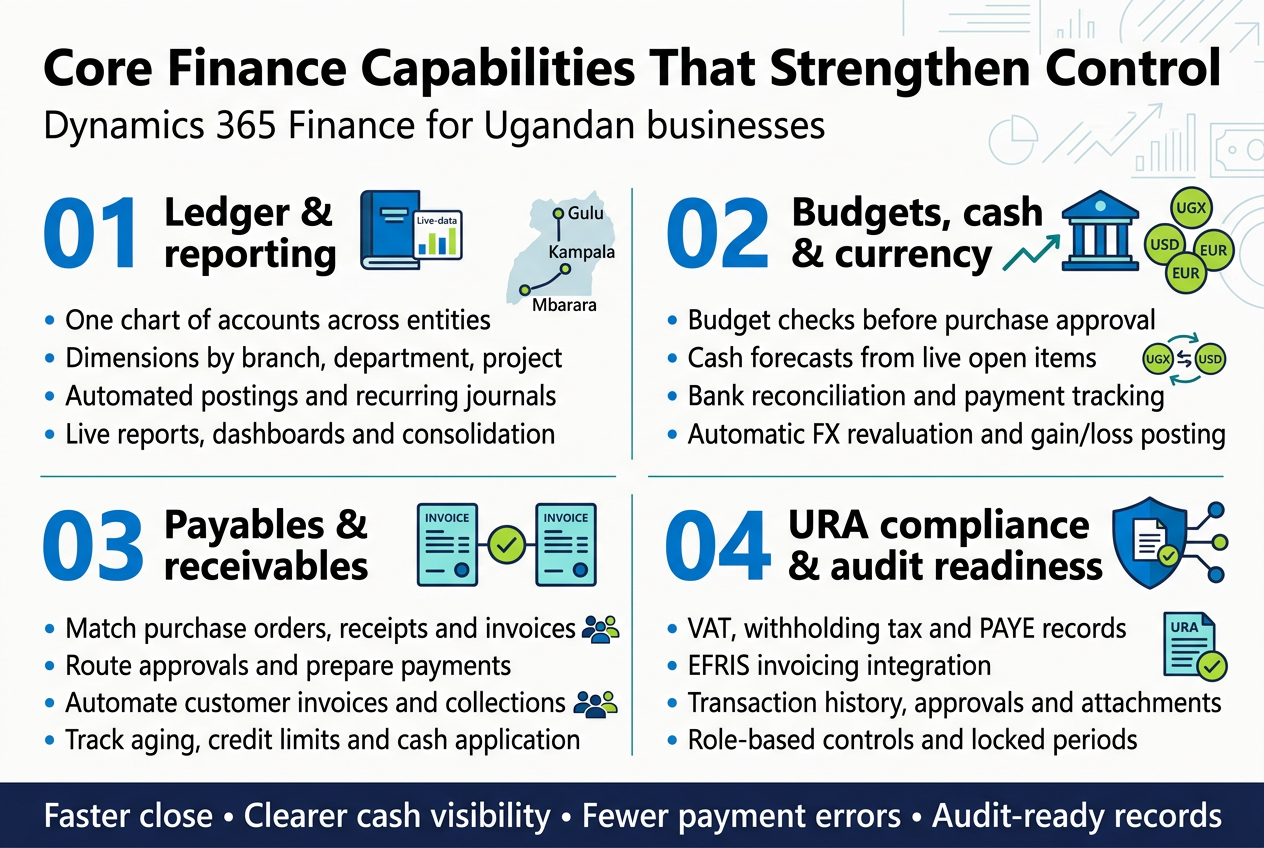
- One chart of accounts, many entities. Run several legal entities, such as a Kampala head office and branches in Gulu or Mbarara, under a shared chart of accounts, with local differences where needed.
- Financial dimensions. Tag every transaction by department, project, branch, or cost center. You can slice the numbers however management asks without rebuilding the books.
- Automated posting. Sales, purchases, payroll journals, inventory movements, and fixed asset depreciation post to the ledger automatically, which cuts manual journal entries and the errors that come with them.
- Recurring and allocation journals. Rent, insurance accruals, and shared cost allocations run on a schedule instead of being rekeyed each month.
- Consolidation. Roll up subsidiaries into group results, including intercompany eliminations, without a separate consolidation spreadsheet.
Reporting that people actually use:
Financial Reporting in Dynamics 365 lets finance teams build balance sheets, income statements, and cash flow reports from live ledger data. Power BI dashboards sit on top, so a managing director can see revenue, margins, and outstanding balances on a phone before a board meeting.
| Task | Typical manual process | With Dynamics 365 Finance |
|---|---|---|
| Month-end close | Days of reconciling spreadsheets | Faster close with checklists and automated postings |
| Management reports | Rebuilt each period | Saved, reusable report definitions |
| Branch reporting | Emailed files | Real-time view by dimension |
| Group consolidation | Manual merging | Built-in consolidation and eliminations |
Othware Uganda, as a Microsoft Dynamics 365 partner in Uganda, usually starts here: designing the chart of accounts and dimensions to fit how your business really reports. A good design at this stage saves months of rework later.
Managing Budgets, Cash Flow, and Multi-Currency Transactions
Cash is tight in most businesses, and in Uganda the shilling’s swings against the dollar can quietly eat margins. Dynamics 365 Finance gives you tools to plan, watch, and react.
Budgeting and budget control
- Build budgets by department, project, or account, and keep multiple versions (original, revised, forecast).
- Turn on budget control so purchase requisitions and orders are checked against available budget before approval. Overspending gets flagged before it happens, not after the quarter closes.
- Compare budget to actuals at any time with no export-and-merge work.
Cash flow visibility
- Cash and bank management handles bank reconciliation, statement imports, and payment tracking, including mobile money and multiple bank accounts.
- Cash flow forecasting pulls from open receivables, payables, sales orders, and purchase orders, so you can see a shortfall weeks ahead.
- Treasury teams can plan loan repayments and supplier payments around expected inflows rather than guessing.
Multi-currency made practical
Many Ugandan businesses buy in US dollars, sell in shillings, and sometimes bill in euros or Kenyan shillings. The system handles that without manual conversion.
- Store transactions in the transaction currency, the accounting currency, and a reporting currency.
- Load exchange rates manually or through a rate provider.
- Run foreign currency revaluation at period end to book unrealized gains and losses properly.
- Settlement automatically calculates realized gains and losses when invoices are paid at a different rate than when they were booked.
| Challenge | How Dynamics 365 Finance responds |
|---|---|
| Shilling volatility | Automatic revaluation and exchange gain/loss posting |
| Importers paying in USD | Vendor invoices held in USD with UGX equivalents |
| Cash surprises | Forecasts based on live open items |
| Overspending | Budget checks at requisition and PO stage |
Simplifying Accounts Payable and Receivable
Payables and receivables are where most day-to-day finance friction lives: late supplier payments, disputed invoices, and customers who forget to pay. The system tightens both sides.
Accounts payable
- Invoice capture and matching. Three-way matching compares the purchase order, product receipt, and vendor invoice. Mismatches are flagged before payment goes out.
- Approval workflows. Route invoices by amount, department, or vendor so nothing sits in someone’s inbox.
- Payment proposals. Select invoices due, apply early-payment discounts, and generate payment files for your bank in a few clicks.
- Vendor management. Keep bank details, payment terms, and withholding tax settings in one place, with change approval to reduce fraud risk.
- Aging and liability reports. Know what you owe, to whom, and when.
Accounts receivable
- Customer credit limits. Block or warn on orders when a customer is over limit.
- Automated invoicing. Invoices generate from sales orders, projects, or subscriptions, with no re-entering.
- Collections management. Set up collection letters, follow-up activities, and aging buckets so your team chases the right accounts first.
- Cash application. Match customer payments to open invoices quickly, including partial payments.
- Customer statements and aging. Share clear statements and cut down on “we never received that invoice” arguments.
What this means in numbers: shorter days sales outstanding, fewer duplicate or incorrect payments, and finance staff spending time on analysis instead of data entry.
Supporting URA Tax Compliance and Audit Readiness
Tax compliance in Uganda comes with real deadlines and real penalties. The Uganda Revenue Authority (URA) expects accurate VAT, withholding tax, and PAYE records, and increasingly expects electronic invoicing through EFRIS. Your ERP should make this routine.
Tax handling inside the system
- Sales tax and VAT setup. Configure VAT codes (standard, zero-rated, exempt) and apply them automatically to sales and purchase transactions.
- Withholding tax. Set rules on vendor payments so the correct amount is deducted, posted, and tracked for remittance.
- Tax reporting. Generate VAT return data straight from posted transactions rather than rebuilding it from invoices.
- EFRIS integration. Dynamics 365 can be extended to connect with URA’s Electronic Fiscal Receipting and Invoicing Solution, so invoices are submitted and fiscalized from the sales process. Othware Uganda configures and tests these local integrations as part of Dynamics 365 Finance and Operations implementation.
Audit readiness
- Full audit trail. Every transaction records who created it, who approved it, and when.
- Segregation of duties. Role-based security prevents one person from creating a vendor, raising a PO, and approving payment.
- Document attachments. Attach invoices, contracts, and receipts to the transaction itself, so auditors can find support in seconds.
- Consistent period controls. Lock closed periods to stop back-dated changes.
- IFRS-friendly structure. Fixed assets, revenue, and leases can be set up to support IFRS reporting, which many Ugandan companies and lenders require.
Audit day comparison:
| Situation | Without a structured ERP | With Dynamics 365 Finance |
|---|---|---|
| Auditor asks for invoice support | Searching files and emails | Open the transaction, view attachment |
| VAT return preparation | Manual summaries | Report from posted tax transactions |
| Who approved this payment? | Unclear | Workflow history shows approver and date |
| Year-end adjustments | Hard to trace | Journal history with user and timestamp |
Working with an experienced Dynamics 365 consultant in Uganda matters here, because tax rules change. A partner who tracks URA updates can adjust tax configurations and reports so you stay compliant without a scramble each filing period.
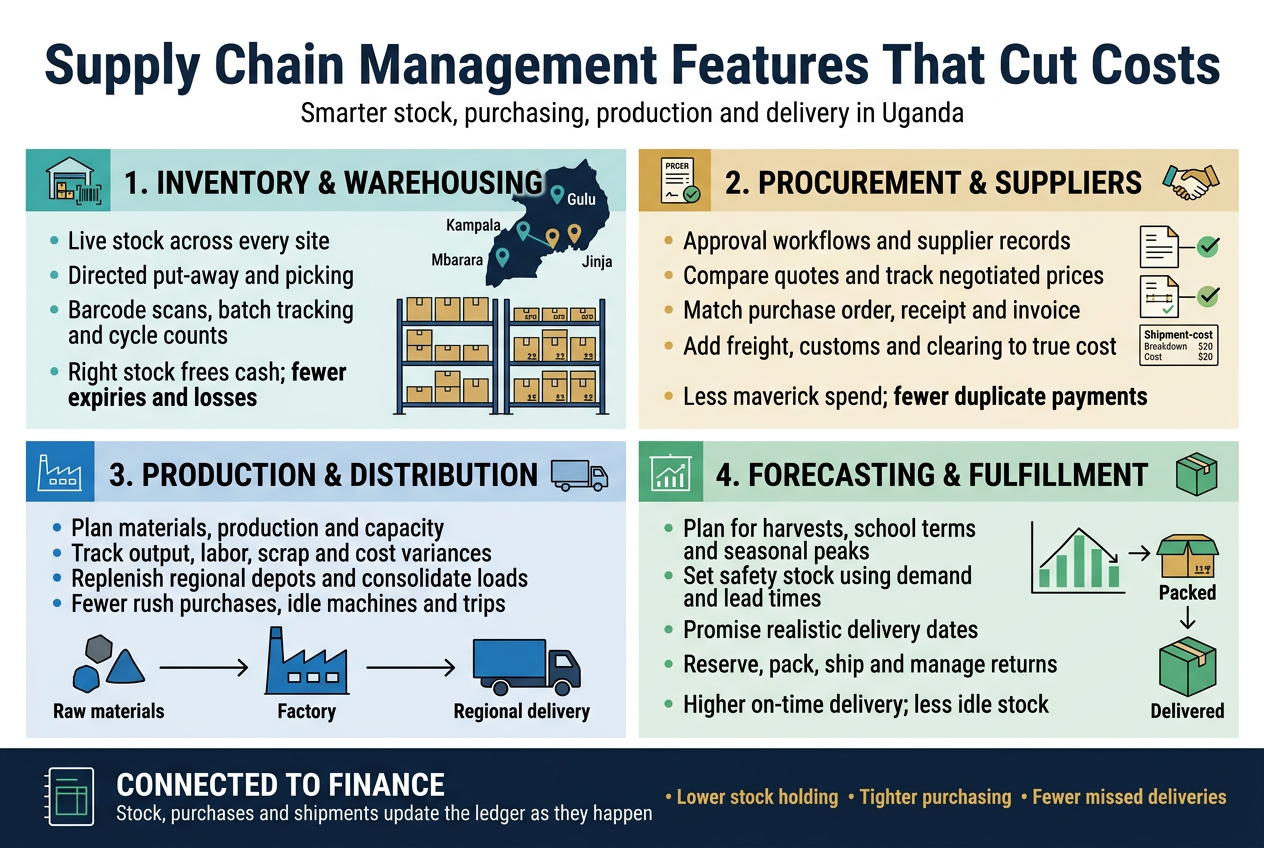
Supply Chain Management Features That Cut Costs
Optimizing Inventory and Warehouse Operations
Stock is where cash gets stuck. In Uganda, long import lead times through Mombasa or Dar es Salaam, currency swings, and unpredictable road delays push many businesses to overstock “just in case.” That ties up shillings and dollars on shelves. Dynamics 365 Supply Chain Management helps you hold the right stock, not just more of it.
What changes on the ground:
- Real-time inventory visibility: Every receipt, pick, transfer, and adjustment updates on-hand quantities as it happens. Your Kampala head office sees what’s sitting in Mbarara, Gulu, or Jinja without a phone call.
- Warehouse Management (WMS): Directed put-away and picking tell staff exactly where to store and fetch items. Less walking, fewer wrong picks, faster loading.
- Mobile warehouse app: Workers scan barcodes on handheld devices or phones. Paper pick lists and end-of-day data entry go away.
- Batch and serial tracking: Track expiry dates and lot numbers for pharmaceuticals, food, chemicals, and agricultural inputs. Recalls become a quick search instead of a week-long scramble.
- Cycle counting: Count small sections of the warehouse regularly instead of shutting everything down for a yearly stocktake.
- Multi-site and multi-warehouse control: Manage depots, bonded warehouses, and retail outlets in a single system with clear transfer workflows.
Where the savings come from:
| Problem | How Dynamics 365 SCM helps | Cost impact |
|---|---|---|
| Overstocking slow movers | Min/max levels, ABC analysis, and aging reports | Frees up working capital |
| Stockouts on fast movers | Reorder alerts and safety stock rules | Protects revenue |
| Expired or damaged goods | FEFO picking and batch expiry tracking | Cuts write-offs |
| Theft and shrinkage | Scan-based movements and audit trails | Reduces losses |
| Slow dispatch | Wave picking and optimized put-away | Lowers labor cost per order |
A distributor with fifty fast-moving SKUs and a few hundred slow ones can see where cash is sleeping and act on it. That kind of insight is hard to get from spreadsheets, and it’s a major reason companies look for ERP software in Uganda that handles warehouses properly.
Improving Procurement and Supplier Collaboration
Buying is often where money leaks quietly. A verbal approval here, a rushed local purchase there, and suddenly nobody can say what you paid last quarter for the same item. Dynamics 365 puts structure around purchasing without slowing the team down.
Key procurement capabilities:
- Purchase requisitions with approval workflows: Staff request what they need, and the right manager approves based on amount, department, or project. Everything is recorded.
- Vendor management: Keep supplier details, payment terms, performance history, and contracts in one place.
- Request for quotation (RFQ): Send RFQs to multiple suppliers, compare responses side by side, and pick the best offer with a clear paper trail. This is especially useful for NGOs, donor-funded projects, and public-sector-linked businesses that need transparent procurement.
- Purchase agreements and price tracking: Lock in negotiated prices and volumes, then watch actual spend against the agreement.
- Three-way matching: The system compares the purchase order, product receipt, and vendor invoice before payment. If the quantities or prices don’t line up, you find out before the money leaves.
- Landed cost management: Freight, customs duties, clearing agent fees, insurance, and port charges get added to the item cost. You see the real cost of imported goods, not just the supplier’s invoice price.
Why landed cost matters in Uganda:
When shilling-to-dollar rates move and clearing costs fluctuate, the invoice price tells only half the story. With proper landed cost tracking, your margins reflect reality. You can decide whether importing, buying locally from a regional supplier, or switching sources makes more sense.
Supplier collaboration:
- Share purchase orders and confirmations electronically.
- Track confirmed delivery dates against promised ones.
- Review supplier scorecards: on-time delivery, quality rejections, and price variance.
- Spot your most reliable suppliers and negotiate from facts.
Over time, this discipline cuts maverick spending, reduces duplicate payments, and gives you real leverage in supplier conversations. A good Microsoft Dynamics 365 partner in Uganda will set up approval hierarchies and matching rules that fit how your business really buys, not a generic template.
Streamlining Production and Distribution Planning
Manufacturers, processors, and distributors in Uganda all face a similar pain: too many moving parts and not enough shared information. Production waits for materials. Sales promises dates that the factory can’t hit. Trucks go out half empty. Dynamics 365 SCM connects those pieces.
Production Planning and Control
- Bills of materials (BOMs) and formulas: Define exactly what goes into each product, including yields, scrap, and co-products. This matters for food and beverage processors, edible oil producers, and building material makers.
- Master planning (MRP): The system looks at demand, current stock, open purchase orders, and lead times, then suggests what to buy and what to produce, and when.
- Production orders and routing: Schedule jobs by machine and work center, and record the materials and labor actually consumed.
- Shop floor execution: Operators log start and stop times, output, and scrap on a terminal or tablet.
- Cost accounting for production: Compare standard cost against actual cost and see where variances come from: material prices, labor hours, or waste.
- Lean and mixed-mode manufacturing: Run discrete, process, and lean production in one system if your business needs it.
Distribution and Transportation
- Multi-warehouse replenishment: Move stock from central warehouses to regional depots based on demand.
- Transportation management: Plan loads, choose carriers, and compare freight costs.
- Delivery tracking: Know what’s on the truck, what’s been delivered, and what’s still pending.
- Intercompany trade: If you run sister companies in Uganda, Kenya, Rwanda, or South Sudan, orders and invoices flow between entities with fewer manual steps.
Cost impact at a glance:
| Area | Typical waste | What improves |
|---|---|---|
| Production scheduling | Idle machines, rush jobs | Better capacity use |
| Material planning | Emergency purchases at higher prices | Planned buying |
| Scrap and yield | Untracked losses | Visible variances to fix |
| Distribution | Partial loads, duplicate trips | Consolidated shipments |
| Overtime | Constant firefighting | Predictable workloads |
Companies searching for supply chain management software in Uganda often start with one pain point, like production delays or stock-outs at depots, and then find the connected view is what really pays off.
Improving Demand Forecasting and Order Fulfillment
If you guess demand wrong, you pay either way: too much stock costs cash, too little costs customers. Uganda’s markets have strong seasonality, including school terms, harvest cycles, festive periods, and construction peaks in the dry season. A system that learns from your history makes planning less of a gamble.
Demand Forecasting
- Statistical forecasting: Dynamics 365 uses historical sales to generate baseline forecasts by product, customer group, or region.
- Demand Planning (Azure-based): Machine learning models pick up trends and seasonality, and planners adjust the numbers with market knowledge such as a big tender, a promotion, or a new outlet.
- Forecast accuracy tracking: See how far your forecasts missed reality and tune your approach.
- Safety stock calculations: Set buffers based on demand variability and supplier lead times instead of gut feel.
- Inventory visibility add-in: Get a near-real-time view of stock across locations and channels, which is handy for businesses selling through branches, distributors, and e-commerce.
Order Fulfillment
- Sales order processing: Capture orders from branches, field sales, or online channels and check stock availability immediately.
- Available-to-promise (ATP) and capable-to-promise (CTP): Give customers a realistic delivery date based on stock on hand, incoming supply, and production capacity.
- Order promising rules: Prioritize key customers or contracts when stock is tight.
- Reservations and allocations: Hold stock for confirmed orders so it doesn’t get sold twice.
- Shipping and packing workflows: Generate pick lists, packing slips, and delivery notes automatically.
- Returns management: Handle damaged goods, wrong deliveries, and credit notes with a clear process.
What you gain:
- Higher on-time, in-full (OTIF) delivery rates.
- Fewer emergency purchases and expedited freight bills.
- Less stock sitting idle at the end of a season.
- Better customer trust, which is worth a lot in competitive local markets.
Bringing it together with finance:
Because Dynamics 365 SCM sits on the same platform as Dynamics 365 Finance, every stock movement, purchase, and shipment posts to the general ledger as it happens. No reconciling between a stock system and an accounting system at month-end. That’s the real value of working with a Dynamics 365 SCM partner who understands both sides: operations and finance stay in step, and the numbers your CFO sees match what the warehouse manager sees.
For businesses weighing Dynamics 365 Finance and Operations implementation in Uganda, supply chain is often where payback shows up first: lower stock holding, tighter purchasing, and fewer missed deliveries. Othware Uganda, as an official Microsoft Dynamics 365 F&O partner, configures these capabilities around local realities such as multi-currency pricing, URA tax requirements, import-heavy supply lines, and multi-branch operations, so the system works from day one rather than needing months of workarounds.
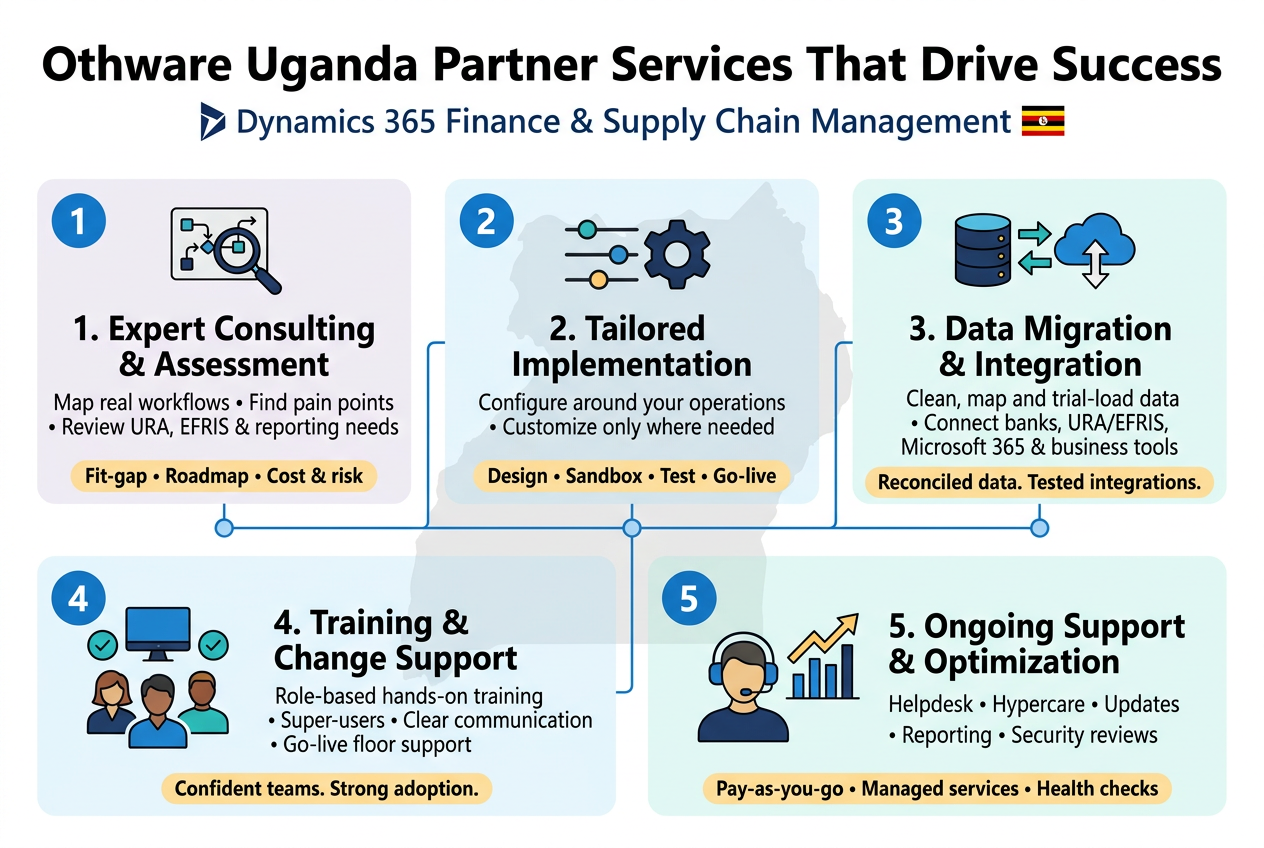
Othware Uganda Partner Services That Drive Success
Expert Consulting and Business Process Assessment
Most failed ERP projects go wrong before anyone touches the software. The team never agreed on what the business needed. Othware Uganda starts with the business, not the system.
Our Dynamics 365 consultants in Uganda sit down with your finance, procurement, warehouse, and operations teams to see how work actually gets done. Not how the SOP says it gets done. How it really happens, spreadsheets, WhatsApp approvals, and all.
What the assessment covers
- Current-state process mapping: order-to-cash, procure-to-pay, record-to-report, inventory flow, and asset management.
- Pain point discovery: slow month-end closes, stock mismatches, delayed supplier payments, manual reconciliations.
- Compliance review: URA requirements such as VAT and withholding tax, EFRIS e-invoicing, plus audit and donor reporting needs.
- Multi-currency and multi-entity needs: UGX, USD, and other currencies, plus group structures across branches or countries.
- System landscape review: what you already run (QuickBooks, Sage, Excel, custom tools) and what should stay, integrate, or retire.
What you get at the end
| Deliverable | Why it matters |
|---|---|
| Fit-gap analysis | Shows what Dynamics 365 Finance and SCM covers out of the box and what needs configuration or extension |
| Prioritized roadmap | Phases the rollout so you get quick wins early |
| Cost and effort estimate | Gives leadership a realistic budget, with no surprises mid-project |
| Risk register | Flags data, people, and process risks up front |
The result is a clear business case. You know what you’re buying, why, and what it should deliver.
Tailored Implementation and Customization
Every business in Uganda runs a little differently. A distributor in Kampala, a manufacturer in Jinja, and an NGO with field offices upcountry won’t use the same setup. As an official Microsoft Dynamics 365 Finance and Operations partner, Othware Uganda configures the platform around your operations instead of forcing you into a template.
Configuration first, customization second
We stick to a simple rule: use standard functionality wherever possible. It keeps upgrades smooth, costs lower, and support simpler. Custom code only comes in when there’s a real business reason.
Typical configuration areas:
- Chart of accounts, financial dimensions, and fiscal calendars
- General ledger, accounts payable, and accounts receivable
- Budgeting, cash and bank management, and fixed assets
- Procurement workflows and approval hierarchies
- Inventory, warehouse, and transportation management
- Production control and master planning, where relevant
- Role-based security and segregation of duties
Local customization where it counts
Some needs are specific to Uganda. We build and adapt for those without breaking the core system:
- Tax setup: VAT, withholding tax, and statutory reporting formats
- EFRIS integration: connecting invoicing to URA’s e-invoicing system
- Mobile money and bank connectivity: payment files and reconciliation with local banks and mobile money providers
- Custom reports and Power BI dashboards: the numbers your management team asks for every Monday
- Approval workflows: matching how your company really signs off on spend
How we deliver
- Design workshops: confirm processes and sign off on the solution design.
- Sandbox build: configure in a test environment so you can see it working early.
- Iterative reviews: your team tests each module and gives feedback before moving on.
- User acceptance testing: real scenarios, real users, real data samples.
- Go-live readiness check: cutover plan, rollback plan, and support lined up.
Seamless Data Migration and System Integration
Bad data in a new ERP is still bad data. Migration is where many projects lose time and trust, so we treat it as its own workstream with its own owner.
Data migration done properly
We help you decide what to bring over and what to leave behind. Ten years of inactive vendors and obsolete stock items don’t need a new home.
Our migration process:
- Data audit: find duplicates, missing fields, and inconsistent records.
- Cleansing rules: standardize customer names, vendor details, item codes, and units of measure.
- Mapping: link each legacy field to its Dynamics 365 counterpart.
- Trial loads: run several mock migrations and reconcile every one.
- Final cutover: load opening balances, open invoices, open orders, and stock on hand with sign-off from finance and operations.
Common data sets we migrate:
| Data type | Examples |
|---|---|
| Master data | Customers, vendors, items, bill of materials, fixed assets |
| Financial data | Opening balances, open AP/AR, bank balances, budgets |
| Supply chain data | Stock on hand, open purchase and sales orders, warehouse locations |
| Historical data | Summarized prior-year figures for comparison reporting |
Integration with the tools you already use
Dynamics 365 works best when it talks to the rest of your business. Othware Uganda connects it with:
- Microsoft 365, Power BI, and Power Platform for reporting, automation, and collaboration
- Banks and payment providers for payment files and statement imports
- URA/EFRIS for tax compliance
- E-commerce, CRM, and POS systems so orders and stock stay in sync
- Warehouse devices like barcode scanners and handhelds
- Payroll and HR systems so labor costs flow into the ledger
Integrations are built with proven connectors, APIs, and Azure services, then tested end to end, so a failed sync doesn’t turn into a month-end headache.
User Training and Change Management Support
You can have a flawless system and still fail if people go back to Excel on day two. Adoption decides whether the investment pays off.
Training that fits real jobs
Generic software demos don’t stick. We train people on their own daily tasks, using your own processes and data.
- Role-based training: accountants, buyers, warehouse staff, sales teams, and managers each get what they actually need.
- Hands-on sessions: people click through real scenarios in a training environment.
- Super-user programs: we build in-house champions who can answer day-to-day questions fast.
- Quick reference guides and videos: short, simple material people can check when they get stuck.
- Train-the-trainer options: so you can onboard new hires without waiting on us.
Change management that actually helps
Resistance to new systems is normal. People worry about extra work, mistakes, or being replaced. We deal with that head-on.
- Leadership alignment: executives agree on goals and visibly back the project.
- Stakeholder communication: regular updates on what’s changing, when, and why.
- Impact analysis: we spot which roles change the most and prepare them first.
- Feedback loops: users raise concerns early and see them addressed.
- Go-live floor support: our consultants stay close during the first weeks, ready to fix issues on the spot.
When teams understand the “why” and feel confident with the “how,” adoption takes care of itself.
Ongoing Support and System Optimization
Go-live is the start, not the finish. Businesses change: new branches, new products, new regulations. Your ERP needs to keep up.
Dependable support after go-live
Othware Uganda offers structured support for Dynamics 365 Finance and Supply Chain Management, so issues get solved quickly by people who know your setup.
- Helpdesk and incident management: a clear route to log issues, with response times agreed in advance
- Hypercare period: intensive support right after launch while the system settles
- Troubleshooting and fixes: quick resolution for transaction errors, security issues, and workflow glitches
- Microsoft update management: testing and applying the regular One Version updates so new releases don’t break anything
- Regulatory updates: adjustments when tax or reporting rules change
Continuous optimization
A system that was right for you last year might not be right today. We review how it’s being used and look for ways to get more from it.
| Optimization area | What we look at |
|---|---|
| Performance | Slow reports, heavy batch jobs, system responsiveness |
| Process efficiency | Manual steps that can be automated with workflows or Power Automate |
| Reporting | New dashboards, KPI tracking, better visibility for managers |
| Licensing | Unused licenses, or users on the wrong plan |
| Expansion | Adding modules, entities, warehouses, or countries |
| Security | Role reviews, access cleanups, audit readiness |
Support options that fit your size
- Pay-as-you-go support for smaller teams with occasional needs
- Managed service agreements with dedicated hours and proactive monitoring
- Periodic health checks to catch problems before users notice them
With the right partner behind you, your ERP software in Uganda keeps getting sharper as your business grows.
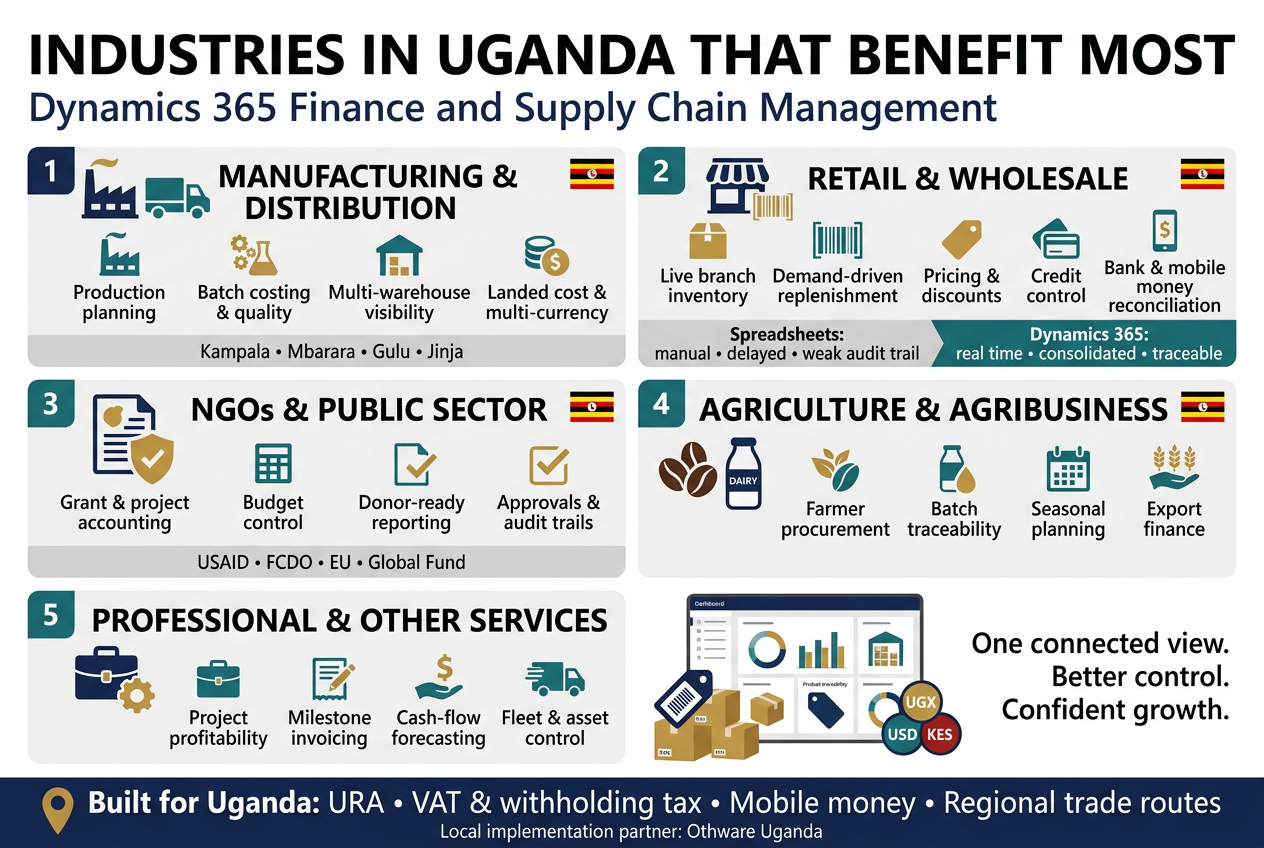
Industries in Uganda That Benefit Most
Manufacturing and Distribution
Ugandan manufacturers and distributors deal with a tough mix of problems: volatile input costs, shilling-to-dollar swings, unreliable stock counts, and long, tangled routes to market. Dynamics 365 Finance and Supply Chain Management gives them one system to tie all of that together.
Where it helps on the factory floor
- Production planning: Master planning looks at demand, stock on hand, and supplier lead times, then suggests what to make and what to buy. Fewer surprise shortages, less cash locked up in idle stock.
- Bill of materials and costing: You see the real cost of each batch, including raw materials, labor, and overhead. That makes pricing decisions far less of a guessing game.
- Quality control: Set up quality orders and tests for incoming materials and finished goods. Handy for beverages, food processing, plastics, and building materials where standards matter.
- Batch and serial tracking: Trace a product back to its supplier lot and forward to the customer. This helps with recalls and with UNBS compliance.
Where it helps in distribution
- Multi-warehouse visibility: Track stock across Kampala, Mbarara, Gulu, Jinja, and upcountry depots in real time.
- Warehouse management: Directed put-away, picking, and cycle counting cut errors and shrinkage.
- Landed cost: Freight, customs duty, and clearing fees feed into item cost, which matters a lot for importers coming through Mombasa or Dar es Salaam.
- Multi-currency finance: Handle UGX, USD, and KES transactions with automatic revaluation, so exchange-rate gains and losses stop surprising you at month-end.
A typical result: a distributor that once reconciled stock in spreadsheets every Friday gets a live view of margins by product, route, and customer. That is the kind of control that supports serious growth. This is why many firms look for a Microsoft Dynamics 365 partner in Uganda that understands local import and distribution realities.
Retail and Wholesale
Retail and wholesale in Uganda run on thin margins and fast turnover. A few percentage points lost to stockouts, expired goods, or pilferage can wipe out profit. Most off-the-shelf accounting tools stop being enough once you have multiple outlets, credit customers, and a mix of cash, mobile money, and bank payments.
What Dynamics 365 brings to the table
- Accurate inventory across branches: See what’s in each shop and warehouse, and move stock between locations based on actual demand instead of gut feel.
- Demand-driven replenishment: Forecasting and reorder rules help you stock the fast sellers and stop overbuying slow ones.
- Pricing and discounts: Manage price lists, trade agreements, and promotions for different customer groups, from walk-in buyers to large wholesale accounts.
- Credit control: Set credit limits, track ageing, and block orders when a customer goes over. Wholesalers who sell on credit know how much this protects cash flow.
- Supplier management: Compare vendor performance, track purchase prices over time, and negotiate with data in hand.
- Payment flexibility: Reconcile bank deposits and mobile money collections without the manual matching headache.
Quick comparison: spreadsheets vs. Dynamics 365 for a growing retailer
| Area | Spreadsheets / basic accounting | Dynamics 365 Finance and SCM |
|---|---|---|
| Stock accuracy | Updated manually, often late | Real time across all locations |
| Multi-branch reporting | Consolidated by hand | Consolidated automatically |
| Credit exposure | Checked after the fact | Enforced at order entry |
| Margin analysis | Rough estimates | By product, branch, and customer |
| Audit trail | Weak | Full, user-level tracking |
For supermarket chains, hardware wholesalers, pharmaceutical distributors, and FMCG traders, this kind of supply chain management software in Uganda turns daily chaos into numbers you can act on.
NGOs and Public Sector Organizations
Donor-funded organizations and public bodies face a different pressure: proving where every shilling went. Reporting to USAID, FCDO, the EU, the Global Fund, or the Ministry of Finance means tight controls, clean audit trails, and the ability to slice spending by grant, project, and activity.
Finance features that matter here
- Financial dimensions: Tag every transaction by donor, project, cost center, location, or budget line. One entry, many reporting views.
- Budget control: Stop spending that goes beyond approved budget lines before it happens, not after the auditors find it.
- Grant and project accounting: Track commitments, expenditure, and balances against each award, and produce donor-specific reports without rebuilding data in Excel.
- Fixed asset management: Keep vehicles, equipment, and field assets properly registered, depreciated, and traceable to the funding source.
- Multi-entity consolidation: Run country offices, regional programs, and implementing partners in one environment with clear separation.
- Approval workflows: Enforce delegation of authority so purchases and payments follow policy every time.
Procurement and supply side
- Purchase requisitions with multi-level approvals
- Request for quotation and vendor comparison for transparent tendering
- Three-way matching of purchase order, receipt, and invoice
- Inventory control for relief supplies, medical items, and program materials
Because everything is logged, audits go faster and findings drop. For organizations that handle public money or donor funds, Dynamics 365 Finance in Uganda gives leadership real confidence in the numbers. Working with experienced Dynamics 365 consultants in Uganda also helps set up the chart of accounts and dimensions to match donor reporting from day one.
Agriculture and Services
Agriculture and Agribusiness
Agriculture is the backbone of Uganda’s economy, and agribusinesses are getting more complex. Coffee exporters, dairy processors, tea estates, grain traders, and sugar producers all juggle seasonal supply, perishable stock, and export paperwork.
Dynamics 365 helps with:
- Procurement from many suppliers: Manage purchases from cooperatives and smallholder farmers, with clear records of quantity, quality, and payment.
- Batch tracking and traceability: Follow coffee lots or dairy batches from intake to export, which buyers and certification bodies increasingly demand.
- Seasonal planning: Plan cash, storage, and working capital around harvest peaks and lean periods.
- Cost visibility: Understand the true cost per kilogram or liter after transport, processing, and storage.
- Export finance: Handle foreign currency invoices, letters of credit, and shipment costs in one place.
Professional and Other Services
Service businesses may not carry much stock, but they carry plenty of complexity. Telecom contractors, logistics firms, construction companies, hospitality groups, and consultancies need tight project and cost control.
- Project accounting: Track time, expenses, and billing against each contract so you know which jobs make money.
- Recurring and milestone invoicing: Bill accurately and on time, and reduce disputes.
- Cash flow forecasting: See incoming and outgoing cash weeks ahead.
- Fleet and asset control: Maintain records for vehicles, machinery, and equipment, with depreciation handled automatically.
- Group reporting: Consolidate subsidiaries and see the full picture on one dashboard.
Why the right partner matters across all these sectors
Every industry above has quirks: VAT and withholding tax rules from URA, local banking habits, mobile money, and regional trade routes. An official Microsoft Dynamics 365 F&O partner like Othware Uganda brings the product knowledge and the local context together, so your ERP software in Uganda is set up for how you actually work, not how a generic template assumes you do.
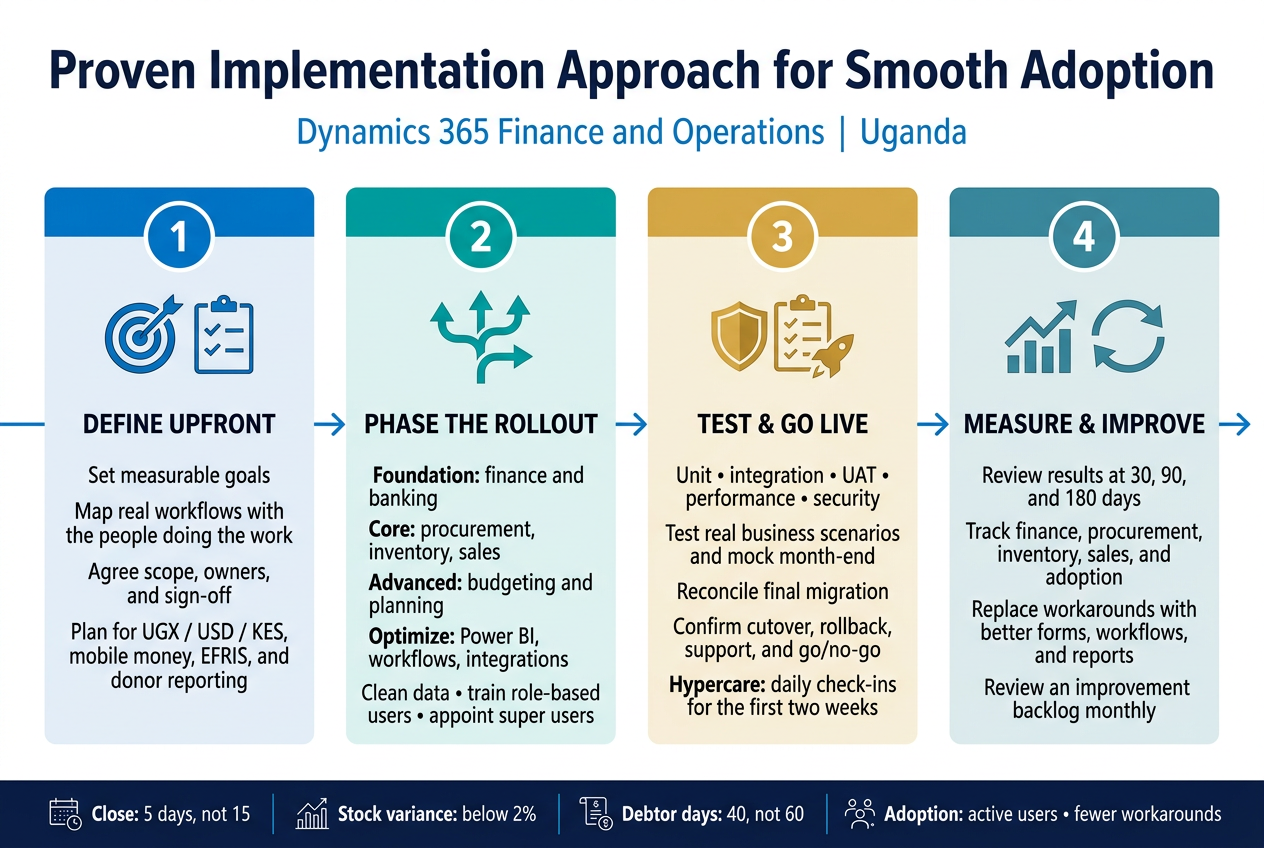
Proven Implementation Approach for Smooth Adoption
Defining Goals and Requirements Upfront
Most ERP projects go sideways before a single screen is configured. The cause is usually fuzzy goals. A strong Dynamics 365 Finance and Operations implementation starts with a plain question: what must be different six months after go-live?
Start with business outcomes
Pin each goal to a number or a deadline. Vague wishes like “better reporting” are hard to build and harder to measure. Compare these:
| Vague goal | Measurable goal |
|---|---|
| Faster month-end | Close the books in 5 working days instead of 15 |
| Better stock control | Cut stock variance below 2% across all warehouses |
| Cleaner cash flow | Reduce average debtor days from 60 to 40 |
| Less manual work | Remove spreadsheet reconciliations for bank and intercompany |
Map current processes honestly
Your Dynamics 365 consultants in Uganda should sit with the people who do the work, not just the managers. Finance clerks, store keepers, procurement officers, and sales staff know where the real workarounds hide. Cover these areas:
- Procure-to-pay: how requisitions, approvals, and supplier payments move today
- Order-to-cash: quoting, invoicing, collections, and credit control
- Inventory and warehousing: receiving, picking, transfers, and stock counts
- Financial close: journals, accruals, consolidations, and reporting
- Compliance: URA tax requirements, VAT, withholding tax, and audit trails
Capture local requirements early
Uganda brings its own needs. Think about multi-currency handling (UGX, USD, KES), mobile money reconciliation, EFRIS e-invoicing integration, and donor or grant reporting for NGOs. Raising these in week one avoids expensive rework later.
Agree on scope and ownership
Write down what’s in, what’s out, and who decides. Name a project sponsor at executive level, a day-to-day project lead from your team, and process owners for finance and supply chain. A signed-off requirements document gives everyone, including your Microsoft Dynamics 365 partner in Uganda, a shared reference when opinions change mid-project.
Phased Deployment That Minimizes Disruption
A big-bang switch across every department sounds efficient. In practice it can stall invoicing, delay supplier payments, and wear out your team. Phasing the rollout keeps the business running while the new system takes hold.
Common phasing options
| Approach | How it works | Best for |
|---|---|---|
| By module | Finance first, then supply chain, then add-ons | Teams that need a solid financial base before anything else |
| By location | Head office pilot, then branches or warehouses | Multi-site businesses across Kampala and upcountry |
| By legal entity | One company goes live, others follow | Groups with several subsidiaries |
| Big bang | Everything switches at once | Smaller, simpler operations with strong readiness |
A typical sequence
- Foundation: General ledger, chart of accounts, dimensions, banking, accounts payable and receivable.
- Core operations: Procurement, inventory, sales orders, and warehouse management.
- Advanced features: Budgeting, fixed assets, cost accounting, master planning, and demand forecasting.
- Optimization: Power BI dashboards, workflow automation, and integrations with other tools.
Keep the data clean
Data migration deserves its own workstream. Don’t carry over every old record just because it exists.
- Clean up duplicate customers, vendors, and items
- Archive closed accounts and obsolete stock codes
- Migrate opening balances and open transactions, not ten years of history
- Run trial migrations several times and reconcile each one against the legacy system
Prepare your people
Change management matters as much as configuration. Run role-based training, name a few super users in each department, and talk openly about what’s changing. People adopt a system they helped shape. They resist one that lands on their desk the night before go-live.
Testing and Go-Live Readiness
Testing is where you find problems while they’re still cheap to fix. Rushing it is the fastest way to turn go-live into a crisis.
Layers of testing
- Unit testing: Consultants check each configured feature works alone.
- Integration testing: Confirm that data flows correctly between modules and connected systems, such as banks, EFRIS, payroll, or e-commerce.
- User acceptance testing (UAT): Your own staff run real scenarios from start to finish. This one is not optional.
- Performance testing: Check the system handles peak loads, like month-end postings or heavy order days.
- Security testing: Confirm role-based access and segregation of duties work as designed.
Test with real scenarios
Skip the generic scripts. Use cases like a purchase order with partial delivery and a foreign currency invoice, a customer return with credit note, or an inter-warehouse transfer with a stock adjustment. Finance should also run a full mock month-end close, including tax reports and bank reconciliation.
Go-live readiness checklist
- All critical UAT defects resolved and signed off
- Final data migration rehearsed and reconciled
- Users trained and holding the right security roles
- Cutover plan with clear times, owners, and rollback steps
- Support team ready, with a hypercare rota in place
- Business leaders have given a formal go/no-go decision
Plan the cutover weekend
Pick a quiet period, often right after a month-end or quarter-end close, so opening balances are clean. Freeze legacy transactions, load final data, verify balances, and confirm key users can post transactions before anyone declares success.
Hypercare after launch
Expect questions and small hiccups in the first few weeks. Having consultants on call, either on-site or remote, means problems get solved in hours instead of lingering. Daily check-ins during the first two weeks help catch recurring issues early.
Measuring Results After Launch
Go-live is a milestone, not the finish line. The real question is whether you’re getting what you set out to get.
Track the goals you set at the start
Go back to those measurable targets and review them on a schedule, say at 30, 90, and 180 days.
| Area | Example KPIs |
|---|---|
| Finance | Days to close, reconciliation effort, reporting turnaround, debtor days |
| Procurement | Purchase cycle time, supplier on-time delivery, spend under contract |
| Inventory | Stock accuracy, inventory turnover, stockouts, write-offs |
| Sales and fulfillment | Order cycle time, on-time delivery, invoice accuracy |
| Adoption | Active users, support tickets, manual workarounds still in use |
Look at adoption, not just numbers
If staff still keep side spreadsheets, something in the setup or training missed the mark. Ask users what slows them down. Small tweaks to forms, workflows, or reports often deliver big gains.
Fix and refine
Build a simple backlog of improvement requests and review it monthly. Early wins might include:
- Custom dashboards in Power BI for management
- Automated approval workflows
- Extra reports for URA or donor requirements
- Refresher training for teams that struggle
Keep the partner relationship active
A reliable Dynamics 365 partner in Uganda sticks around after launch. Othware Uganda, as an official Microsoft Dynamics 365 F&O partner, supports ongoing optimization, updates, and new module rollouts so your ERP software keeps pace with the business instead of falling behind it.
Maximizing Long-Term Value and ROI
Scaling with Cloud Flexibility and Security
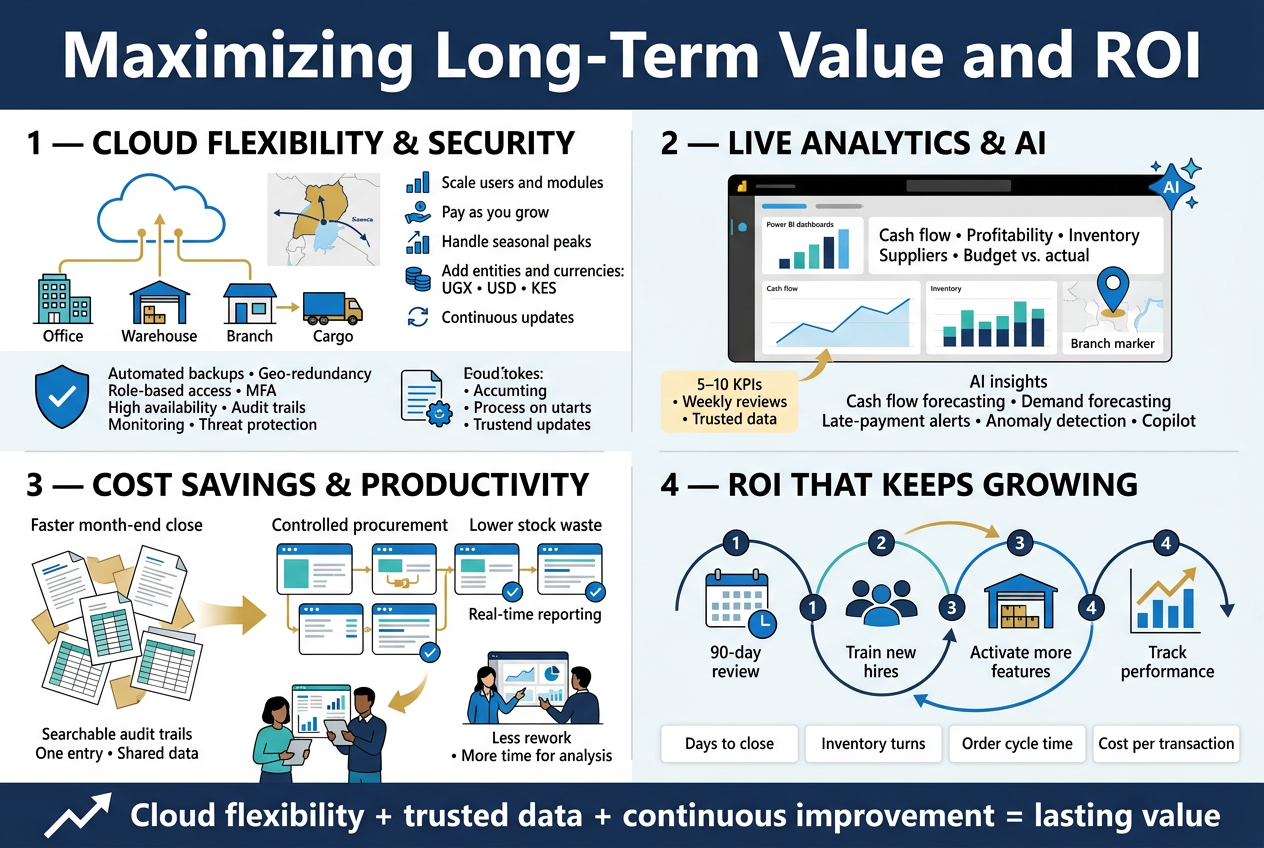
Your business won’t look the same in three years. You might open a new branch in Gulu, add a distribution line, or start exporting to Rwanda and Kenya. Dynamics 365 Finance and Operations runs on Microsoft Azure, so growth doesn’t mean buying new servers or rebuilding your ERP software setup from scratch.
How the cloud helps you grow
- Add users and modules as you go. Start with finance and procurement, then bring in warehouse management or production later.
- Pay for what you use. Subscription licensing replaces big upfront hardware spending, which helps when cash flow is tight.
- Handle seasonal spikes. Harvest periods, year-end closes, and festive-season demand don’t slow the system down.
- Open new entities quickly. Multi-company and multi-currency setups let you add subsidiaries, with UGX, USD, and KES handled in one place.
- Get updates without disruption. Microsoft pushes continuous updates, so you’re not stuck on an outdated version.
Security you’d struggle to build yourself
Many Ugandan companies still keep critical data on one office server or in scattered spreadsheets. A power outage, theft, or ransomware attack can wipe out months of records. Azure changes that picture:
| Concern | Typical on-premise risk | Dynamics 365 on Azure |
|---|---|---|
| Data loss | Single server, manual backups | Automated backups and geo-redundancy |
| Unauthorized access | Shared passwords, weak controls | Role-based security, multi-factor authentication |
| Downtime | Power cuts, hardware failure | High-availability infrastructure |
| Compliance | Hard to prove who did what | Full audit trails and segregation of duties |
| Threats | Outdated patches | Continuous monitoring and threat protection |
A good Dynamics 365 partner in Uganda sets up security roles around your actual structure, so the accountant sees what they need and nothing else. At Othware Uganda, this is part of how we configure every Dynamics 365 Finance and Operations implementation, not an afterthought.
Leveraging Analytics, Power BI, and AI Insights
Most businesses have plenty of data and very little time to make sense of it. The real return from an ERP shows up when managers stop asking “Can someone pull that report?” and start looking at a live dashboard.
Real-time visibility with Power BI
Dynamics 365 connects natively with Power BI, so finance and supply chain data feeds straight into dashboards. Instead of waiting for month-end, you can check things as they happen.
Useful dashboards for Ugandan businesses include:
- Cash flow and liquidity: receivables aging, upcoming payables, and bank balances in one view.
- Branch or project profitability: which locations or contracts earn money, and which quietly lose it.
- Inventory health: slow-moving stock, stock-outs, and reorder points.
- Supplier performance: delivery times, price changes, and quality issues.
- Budget vs. actual: spending checked against plan before the quarter ends.
AI that does more than look pretty
Built-in intelligence in Dynamics 365 goes beyond charts. Depending on your setup and licensing, you can use:
- Cash flow forecasting that predicts incoming and outgoing money from historical patterns.
- Demand forecasting that helps you buy the right quantity at the right time instead of guessing.
- Customer payment predictions that flag invoices likely to be paid late, so collections can focus on them first.
- Anomaly detection that spots unusual transactions, which helps catch errors and fraud early.
- Copilot capabilities that help summarize information and speed up routine tasks.
Making analytics stick
Dashboards only pay off if people use them. A few habits help:
- Pick five to ten KPIs that matter to your leadership team and start there.
- Review them in a regular weekly meeting.
- Assign an owner to each number.
- Clean your master data (items, vendors, customers) so the insights can be trusted.
Our Dynamics 365 consultants in Uganda often build the first set of dashboards during implementation, then refine them as your questions get sharper.
Reducing Costs and Boosting Productivity
ROI isn’t one big moment. It builds up from many small savings: fewer errors, faster closes, less wasted stock, and less time spent chasing paperwork.
Where the savings come from
| Area | Before | After Dynamics 365 |
|---|---|---|
| Month-end close | Days of reconciling spreadsheets | Faster close with automated postings and reconciliations |
| Procurement | Paper approvals, maverick buying | Workflow approvals, purchase controls, contract pricing |
| Inventory | Overstocking or stock-outs | Better planning and accurate stock visibility |
| Reporting | Manual compilation | Self-service, real-time dashboards |
| Audit prep | Hunting for documents | Searchable audit trails |
| Data entry | Same information typed multiple times | One entry, shared across modules |
Productivity gains your team will feel
- Less rework: One source of truth means finance, procurement, and warehouse teams stop arguing over whose numbers are right.
- Automation of routine work: Recurring journals, bank reconciliation, invoice matching, and approvals run with less manual effort.
- Faster decisions: Managers get answers in minutes, not days.
- Better use of skilled people: Accountants spend time analyzing instead of retyping.
- Smoother audits and tax compliance: Clean records make life easier when URA or external auditors come knocking.
Keeping the ROI growing after go-live
The first year is about stabilizing. After that, the biggest returns often come from continuing to improve. Here’s what works:
- Run a post-go-live review at 90 days to find gaps in process and training.
- Train new hires properly so habits don’t slip.
- Switch on features you skipped at launch, such as advanced warehousing, budgeting, or demand planning.
- Track your numbers: Days to close, inventory turns, order cycle time, and cost per transaction show whether the system is paying off.
- Lean on support: An experienced Microsoft Dynamics 365 partner in Uganda can handle updates, tune performance, and adapt the system as regulations and your business change.
With Othware Uganda’s Dynamics 365 SCM partner services and finance expertise, the goal isn’t just a system that works on day one. It’s one that keeps saving you money and giving you clearer insight long after the project team has gone home.
Choosing the Right Dynamics 365 Partner in Uganda
Local Expertise and Microsoft Certification
An ERP project in Uganda runs into things a generic global playbook never covers. You have URA tax rules, EFRIS e-invoicing, mobile money payments, patchy power and connectivity in some regions, and supply routes that run through Mombasa or Dar es Salaam. A partner who has dealt with these before saves you months of trial and error.
Here’s what to look for.
Why local knowledge matters
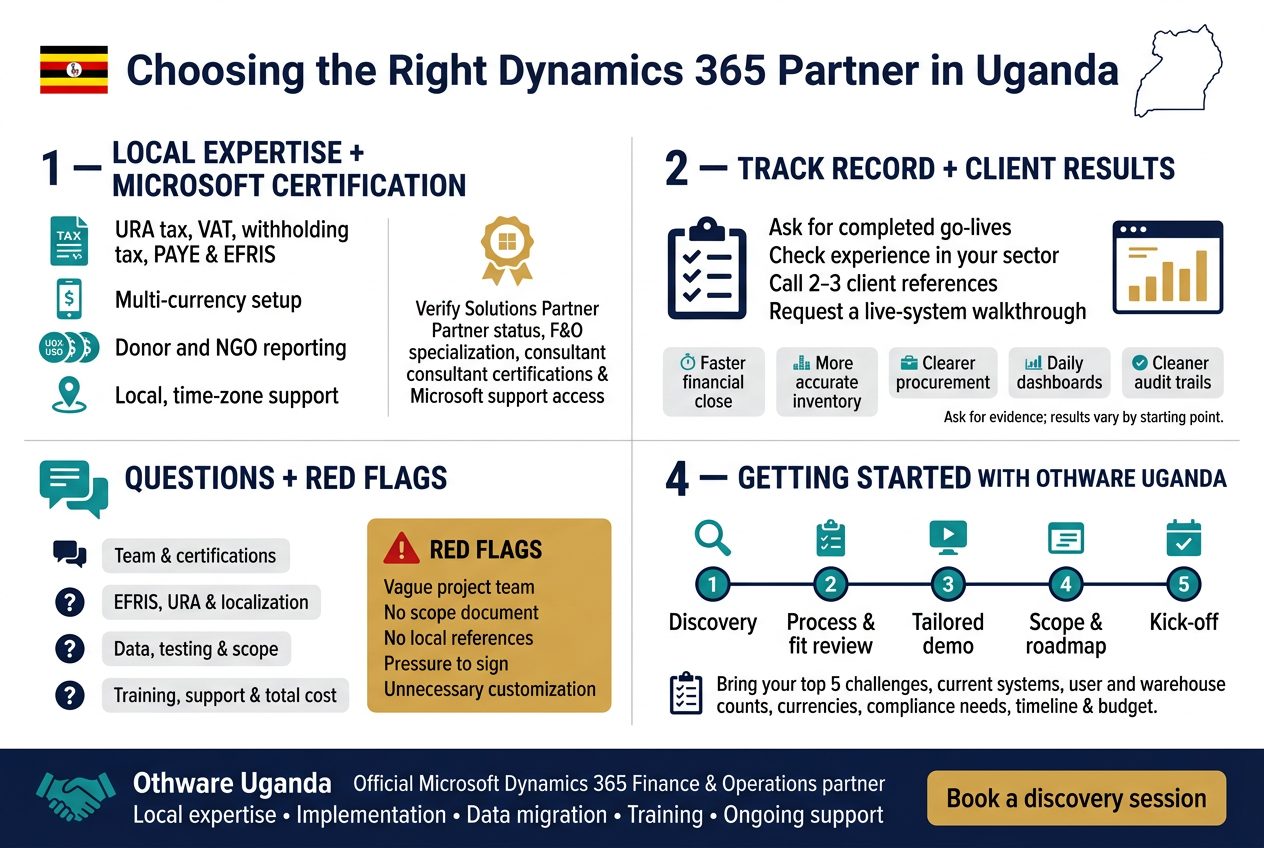
- Tax and compliance: VAT, withholding tax, PAYE, and EFRIS integration need to be configured correctly from day one. Fixing them after go-live is expensive.
- Multi-currency reality: Many Ugandan businesses deal in UGX, USD, and KES in the same week. Your partner should know how to set up exchange rate types and revaluation properly.
- Donor and NGO reporting: If you work with development funding, you need grant tracking, fund accounting, and donor-specific reports.
- Support in your time zone: When month-end close is at stake, you want someone you can call in Kampala, not a ticket queue on the other side of the world.
Why Microsoft certification matters
Certification is more than a badge on a website. It shows the partner has passed Microsoft’s assessments, employs qualified consultants, and has access to Microsoft’s technical resources and escalation paths.
| What to verify | Why it matters |
|---|---|
| Microsoft Solutions Partner status | Confirms proven capability and customer success in Microsoft’s eyes |
| Finance and Operations specialization or certified consultants | Dynamics 365 F&O is a different beast from Business Central, so you need people who work with it daily |
| Consultant certifications (for example, Finance, Supply Chain Management, Functional Consultant) | Tells you who will actually be on your project |
| Access to Microsoft support channels | Faster resolution when a product issue pops up |
Othware Uganda is positioned as an official Microsoft Dynamics 365 F&O partner, which means you work with a team that knows the platform and the local business environment. That combination is hard to find, and it’s the reason many Ugandan companies prefer a local Dynamics 365 partner over a remote vendor.
Track Record and Client Success
Anyone can say they’re good at ERP. What you want is proof, and ideally proof from companies that look like yours.
What a real track record looks like
- Completed go-lives: Ask how many Dynamics 365 Finance and Supply Chain Management implementations the partner has finished, not just started.
- Similar clients: A distributor, a manufacturer, an NGO, and a bank all use the system differently. Look for experience in your sector.
- Long-term relationships: Clients who stay with a partner for years after go-live are a strong signal. It means the support is good and the system keeps delivering.
- Measurable outcomes: Good case studies include numbers, such as a shorter month-end close, lower inventory carrying costs, fewer stockouts, or faster invoice cycles.
Results you should expect to hear about
| Area | Typical result from a well-run implementation |
|---|---|
| Financial close | Days cut from the month-end process through automation and real-time ledgers |
| Inventory | Better stock accuracy and fewer write-offs through warehouse and demand planning tools |
| Procurement | Tighter approval workflows and clearer spend visibility |
| Reporting | Management dashboards available daily instead of waiting for spreadsheets |
| Compliance | Cleaner audit trails and fewer tax filing errors |
Actual numbers depend on your starting point, so treat these as the kind of improvements to ask about, not guarantees.
How to check claims
- Ask for two or three references and actually call them.
- Ask what went wrong during the project and how the partner handled it. Every project has bumps. How they were handled tells you plenty.
- Request a walkthrough of a live environment, not just slides.
- Find out whether the consultants on the references’ projects are the same ones who would work on yours.
Questions to Ask Before You Commit
A good conversation with a prospective partner should feel like a two-way interview. These questions will help you separate the real experts from the sales pitch.
About experience and team
- How many Dynamics 365 Finance and Operations projects have you delivered in Uganda and East Africa?
- Who will be on my project team, and what are their certifications?
- Will the people who do the demo be the same people who implement?
- How do you handle staff turnover during a project?
About local compliance
- How do you handle EFRIS integration and URA reporting requirements?
- Can you configure multi-currency, withholding tax, and VAT scenarios specific to Uganda?
- What do you do about localization gaps in the standard product?
About methodology
- What implementation approach do you follow, and how do you use Microsoft’s best-practice tools?
- How do you handle data migration, and who is responsible for cleaning up legacy data?
- What does your testing process look like, including user acceptance testing?
- How do you manage change requests and scope creep?
About training and adoption
- Do you train key users and end users, and in what format?
- What does the handover to my internal team look like?
- How do you encourage people to actually use the system?
About cost and commitment
- What is included in the quote, and what isn’t? Ask specifically about licenses, customizations, integrations, training, and travel.
- How are changes priced?
- What does post-go-live support cost, and what are the response times?
- What happens if we’re not happy with a deliverable?
About the long term
- How will you help us keep up with Microsoft’s continuous updates?
- Can you support us as we add new modules, entities, or locations?
- Do you offer managed services or a support retainer?
Red flags to watch for
- Vague answers about who will do the work
- A fixed price with no scope document
- No local references
- Heavy pressure to sign quickly
- Heavy customization suggested before exploring standard features
- Little interest in understanding your processes before quoting
Getting Started with Othware Uganda
If you’re weighing up ERP software in Uganda, the first step doesn’t have to be a big commitment. It starts with a conversation about how your business runs today and where it’s getting stuck.
What the first steps usually look like
- Discovery conversation: You share your pain points, such as slow closes, stock mismatches, disconnected systems, or compliance headaches. The Othware Uganda team listens and asks questions about your processes, team size, and goals.
- Process and fit review: Together you look at which Dynamics 365 Finance and Supply Chain Management capabilities match your needs, and which can wait for a later phase.
- Tailored demo: Instead of a generic walkthrough, you see the system handle scenarios that look like your real day-to-day work.
- Scope and roadmap: You get a clear plan covering modules, timeline, team roles, and budget, with a phased approach if that suits you better.
- Kick-off: Once you’re comfortable, the project starts with a structured plan, clear owners on both sides, and agreed success measures.
What to bring to the first meeting
- A list of your top five operational or financial headaches
- Your current systems (accounting software, spreadsheets, inventory tools)
- Rough numbers: users, legal entities, warehouses, currencies, monthly transaction volume
- Any compliance or audit requirements you’re worried about
- A sense of your timeline and budget range
Why talk to Othware Uganda
- Official Microsoft Dynamics 365 F&O partner with consultants who know the platform inside out
- Local understanding of Ugandan tax, banking, and business realities
- End-to-end services covering consulting, implementation, data migration, training, and ongoing support
- A practical approach that focuses on getting your team comfortable with the system and delivering results you can measure
Ready to see what Dynamics 365 Finance and Supply Chain Management could do for your business? Reach out to Othware Uganda to book a discovery session and get a clear, honest view of what an implementation would look like for you.
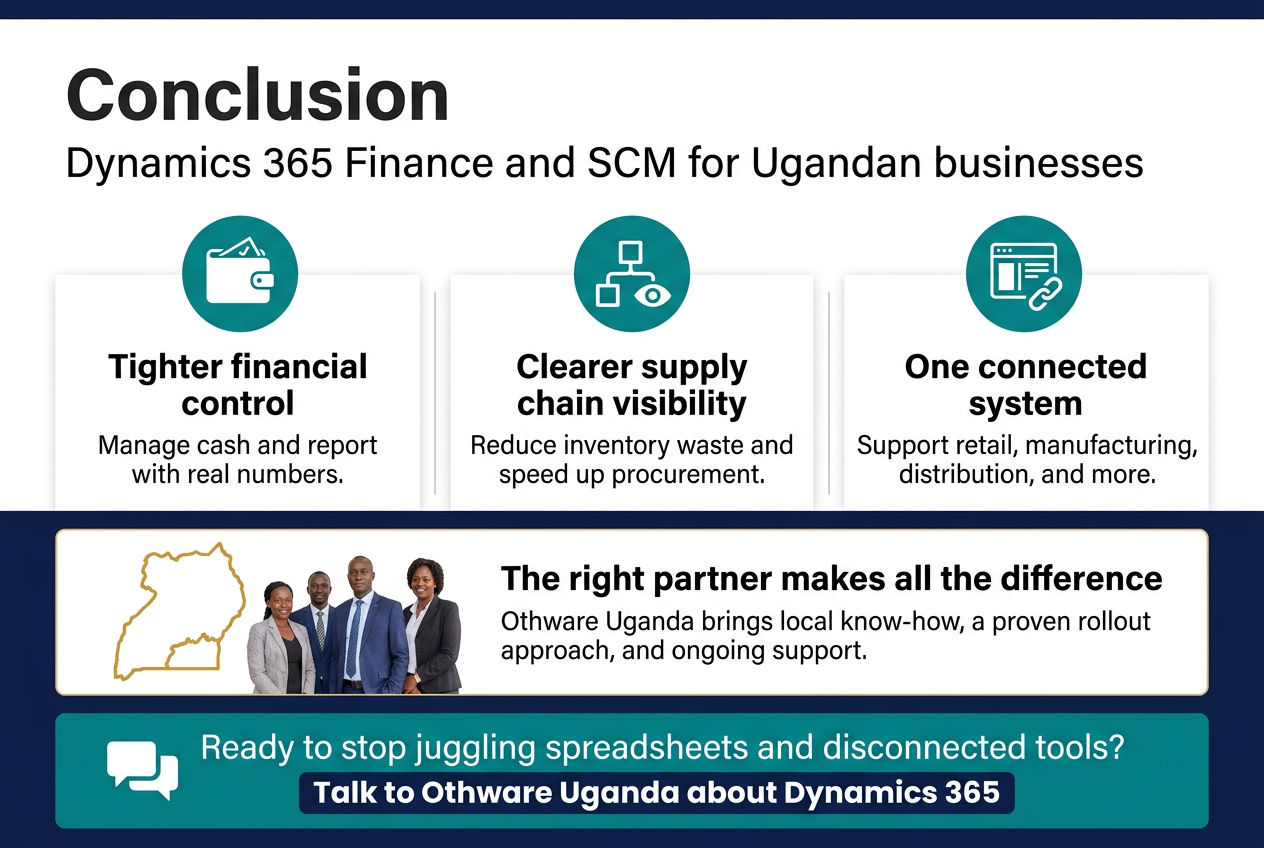
Dynamics 365 Finance and SCM gives Ugandan businesses what they’ve been missing: tighter financial control, clearer supply chain visibility, and one system that connects it all. From managing cash and reporting to cutting inventory waste and speeding up procurement, it helps you run leaner and make decisions with real numbers instead of guesswork. It works well across retail, manufacturing, distribution, and more, especially when it’s set up the right way from day one.
That’s where the right partner makes all the difference. Othware Uganda brings local know-how, a proven rollout approach, and ongoing support that keeps your system paying off long after go-live. If you’re ready to stop juggling spreadsheets and disconnected tools, reach out to Othware Uganda for a quick chat about what Dynamics 365 could do for your business.

Tech Evangelist and Business Developer.
I love connecting with nature