Leveraging Annual Subscription Discounts Versus Monthly Payments
When you’re looking at Microsoft 365 Business pricing Uganda, the payment frequency you choose can dramatically impact your bottom line. The difference between annual and monthly subscriptions isn’t just about convenience – it’s about significant cost savings that can transform your IT budget.
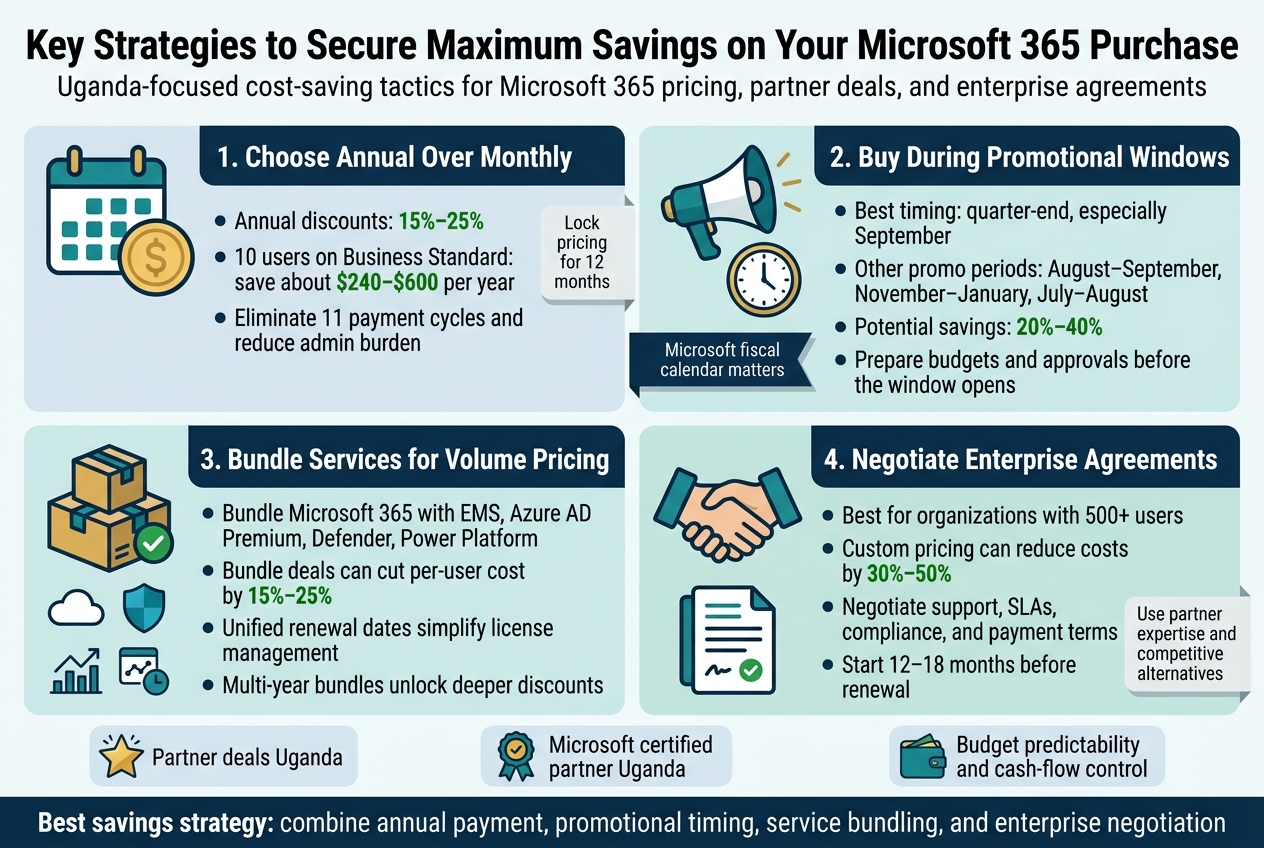
Annual subscriptions typically offer discounts ranging from 15% to 25% compared to monthly payments. For a small business with 10 employees using Microsoft 365 Business Standard, this translates to savings of approximately $240 to $600 per year. While this might seem modest, these savings compound quickly as your organization grows.
The math becomes even more compelling when you consider the administrative overhead. Monthly payments require more frequent processing, account management, and budget reconciliation. Annual payments eliminate 11 payment cycles, reducing administrative burden and the risk of service interruption due to payment processing issues.
Microsoft 365 partner deals Uganda often include additional annual payment incentives. Partners frequently receive better commission structures on annual deals, which they can pass along to customers as enhanced discounts or value-added services. Smart businesses negotiate these partner benefits into their annual agreements.
Cash flow considerations play a significant role in this decision. While annual payments require a larger upfront investment, the cost predictability helps with budget planning. You lock in current pricing for 12 months, protecting against mid-year price increases that Microsoft occasionally implements.
For businesses with seasonal revenue patterns, annual subscriptions offer budget stability. Rather than managing monthly Microsoft 365 subscription costs during lean months, you can plan for a single annual expense that aligns with your fiscal planning cycles.
The discount structure varies by plan type. Business Basic plans often see smaller percentage savings on annual commitments compared to Business Premium or Enterprise plans. This scaling discount structure reflects Microsoft’s focus on encouraging long-term commitments from larger organizations with more complex needs.
Consider the hidden costs of monthly billing. Credit card processing fees, bank charges, and the staff time required for monthly payment reconciliation can add 2-5% to your actual Microsoft 365 costs. Annual payments eliminate most of these ancillary expenses.
Some organizations worry about committing to annual plans due to potential business changes. However, Microsoft allows license adjustments during annual subscription periods. You can add users immediately and pay prorated amounts, while license reductions typically take effect at renewal. This flexibility reduces the risk of over-committing.
Microsoft certified partners in Uganda like Othware often structure their service agreements to align with annual Microsoft subscriptions. This alignment can result in bundled discounts on support services, training, and implementation assistance that wouldn’t be available with monthly subscriptions.
The timing of annual payments also affects your negotiating position. Partners are often more willing to offer additional discounts or services when they receive full annual payments upfront, as this improves their own cash flow and reduces administrative overhead.
For businesses considering migration from competing platforms, annual Microsoft 365 commitments can unlock migration assistance and training credits that aren’t available with monthly subscriptions. These additional benefits can significantly reduce the total cost of platform transition.
Timing Your Purchase During Microsoft Promotional Periods
Microsoft’s fiscal calendar drives promotional periods that smart buyers can leverage for substantial savings on Microsoft 365 pricing 2026. Understanding these cycles gives you strategic advantages that can reduce your licensing costs by 20-40% in some cases.
The most significant promotional periods align with Microsoft’s fiscal quarters, which end in September, December, March, and June. Partners receive enhanced incentives during the final month of each quarter, with September being the most aggressive period as it marks Microsoft’s fiscal year-end.
End-of-fiscal-year promotions in August and September often include partner incentives that can be structured as customer discounts. During this period, Microsoft provides additional margin to partners, enabling them to offer deeper discounts while maintaining profitability. These promotions typically focus on multi-year commitments and Enterprise Agreement renewals.
New product launch periods create unique opportunities for early adopters. When Microsoft introduces new features or plan types, they often provide promotional pricing to accelerate adoption. Businesses that can time their purchases or upgrades around these launches can access introductory pricing that may not be available later.
Holiday promotional periods, particularly November through January, target businesses making fiscal year-end purchases or planning for the following year. Microsoft partner discounts Uganda during these periods often include bonus licenses, extended trial periods, or bundled services at reduced costs.
The back-to-school period in July and August presents opportunities for businesses in education-adjacent industries. While primarily targeting educational institutions, some promotions extend to businesses that provide services to schools or universities, creating savings opportunities for qualifying organizations.
Microsoft’s MCAPS conferences serve as a launching pad for partner-focused promotions that run through the following quarter. Partners receive enhanced training, marketing support, and commission structures that they can leverage to provide better customer deals.
Economic downturns or competitive pressures trigger special promotional periods outside the standard calendar. During these periods, Microsoft may introduce temporary discount programs or enhanced partner incentives to maintain market share and customer loyalty.
Regional promotional calendars sometimes differ from global patterns. In Uganda, local economic conditions, currency fluctuations, or competitive dynamics might trigger country-specific promotions that provide better value than global offers.
Quarter-end urgency creates negotiating leverage for buyers. Partners under pressure to meet quarterly targets are often more flexible on pricing, services, and contract terms. Savvy buyers can use this timing to secure better overall deals.
Product end-of-life announcements create transition promotional periods. When Microsoft discontinues products or significantly changes licensing models, they often provide promotional migration pricing to encourage smooth transitions to newer platforms.
Competitive response promotions occur when Microsoft faces significant pressure from Google Workspace, Zoom, or other productivity platforms. These promotions can provide exceptional value but require quick decision-making as they’re often time-limited.
Business software licensing Uganda markets sometimes receive special consideration during global economic uncertainty. Microsoft may extend promotional periods or provide additional flexibility in emerging markets to maintain growth trajectories.
The key to leveraging promotional timing lies in preparation. Having your requirements documented, budgets approved, and decision-makers aligned allows you to move quickly when promotional windows open. Missing a promotional deadline by days can cost thousands in additional licensing fees.
Understanding the difference between partner-driven and Microsoft-driven promotions helps optimize your approach. Partner promotions offer more flexibility and customization, while Microsoft promotions typically provide broader benefits but less room for negotiation.
Building relationships with multiple Microsoft certified partner Uganda providers gives you visibility into different promotional opportunities. Partners often have access to different program tiers and promotional benefits based on their competency levels and sales performance.
Bundling Multiple Services for Volume Pricing Advantages
Volume pricing through service bundling represents one of the most effective strategies for reducing overall Microsoft 365 enterprise pricing. When you combine multiple Microsoft services into a single agreement, you unlock pricing tiers and discounts that aren’t available through individual service purchases.
The foundation of effective bundling starts with understanding Microsoft’s licensing model hierarchy. Enterprise Mobility + Security (EMS), Azure Active Directory Premium, Microsoft Defender, and Power Platform licenses can be combined with core Microsoft 365 plans to create comprehensive bundles that reduce per-user costs significantly.
Office 365 business plans Uganda pricing becomes more competitive when bundled with complementary services. For example, combining Business Premium with Power BI Pro and Microsoft Defender for Business can reduce the total cost per user by 15-25% compared to purchasing these services separately.
Service bundling also simplifies license management and compliance. Instead of tracking multiple subscription types with different renewal dates and payment cycles, bundled agreements consolidate everything under unified terms. This administrative simplification reduces the risk of service lapses and compliance issues.
Microsoft’s E3 and E5 enterprise bundles exemplify the power of integrated licensing. These plans include services that would cost significantly more if purchased individually, including advanced security features, compliance tools, and business intelligence capabilities that many organizations need anyway.
Azure services bundling creates particular value for organizations with hybrid infrastructure needs. Combining Microsoft 365 with Azure Active Directory Premium, Azure Information Protection, and Cloud App Security provides comprehensive security and compliance coverage at bundled rates.
The negotiating power increases substantially with larger bundles. Partners can often secure better pricing from Microsoft when presenting comprehensive service packages rather than individual product sales. This improved margin allows partners to offer better customer pricing while maintaining profitability.
Cross-platform bundling opportunities extend beyond traditional productivity suites. Organizations using Microsoft Teams can bundle with Azure Communication Services, Power Platform licensing, and Microsoft Viva for employee experience enhancement at package rates that beat individual service pricing.
Microsoft 365 partner deals Uganda often include unique bundling opportunities not available through direct Microsoft channels. Partners may bundle their own services – such as implementation, training, and ongoing support – with Microsoft licenses to create comprehensive packages that provide better overall value.
Volume licensing tiers kick in at different user counts depending on the services bundled. While core Microsoft 365 plans might require 250+ users for significant volume discounts, bundles that include Enterprise Mobility + Security or Azure services often trigger volume pricing at 100+ users.
The timing of bundle assembly affects available pricing. Building bundles during renewal periods allows you to restructure existing licenses and add new services at negotiated rates. Mid-contract bundling typically involves prorated pricing that may not optimize costs as effectively.
Service interdependencies create natural bundling opportunities. Organizations using SharePoint Online extensively benefit from bundling with Power Automate for workflow automation and Power BI for analytics. These integrated solutions provide more value than the sum of their parts while reducing overall licensing costs.
Educational and non-profit organizations can leverage specialized bundling programs that aren’t available to commercial entities. These programs often provide significant discounts on bundled services that support organizational missions and educational outcomes.
Multi-year bundling commitments unlock the deepest discounts. Microsoft provides substantial incentives for 3-year bundle commitments, particularly when they include newer services like Microsoft Viva, Power Platform, or advanced security features.
Geographic bundling considerations apply in emerging markets like Uganda. Microsoft may provide additional bundling incentives to accelerate cloud adoption and compete with local or regional productivity solutions.
The complexity of bundle management requires careful planning. While bundles reduce costs, they can create challenges if you need to remove services or adjust user counts for specific service types. Understanding these limitations before committing prevents future complications.
Competitive bundling strategies involve comparing Microsoft bundles against equivalent Google Workspace or other platform combinations. Sometimes splitting services between platforms provides better value than comprehensive single-vendor bundles, particularly for organizations with specific workflow requirements.
As the top Microsoft partner in Uganda, Othware excel at bundle optimization. They understand which combinations provide maximum value and can model different scenarios to identify the most cost-effective service mix for your specific needs and usage patterns.
Custom bundle negotiations become possible with larger deployments. Enterprise customers can work with partners to create custom service combinations that align perfectly with their operational requirements while maximizing volume discounts.
Negotiating Custom Enterprise Agreements for Larger Organizations
Enterprise Agreement (EA) negotiations represent the pinnacle of Microsoft licensing optimization for organizations with 500+ users. These custom agreements provide pricing, terms, and service combinations that simply aren’t available through standard licensing channels.
The EA negotiation process typically begins 12-18 months before your current agreement expires. This extended timeline allows for comprehensive requirement analysis, competitive benchmarking, and strategic planning that forms the foundation for successful negotiations.
Microsoft 365 enterprise pricing in EA structures differs fundamentally from standard pricing models. Instead of fixed per-user costs, EAs often include volume pools, usage commitments, and flexible allocation mechanisms that can reduce effective per-user costs by 30-50% for qualifying organizations.
Negotiation leverage in EA discussions comes from multiple sources. Organizations with significant growth projections, multi-year commitments, or strategic importance to Microsoft’s regional objectives often receive enhanced consideration during EA negotiations.
The scope of EA negotiations extends far beyond basic licensing costs. Terms covering support levels, service level agreements, data residency, compliance requirements, and termination rights can be customized to meet specific organizational needs.
Microsoft certified partner Uganda organizations with Gold or Solutions Partner competencies often participate directly in EA negotiations. Their involvement can provide additional leverage and ensure that local market conditions and requirements receive appropriate consideration.
Competitive alternatives strengthen EA negotiating positions. Organizations that can credibly demonstrate equivalent capabilities from Google Workspace, Amazon WorkSpaces, or other platforms often receive more favorable Microsoft terms and pricing.
Usage commitment structures in EAs provide cost predictability while offering flexibility for growth. Rather than paying for exact user counts, organizations can commit to minimum usage levels and receive credits or banking mechanisms for excess purchases.
Multi-product EAs create the greatest value opportunities. Including Azure services, Dynamics 365, Power Platform, and security services in enterprise agreements unlocks volume discounts and integrated pricing that individual service agreements cannot match.
Geographic considerations in EA negotiations account for local market conditions, currency fluctuations, and regional competitive dynamics. Organizations in emerging markets like Uganda may receive special consideration to support Microsoft’s growth objectives in these regions.
The legal framework of EAs provides protection and flexibility that standard agreements don’t offer. Custom termination rights, service level guarantees, and dispute resolution mechanisms can be negotiated to address specific organizational risk concerns.
Technical requirements integration allows EAs to include specific performance guarantees, integration commitments, and feature development priorities. Large organizations can sometimes influence Microsoft’s product development roadmap through EA negotiations.
Financial structuring options in EAs include various payment terms, currency protections, and budget allocation mechanisms. Multi-year payments, quarterly true-ups, and departmental allocation systems can be customized to match organizational financial management practices.
Change management provisions in EAs address the reality of organizational evolution. Mechanisms for adding or removing services, adjusting user counts, and modifying usage patterns ensure that agreements remain relevant as business needs change.
Training and support commitments often form significant components of EA negotiations. Microsoft may provide enhanced training credits, dedicated support resources, or priority technical assistance as part of comprehensive enterprise agreements.
Microsoft 365 pricing 2026 protection can be negotiated into multi-year EAs. Organizations can lock in current pricing or negotiate specific escalation limits to provide budget predictability despite potential future price increases.
Local partner involvement in EA negotiations ensures that implementation, support, and ongoing management receive appropriate attention. Partners can often provide local services and expertise that complement Microsoft’s global EA support structure.
Due diligence processes for EA negotiations require comprehensive analysis of current usage, future projections, and competitive alternatives. Organizations should engage legal, financial, and technical experts to ensure all aspects of proposed agreements receive appropriate review.
Benchmark analysis during EA negotiations involves comparing proposed terms against industry standards and competitive alternatives. Third-party licensing experts can provide valuable perspective on market rates and negotiation strategies.
Implementation planning for new EAs requires coordination across IT, finance, legal, and business units. The complexity of enterprise agreements demands careful project management to ensure successful deployment and ongoing compliance.
Compliance monitoring systems for EAs must track usage against commitments, service level performance, and financial obligations. Many organizations implement dedicated license management tools to ensure EA compliance and optimization.
Renewal strategies for EAs begin early in the agreement lifecycle. Tracking performance, identifying optimization opportunities, and preparing for future negotiations ensures continued value from enterprise licensing relationships.
The relationship management aspect of EAs extends beyond the initial negotiation. Regular business reviews, performance assessments, and strategic planning sessions help maximize value throughout the agreement lifecycle and prepare for future negotiations.
Risk mitigation in EA negotiations addresses potential business changes, technology evolution, and market disruptions. Flexibility mechanisms and exit provisions protect organizations against unforeseen circumstances that could affect agreement value.
Success measurement for EAs requires establishing clear metrics and regular assessment processes. Cost per user, service adoption rates, productivity improvements, and total cost of ownership calculations help validate EA value and inform future negotiation strategies.

Tech Evangelist and Business Developer.
I love connecting with nature