
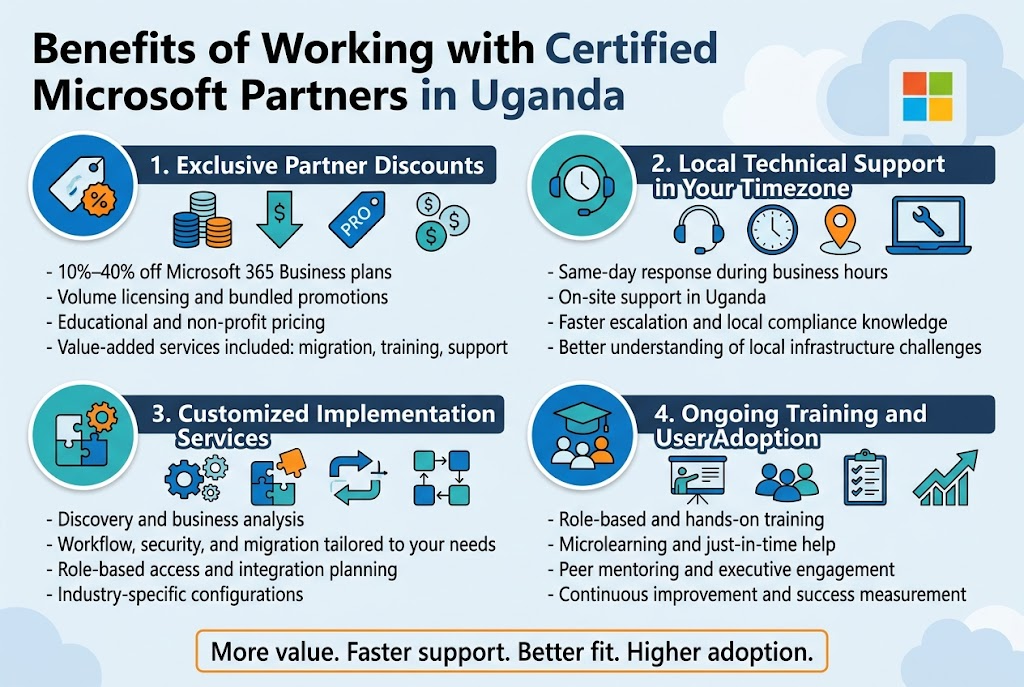
Access to Exclusive Partner Discounts and Promotions
When you work with certified Microsoft partners in Uganda, you gain access to pricing advantages that simply aren’t available through direct Microsoft purchases. These partners have earned special status through rigorous certification processes, extensive training programs, and proven track records of successful implementations. The financial benefits they can offer often make the difference between a budget-stretching investment and a smart business decision that delivers real value.
Microsoft partners in Uganda like Othware typically offer discounts ranging from 10% to 40% off standard retail pricing for Microsoft 365 Business plans. The exact discount depends on several factors including your organization size, the length of your commitment, and the specific partner tier. Gold and Silver certified partners often have access to deeper discount structures compared to basic registered partners. These savings aren’t just marketing gimmicks – they represent real cost reductions that can save Ugandan businesses thousands of dollars annually.
The discount structure works through Microsoft’s partner incentive programs, which reward certified partners for driving adoption and maintaining customer satisfaction. Partners earn rebates and margin enhancements based on their sales volumes, customer retention rates, and technical competencies. Smart partners pass much of these savings directly to customers, creating win-win scenarios where businesses get better pricing while partners build long-term relationships.
Beyond standard discounts, certified partners in Uganda often have access to special promotional campaigns that Microsoft runs throughout the year. These might include limited-time offers during specific quarters, promotional pricing for new customer acquisitions, or bundled deals that combine multiple Microsoft services at reduced rates. Partners typically receive advance notice of these promotions, allowing them to time purchases strategically for maximum savings.
Volume licensing agreements represent another significant advantage when working with Microsoft certified partners in Uganda. Even smaller businesses can benefit from volume pricing when partners aggregate multiple customer purchases. This approach allows a 50-person company to access pricing tiers typically reserved for much larger organizations. Partners can structure these agreements to provide immediate savings while maintaining flexibility for future growth.
Educational discounts and non-profit pricing present additional opportunities for eligible organizations. Certified partners understand the complex qualification requirements for these special pricing tiers and can guide organizations through the application process. Schools, universities, and qualified non-profits in Uganda can often access Microsoft 365 Business plans at significantly reduced rates, sometimes up to 50% below standard commercial pricing.
Microsoft partner deals in Uganda also frequently include value-added services that would cost extra when purchasing directly. These might encompass free migration services, complimentary training sessions, or included technical support hours. When you calculate the total cost of ownership, these bundled services often represent hundreds or thousands of dollars in additional value beyond the base discount.
Payment flexibility represents another financial advantage of working with certified partners. While Microsoft typically requires annual commitments for the best pricing, partners can often structure payment plans that better match your cash flow needs. Some partners offer quarterly payment options, gradual implementation schedules, or seasonal payment adjustments that work better for businesses with cyclical revenue patterns.
Currency considerations add another layer of value for Ugandan businesses. Certified partners often handle currency conversion and can sometimes offer pricing protection against exchange rate fluctuations. This stability helps with budget planning and removes the uncertainty that comes with direct international purchases where exchange rates can impact your final costs.
Partner-exclusive licensing options sometimes include hybrid arrangements that aren’t available through standard Microsoft channels. For example, partners might offer creative licensing structures that combine cloud subscriptions with on-premises components, or they might provide access to special development environments at reduced costs. These flexible arrangements can result in significant savings for businesses with specific technical requirements.
The competitive landscape among Microsoft certified partners in Uganda creates additional opportunities for savings. Partners compete not just on base pricing but on the total value proposition they offer. This competition drives innovation in pricing structures, service bundling, and customer support offerings. Businesses benefit by evaluating multiple partner proposals and leveraging this competition to secure the best possible terms.
Renewal pricing represents a long-term financial advantage that’s often overlooked. Certified partners typically offer loyalty pricing for existing customers that can be significantly better than standard renewal rates. These relationships become more valuable over time, as partners invest in understanding your business and can recommend cost-optimization strategies during renewal periods.
Local Technical Support in Your Timezone
The value of local technical support cannot be overstated when implementing and maintaining Microsoft 365 Business solutions in Uganda. Time zone alignment alone transforms the support experience from a potential source of frustration into a competitive advantage. When technical issues arise – and they inevitably do – having support professionals available during your business hours means problems get resolved quickly instead of lingering for days while you wait for responses from distant support centers.
Certified Microsoft partners in Uganda provide support that understands the local business context. They’re familiar with the specific challenges that Ugandan businesses face, from infrastructure limitations to local compliance requirements. This contextual knowledge allows them to provide more relevant and effective solutions compared to generic international support centers that may not understand the unique operating environment in Uganda.
Language and communication represent significant advantages of local support. While English proficiency is generally high in Uganda’s business community, technical discussions often benefit from nuanced understanding of local communication styles and business practices. Local support teams can explain complex technical concepts in ways that resonate with local business culture, reducing misunderstandings and accelerating problem resolution.
The infrastructure reality in Uganda means that support teams need to understand local connectivity challenges, power reliability issues, and bandwidth limitations. International support centers might suggest solutions that work perfectly in ideal conditions but fail in real-world Ugandan environments. Local partners understand these constraints and can provide practical solutions that work within existing infrastructure limitations.
Response times improve dramatically with local support. While international support might promise 24-hour response times, local partners often provide same-day or even immediate response during business hours. This responsiveness becomes critical when dealing with productivity-impacting issues that could cost your business money for every hour they remain unresolved.
On-site support capabilities represent a massive advantage that international support simply cannot provide. When complex implementation challenges arise or when hands-on troubleshooting becomes necessary, local certified partners can dispatch technical personnel to your location. This on-site capability proves invaluable during initial deployments, major upgrades, or when training users who might struggle with remote support sessions.
Local partners understand regulatory and compliance requirements specific to Uganda’s business environment. They can guide you through data residency considerations, local privacy regulations, and industry-specific compliance requirements that international support teams might not fully understand. This knowledge helps ensure your Microsoft 365 implementation remains compliant with local laws and regulations.
Escalation procedures work more efficiently with local partners. When first-line support can’t resolve an issue, local partners have established relationships with Microsoft’s regional technical teams. These relationships often result in faster escalations and more focused attention from Microsoft’s engineering teams. Local partners also understand which escalation paths work best for different types of issues.
Training and knowledge transfer become more effective when delivered by local teams. Technical training sessions conducted by local partners can incorporate real-world examples from similar Ugandan businesses, making the content more relevant and actionable. Local trainers also understand the typical skill levels and technical backgrounds of Ugandan business users, allowing them to tailor training programs accordingly.
Ongoing relationship management represents a long-term advantage of local support. Local partners invest in understanding your business, your growth plans, and your evolving technical needs. This relationship depth allows them to provide proactive support and recommendations that prevent problems before they occur. International support centers rarely develop this level of business understanding with individual customers.
Integration support for local business applications becomes much more effective with local partners. Many Ugandan businesses use specialized local software for accounting, inventory management, or industry-specific functions. Local partners understand these applications and can provide better guidance on integrating them with Microsoft 365 services. This integration expertise proves valuable during initial setup and ongoing optimization.
Business continuity planning benefits significantly from local support teams who understand Uganda’s specific risk factors. Local partners can help design disaster recovery plans that account for local infrastructure challenges, seasonal connectivity issues, or regional power grid limitations. This practical approach to business continuity planning creates more robust and reliable systems.
Performance optimization gets better results with local support teams who understand typical network conditions and infrastructure limitations in Uganda. They can provide specific recommendations for improving Microsoft 365 performance within the constraints of local internet service providers and connectivity options. This localized performance tuning often delivers dramatic improvements in user experience.
Security guidance becomes more relevant when provided by local partners who understand the specific threat landscape facing Ugandan businesses. Local partners stay informed about regional security trends, local cybercrime patterns, and industry-specific threats. This knowledge allows them to provide more targeted and effective security recommendations for your Microsoft 365 implementation.
Customized Implementation Services for Your Business Needs
Every Ugandan business operates with unique requirements, workflows, and challenges that demand customized approaches to Microsoft 365 implementation. Certified Microsoft partners excel at creating tailored solutions that align with your specific business objectives rather than forcing your organization to adapt to generic configurations. This customization capability transforms Microsoft 365 from a standard software package into a strategic business tool that enhances productivity and drives growth.
The discovery phase represents the foundation of effective customization. Experienced Microsoft partners in Uganda begin implementations with comprehensive business analysis that goes beyond simple user counts and feature requirements. They examine your current workflows, identify productivity bottlenecks, understand your industry-specific needs, and analyze your growth projections. This thorough understanding enables them to design implementations that solve real business problems rather than simply deploying software.
Industry-specific customization becomes particularly valuable for businesses operating in Uganda’s diverse economic sectors. A certified partner working with a agricultural cooperative will configure Microsoft 365 differently than one serving a financial services firm or a manufacturing company. Partners understand the unique compliance requirements, workflow patterns, and collaboration needs of different industries and can tailor implementations accordingly.
Workflow integration represents a critical aspect of customization that generic implementations often overlook. Certified partners analyze your existing business processes and configure Microsoft 365 tools to support and enhance these workflows rather than disrupting them. This might involve creating custom SharePoint sites that mirror your document approval processes, configuring Teams channels that reflect your organizational structure, or setting up Power Automate workflows that automate routine tasks specific to your business.
Security customization addresses the specific risk profile and regulatory requirements of your business. Partners don’t just apply generic security settings – they analyze your data sensitivity, compliance obligations, and threat exposure to create security configurations that provide appropriate protection without unnecessarily restricting productivity. This balanced approach ensures security measures enhance rather than hinder business operations.
Migration strategies receive extensive customization based on your current technology environment and business continuity requirements. A partner might recommend a gradual migration approach for organizations with complex legacy systems, or they might suggest accelerated deployment for businesses that need immediate productivity gains. These strategies account for your specific technical constraints, user readiness levels, and business calendars to minimize disruption during the transition.
User role customization ensures that each employee receives access to exactly the tools and information they need to perform their job effectively. Rather than applying broad user categories, certified partners create detailed role-based configurations that reflect your organizational hierarchy, departmental needs, and individual responsibilities. This granular approach improves security while enhancing user productivity.
Integration planning addresses the specific third-party applications and services your business relies upon. Certified partners evaluate your existing software ecosystem and design integration strategies that maintain functionality while leveraging Microsoft 365 capabilities. This might involve configuring connectors for local accounting software, setting up data synchronization with industry-specific applications, or creating custom integrations that bridge gaps between systems.
Governance frameworks receive customization based on your organizational culture and management preferences. Some Ugandan businesses prefer centralized control with strict policies, while others operate more effectively with distributed management and flexible guidelines. Certified partners design governance structures that align with your management style while ensuring security and compliance requirements are met.
Training customization addresses the specific skill levels and learning preferences of your workforce. Partners assess your team’s current technical capabilities and design training programs that build upon existing knowledge rather than starting from scratch. They might create role-specific training modules, develop hands-on workshops that use real business scenarios, or establish mentorship programs that pair technically advanced users with those who need additional support.
Pilot program design allows for risk-managed customization that proves concepts before full deployment. Experienced partners structure pilot programs that test specific configurations with representative user groups, validate integration approaches with critical business systems, and refine workflows based on real-world feedback. These pilots provide opportunities to customize implementations based on actual usage patterns rather than theoretical requirements.
Data architecture customization ensures that information flows efficiently through your Microsoft 365 environment. Partners analyze your data relationships, reporting requirements, and collaboration patterns to design information architectures that support decision-making and enhance productivity. This might involve configuring SharePoint document libraries that reflect your filing systems, setting up Power BI dashboards that display relevant business metrics, or creating Teams structures that facilitate project collaboration.
Compliance configuration addresses the specific regulatory requirements that affect your business operations. Partners understand local data protection laws, industry regulations, and international compliance standards that might apply to your organization. They configure Microsoft 365 features to support these requirements, creating audit trails, data retention policies, and access controls that demonstrate compliance.
Performance optimization receives customization based on your specific usage patterns and technical infrastructure. Partners monitor how your organization actually uses Microsoft 365 services and adjust configurations to optimize performance for your most critical workflows. This ongoing optimization ensures that your implementation continues to deliver value as your usage patterns evolve and your business grows.
Change management approaches get customized based on your organizational culture and change tolerance. Some businesses adapt quickly to new technologies, while others require more structured change management processes. Partners design implementation timelines and support strategies that match your organization’s change management preferences, ensuring successful adoption while minimizing disruption.
Reporting and analytics customization provides business intelligence that reflects your specific key performance indicators and management reporting needs. Rather than relying on generic Microsoft 365 usage reports, partners configure dashboards and reports that track metrics relevant to your business objectives. This customized reporting provides insights that support strategic decision-making and demonstrate return on investment.
Ongoing Training and User Adoption Assistance
Successful Microsoft 365 implementations depend far more on user adoption than on technical configuration, making ongoing training and adoption assistance critical factors that distinguish excellent certified partners from average ones. The most sophisticated technical implementation becomes worthless if users don’t understand how to leverage the tools effectively or if they resist changing established work patterns. Certified Microsoft partners in Uganda excel at creating comprehensive adoption programs that transform initial user resistance into enthusiastic engagement with new productivity tools.
Adult learning principles guide effective Microsoft 365 training programs that certified partners design for Ugandan businesses. These principles recognize that business professionals learn differently than students in academic settings. They need practical, immediately applicable knowledge that solves real problems in their daily work. Certified partners structure training around actual business scenarios, using your company’s data and workflows to demonstrate functionality rather than relying on generic examples that users struggle to relate to their real responsibilities.
Progressive skill building represents a cornerstone of effective user adoption strategies. Rather than overwhelming users with comprehensive feature overviews, experienced partners design learning paths that build competency gradually. Users might start with basic email and calendar functions, progress to file sharing and collaboration features, and eventually master advanced capabilities like workflow automation and business intelligence tools. This progressive approach prevents information overload while building confidence and competence systematically.
Role-based training customization ensures that each employee receives instruction relevant to their specific job functions and responsibilities. A certified partner working with a Ugandan business might create different training tracks for executives, project managers, administrative staff, and technical personnel. Each track focuses on the Microsoft 365 features most relevant to that role, providing practical value while avoiding confusion about irrelevant functionality.
Hands-on practice sessions prove far more effective than theoretical presentations for building user competency. Certified partners design training programs that allow users to work with actual business documents, practice collaboration scenarios, and experiment with features in safe environments. These practice sessions build muscle memory and confidence that enables users to apply their learning immediately in real work situations.
Peer mentoring programs leverage existing organizational relationships to accelerate user adoption. Certified partners often identify technically inclined employees who can serve as local champions and provide ongoing support to their colleagues. These peer mentors receive advanced training and become resources for day-to-day questions and encouragement. This approach scales support effectively while building internal expertise that reduces long-term dependence on external assistance.
Just-in-time learning resources address the reality that users often need specific help at the moment they encounter challenges. Rather than expecting employees to remember everything from initial training sessions, certified partners create quick-reference guides, video tutorials, and searchable knowledge bases that provide immediate answers to common questions. These resources prove invaluable for maintaining momentum during the critical early adoption period.
Microlearning approaches recognize that busy professionals learn most effectively in short, focused sessions rather than lengthy training programs. Certified partners might deliver training through brief weekly sessions that cover specific features or use cases. This approach fits better with business schedules while allowing users to absorb and practice each concept before moving to the next topic.
Practical application workshops connect training directly to business outcomes by focusing on specific projects or processes. A certified partner might conduct workshops that show users how to collaborate on budget planning using Excel Online and Teams, or demonstrate how to automate routine approval processes using Power Automate. These application-focused sessions make the value of Microsoft 365 immediately apparent and relevant.
Assessment and feedback mechanisms help certified partners understand which training approaches work best for your specific workforce. They might use brief surveys, observation sessions, or usage analytics to identify areas where additional support might be needed. This feedback allows them to adjust training programs and adoption strategies based on actual results rather than assumptions about user needs.
Executive engagement strategies recognize that leadership support significantly impacts user adoption success. Certified partners help business leaders understand how to model effective Microsoft 365 usage and communicate the importance of adoption to their teams. They might provide executive briefings that demonstrate productivity gains, or help leaders understand how to use Microsoft 365 tools in ways that encourage broader organizational adoption.
Cultural adaptation ensures that training programs align with local business practices and communication styles. Certified partners in Uganda understand how business relationships, hierarchy, and communication patterns affect technology adoption. They design training approaches that work within existing cultural frameworks rather than requiring dramatic changes to established work relationships.
Resistance management strategies help address the inevitable concerns and objections that arise when introducing new technologies. Experienced partners anticipate common sources of resistance and develop specific responses that address underlying concerns. They might demonstrate how Microsoft 365 tools actually reduce workload rather than adding complexity, or show how new collaboration features enhance existing relationships rather than replacing them.
Success measurement frameworks help organizations track adoption progress and identify areas where additional support might be needed. Certified partners establish metrics that go beyond simple usage statistics to measure actual productivity improvements and user satisfaction. These measurements help justify training investments while identifying opportunities for additional optimization.
Advanced skill development programs ensure that user competency continues to grow long after initial implementation. As users become comfortable with basic functionality, certified partners provide opportunities to learn more sophisticated features that can deliver additional productivity gains. These advanced programs might cover topics like business intelligence, workflow automation, or advanced collaboration techniques.
Continuous improvement processes ensure that training and adoption assistance evolve based on changing business needs and user feedback. Certified partners establish regular review cycles that evaluate training effectiveness and identify opportunities for enhancement. This continuous improvement approach ensures that adoption support remains relevant and valuable as your organization’s Microsoft 365 usage matures.
Change reinforcement techniques help ensure that new work patterns become permanent rather than temporary changes that fade over time. Certified partners might establish recognition programs that celebrate effective Microsoft 365 usage, create internal sharing sessions where users demonstrate innovative applications, or integrate Microsoft 365 proficiency into performance evaluation processes.
Troubleshooting skill development helps users become more self-sufficient in resolving common issues and questions. Rather than creating dependence on external support, effective training programs teach users how to find answers to routine questions and resolve simple problems independently. This skill development reduces support costs while building user confidence and competency.
Business process optimization training shows users how to leverage Microsoft 365 capabilities to improve existing workflows and create new efficiencies. Certified partners help identify opportunities where Microsoft 365 tools can streamline processes, reduce manual work, or improve collaboration effectiveness. This optimization focus ensures that technology adoption delivers measurable business value rather than simply replacing existing tools with new ones.
Long-term relationship development ensures that training and adoption assistance continue to deliver value as business needs evolve and Microsoft 365 capabilities expand. The best certified partners view training as an ongoing relationship rather than a one-time service, providing continued support as new features become available and as organizational needs change. This long-term perspective creates partnerships that deliver sustained value and continuous improvement in productivity and collaboration effectiveness.

Tech Evangelist and Business Developer.
I love connecting with nature