
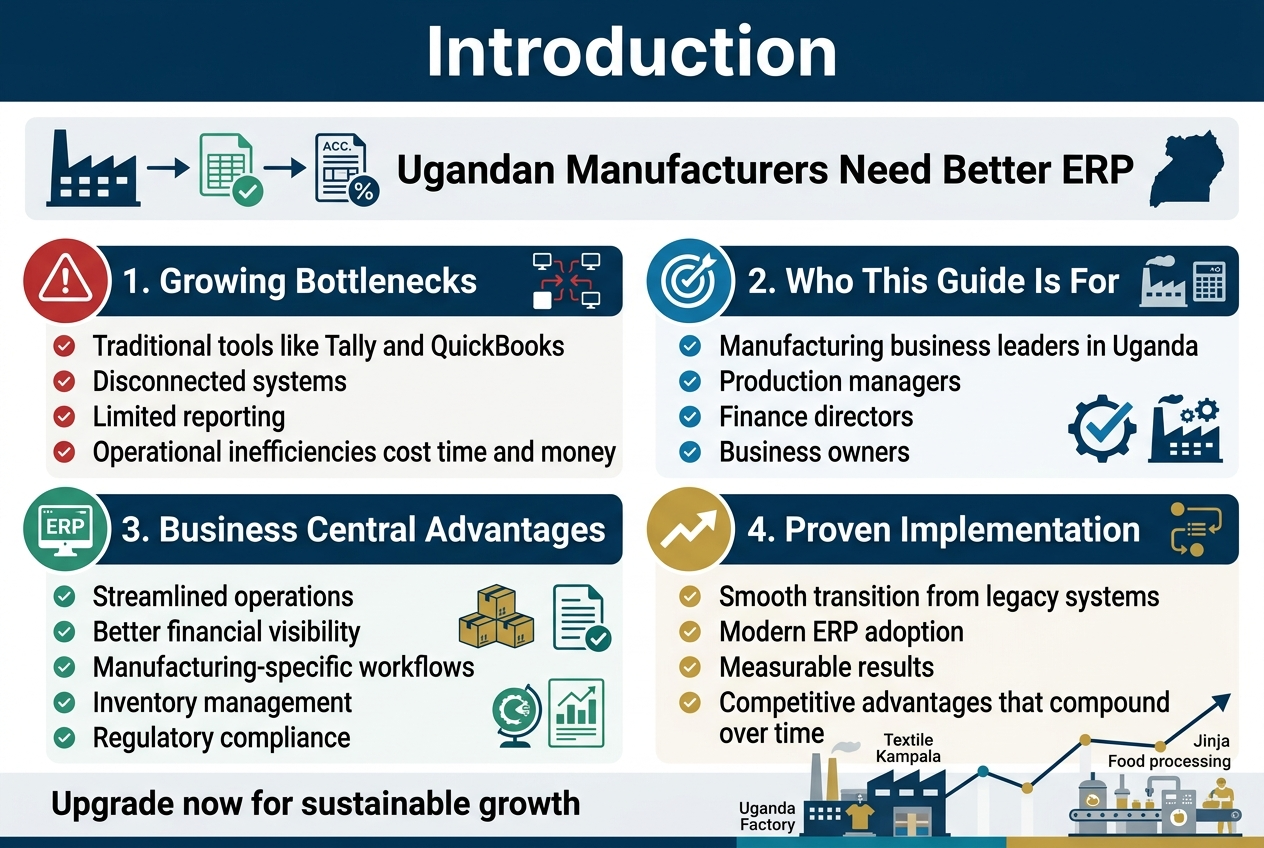
Ugandan manufacturers using Tally or QuickBooks face growing operational bottlenecks as their businesses expand. These traditional accounting tools weren’t built for complex manufacturing workflows, leaving production managers, finance directors, and business owners struggling with disconnected systems and limited reporting capabilities.
This guide is for manufacturing business leaders in Uganda who need robust ERP solutions to streamline operations, improve financial visibility, and support sustainable growth. Whether you run a textile factory in Kampala or manage food processing operations in Jinja, you’ll discover why Business Central for manufacturing delivers superior results compared to basic accounting software.
We’ll explore why traditional accounting solutions limit manufacturing growth and how outdated systems create operational inefficiencies that cost money and time. You’ll also learn about Business Central’s manufacturing-specific advantages that address Uganda’s unique business environment, from inventory management to regulatory compliance.
Finally, we’ll cover proven implementation strategies that help Ugandan manufacturers transition smoothly from legacy systems to modern ERP solutions. As Othware Official Microsoft Partner for Uganda and a leading Dynamics ERP Company in Uganda, we’ve helped dozens of local manufacturers modernize their operations with measurable results.
The manufacturing landscape in Uganda is evolving rapidly. Companies that upgrade their systems now gain competitive advantages that compound over time.
Current Manufacturing Landscape in Uganda
Growth Potential in Uganda’s Manufacturing Sector
Uganda stands at a critical juncture in its economic development, with the manufacturing sector emerging as a cornerstone of the nation’s industrial transformation. The country’s manufacturing industry contributes approximately 20% to the national GDP, showcasing remarkable resilience and growth potential that attracts both local entrepreneurs and international investors.
The sector has witnessed substantial expansion across diverse industries, from textile and garment production to food processing, pharmaceuticals, and automotive assembly. Major industrial hubs in Kampala, Jinja, and Mbale are becoming increasingly sophisticated, with manufacturers scaling operations to serve not only domestic markets but also the broader East African Community. This regional integration presents unprecedented opportunities for Ugandan manufacturers to expand their reach across borders.
Government initiatives through the Uganda Investment Authority have created favorable conditions for manufacturing growth, including tax incentives, infrastructure development, and streamlined business registration processes. The National Development Plan III specifically targets manufacturing as a key driver for economic transformation, aiming to increase the sector’s contribution to GDP while creating sustainable employment opportunities.
Raw material availability gives Ugandan manufacturers a competitive edge, particularly in agro-processing where the country’s agricultural abundance provides steady supply chains. Cotton production supports textile manufacturing, while abundant fish resources drive aquaculture processing facilities. These natural advantages position local manufacturers to compete effectively in regional markets.
Young entrepreneurial energy drives innovation across manufacturing subsectors, with emerging businesses leveraging technology to optimize production processes. Many manufacturers are transitioning from traditional family-owned operations to professionally managed enterprises, creating demand for sophisticated business management systems that can support this evolution.
Common Operational Challenges Facing Local Manufacturers
Ugandan manufacturers face a complex web of operational challenges that significantly impact their competitiveness and growth potential. Supply chain disruptions rank among the most pressing concerns, particularly for manufacturers dependent on imported raw materials or machinery components. Foreign exchange fluctuations create additional uncertainty, making cost planning and pricing strategies increasingly difficult to manage.
Quality control represents another critical challenge, especially for manufacturers targeting export markets with stringent quality standards. Many local facilities lack sophisticated quality management systems, relying instead on manual inspection processes that are prone to human error and inconsistency. This limitation often results in product rejections, returned shipments, and damaged reputation in international markets.
Inventory management poses significant operational headaches for manufacturers using basic tracking systems. Stockouts of critical raw materials can halt production lines, while excess inventory ties up working capital and increases storage costs. Without real-time visibility into inventory levels, manufacturers struggle to optimize procurement timing and quantities, leading to inefficient cash flow management.
Production scheduling challenges compound these operational difficulties. Many manufacturers operate with paper-based or spreadsheet-driven planning systems that cannot accommodate complex production sequences, machine capacity constraints, or rush orders. This results in missed delivery deadlines, overtime costs, and customer dissatisfaction.
Workforce management adds another layer of complexity, particularly for manufacturers with multiple shifts or seasonal production patterns. Tracking employee productivity, managing overtime costs, and ensuring compliance with labor regulations becomes increasingly challenging as operations scale up.
Equipment maintenance represents a hidden cost center that many manufacturers underestimate. Without proper maintenance scheduling and parts inventory management, unexpected machine breakdowns can devastate production schedules and inflate maintenance costs. The lack of predictive maintenance capabilities forces manufacturers into reactive mode, where emergency repairs cost significantly more than planned maintenance.
Communication breakdowns between departments create inefficiencies that ripple throughout the organization. Sales teams may commit to delivery dates without consulting production capacity, while purchasing departments may order materials without coordinating with production schedules. These coordination failures result in customer service issues and increased operational costs.
Technology Gaps Hindering Competitive Advantage
The digital divide presents substantial barriers for Ugandan manufacturers seeking to compete in increasingly sophisticated global markets. Most manufacturing operations still rely on disconnected systems that create information silos, preventing real-time decision-making and responsive management.
Enterprise Resource Planning (ERP) adoption remains limited among local manufacturers, with many still operating on standalone applications that don’t communicate with each other. Production planning happens in isolation from inventory management, while financial reporting occurs separately from operational metrics. This fragmented approach makes it nearly impossible to achieve the integrated visibility that modern manufacturing demands.
Data analytics capabilities represent a significant gap that prevents manufacturers from optimizing operations. Without sophisticated reporting tools, manufacturers cannot identify bottlenecks, track key performance indicators, or make data-driven decisions about process improvements. Many rely on intuition and experience rather than concrete metrics to guide strategic decisions.
Automation opportunities remain largely untapped due to both capital constraints and technological knowledge gaps. While competitors in more developed markets leverage automated production lines, quality control systems, and material handling equipment, Ugandan manufacturers often operate with manual processes that limit scalability and consistency.
Cloud technology adoption lags behind global standards, with many manufacturers concerned about internet reliability and data security. This reluctance to embrace cloud solutions limits access to modern software applications and restricts remote management capabilities that could improve operational flexibility.
Mobile technology integration represents another missed opportunity. In a country where mobile phone penetration exceeds 80%, manufacturers could leverage mobile applications for real-time data collection, employee communication, and customer engagement. However, most manufacturing systems remain desktop-bound and location-dependent.
Cybersecurity awareness and implementation fall short of international standards, leaving manufacturers vulnerable to data breaches and system compromises. As operations become more digitized, these security gaps create risks that could undermine customer trust and regulatory compliance.
Training and skill development in modern manufacturing technologies remain insufficient. Many employees lack exposure to advanced manufacturing software, limiting the organization’s ability to leverage technology investments effectively. This skills gap perpetuates reliance on outdated processes and systems.
Financial Management Struggles with Basic Accounting Software
Traditional accounting software like Tally and QuickBooks, while adequate for simple business operations, creates significant limitations for manufacturing enterprises with complex financial requirements. These systems typically handle basic bookkeeping functions but lack the sophisticated features necessary for comprehensive manufacturing financial management.
Cost accounting presents one of the most significant challenges when using basic accounting software for manufacturing operations. Traditional systems struggle to accurately track production costs, allocate overhead expenses, and calculate true product profitability. Without proper costing mechanisms, manufacturers cannot make informed pricing decisions or identify unprofitable product lines.
Work-in-progress (WIP) tracking becomes nearly impossible with basic accounting solutions. Manufacturing operations require detailed monitoring of materials, labor, and overhead costs as products move through various production stages. Simple accounting software cannot provide the granular visibility needed to track WIP accurately, leading to distorted financial statements and poor cash flow management.
Multi-currency operations create additional complications for manufacturers engaged in import-export activities. Basic accounting software often provides limited foreign exchange management capabilities, making it difficult to track exchange rate fluctuations, hedge currency risks, or maintain accurate financial records for international transactions.
Budgeting and forecasting limitations restrict strategic financial planning capabilities. Manufacturing businesses require sophisticated budgeting tools that can accommodate seasonal variations, capacity constraints, and market fluctuations. Traditional accounting software typically offers basic budgeting features that cannot handle the complexity of manufacturing financial planning.
Cash flow management becomes increasingly challenging as manufacturing operations scale up. Basic accounting systems may not provide real-time visibility into accounts receivable, accounts payable, and inventory values, making it difficult to predict cash requirements and optimize working capital management.
Regulatory compliance poses ongoing challenges, particularly for manufacturers operating in multiple jurisdictions or export markets. Simple accounting software may not accommodate various tax structures, reporting requirements, or audit trails necessary for regulatory compliance, creating risks and administrative burdens.
Integration limitations prevent seamless data flow between accounting and operational systems. When financial systems cannot communicate with production planning, inventory management, or customer relationship management applications, manufacturers face manual data entry requirements that increase errors and reduce efficiency.
Reporting capabilities in basic accounting software often fall short of manufacturing requirements. Manufacturers need detailed financial reports that incorporate operational metrics, production costs, and profitability analyses by product line, customer, or geographic region. Traditional accounting software typically provides standard financial statements that lack the operational insights necessary for manufacturing decision-making.
Scalability constraints become apparent as manufacturing operations grow. Basic accounting software may struggle to handle increased transaction volumes, additional users, or expanded functionality requirements. This limitation forces manufacturers to consider expensive system replacements or accept reduced efficiency as they scale operations.
Real-time financial visibility remains elusive with traditional accounting systems that rely on batch processing or manual updates. Manufacturing operations require immediate access to current financial position, particularly for cash management, credit decisions, and pricing negotiations. Basic software cannot provide the real-time insights that modern manufacturing demands.
Limitations of Traditional Accounting Solutions
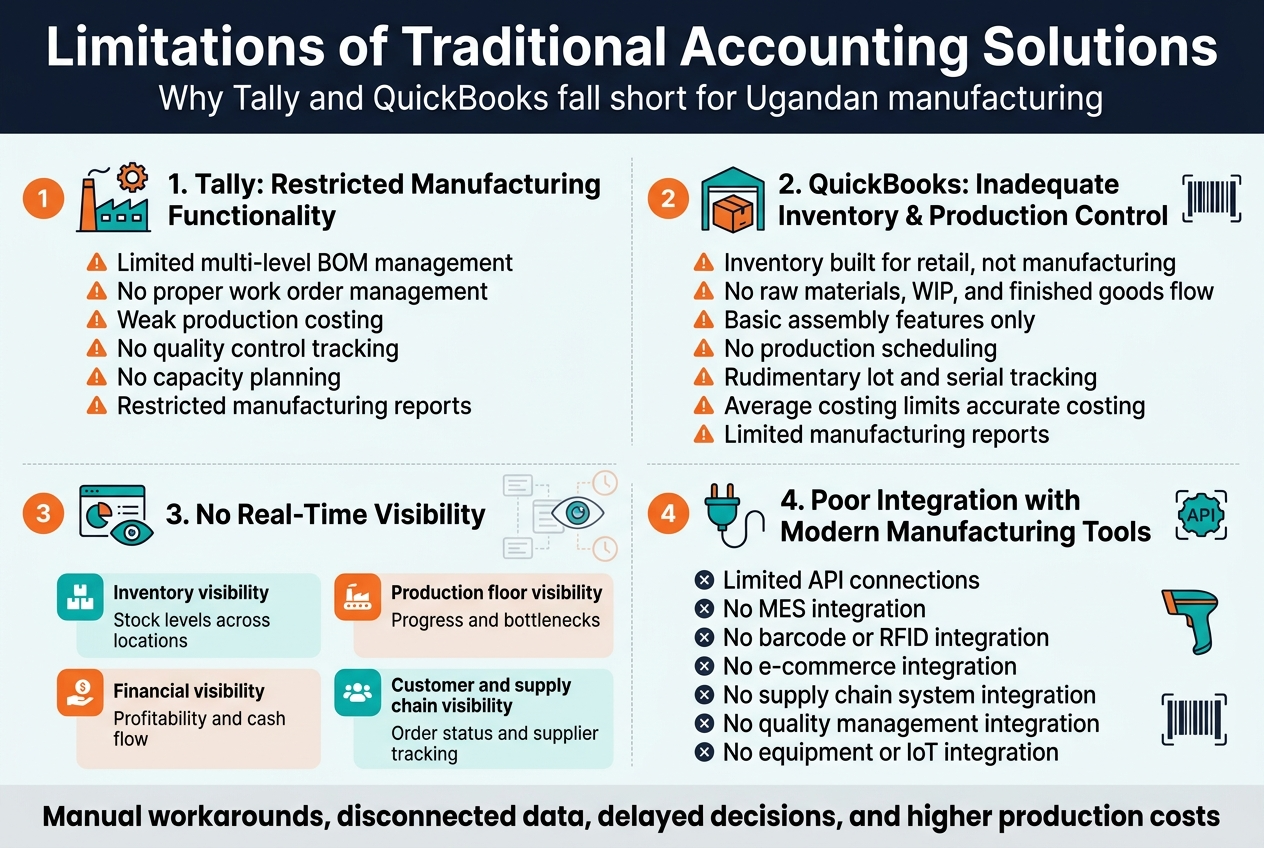
Tally’s Restricted Functionality for Complex Manufacturing Processes
Manufacturing businesses in Uganda face significant challenges when trying to manage complex production workflows with Tally. While Tally excels as a basic accounting software, it falls short when manufacturers need sophisticated production planning and control systems.
Tally’s bill of materials (BOM) management capabilities are extremely limited compared to what modern manufacturing ERP systems require. The software struggles to handle multi-level BOMs, making it difficult for manufacturers to track components, sub-assemblies, and finished goods accurately. This becomes particularly problematic for Ugandan manufacturers producing complex products like furniture, textiles, or food processing items where multiple components and production stages are involved.
The software lacks proper work order management functionality, forcing manufacturers to rely on manual processes or external spreadsheets to track production schedules. This creates disconnected data silos where production information doesn’t integrate seamlessly with financial records, leading to inventory discrepancies and cost calculation errors.
Production costing in Tally is another major limitation. The software cannot handle advanced costing methods like activity-based costing or job costing effectively. Ugandan manufacturers using Tally often find themselves unable to determine the true cost of production, which directly impacts pricing decisions and profitability analysis. Without accurate production costing, manufacturers struggle to identify bottlenecks, optimize resource allocation, and maintain competitive pricing in both local and export markets.
Quality control processes are virtually non-existent in Tally’s framework. Modern manufacturing operations require robust quality management systems to track inspections, manage non-conformances, and maintain quality certifications. Manufacturers relying on Tally must maintain separate quality management systems, creating additional complexity and potential for data inconsistencies.
The software also lacks proper capacity planning tools. Ugandan manufacturers cannot effectively plan production schedules based on available machine capacity, labor resources, or material availability. This limitation often results in overcommitment to customers, delayed deliveries, and increased production costs due to rush orders and inefficient resource utilization.
Tally’s reporting capabilities for manufacturing are severely restricted. Manufacturers cannot generate comprehensive production reports, efficiency metrics, or variance analyses that are essential for operational improvements. The lack of real-time production visibility means management decisions are based on outdated information, hampering the ability to respond quickly to market demands or production issues.
QuickBooks’ Inadequate Inventory and Production Management
QuickBooks, while popular among small businesses globally, presents significant limitations for manufacturing accounting software requirements in Uganda. The software’s inventory management system is designed primarily for retail and service businesses, not complex manufacturing operations that require sophisticated inventory tracking and production management capabilities.
The inventory tracking in QuickBooks is fundamentally flawed for manufacturing environments. The software treats inventory as simple buy-sell transactions rather than understanding the transformation processes involved in manufacturing. This creates major challenges for Ugandan manufacturers who need to track raw materials, work-in-progress inventory, and finished goods through various production stages.
QuickBooks lacks proper assembly management features. While it offers basic assembly items, the functionality is too simplistic for real manufacturing scenarios. Manufacturers cannot track component consumption during production, monitor assembly progress, or handle partial assemblies effectively. This limitation becomes critical when managing production batches, tracking yield rates, or dealing with production variations common in food processing, textile manufacturing, or other industries prevalent in Uganda.
Production scheduling is virtually impossible with QuickBooks. The software has no built-in production planning tools, making it extremely difficult for manufacturers to coordinate production activities with available resources. Ugandan manufacturers often resort to external scheduling tools or manual methods, creating disconnected systems that don’t communicate with their financial records.
Lot tracking and serial number management in QuickBooks are rudimentary at best. For manufacturers dealing with perishable goods, pharmaceuticals, or products requiring traceability for export compliance, these limitations create serious operational and regulatory challenges. The inability to track product genealogy or implement proper recall procedures can be devastating for manufacturers trying to meet international quality standards.
The software’s costing methodology is inadequate for manufacturing operations. QuickBooks uses average costing, which doesn’t provide accurate production cost information when material costs fluctuate or when different production runs have varying efficiency levels. This limitation prevents Ugandan manufacturers from implementing standard costing systems or conducting meaningful variance analysis to improve production efficiency.
Reporting capabilities in QuickBooks are severely limited for manufacturing businesses. The software cannot generate production reports, efficiency metrics, or manufacturing-specific financial analyses. Manufacturers struggle to obtain insights into production performance, material usage efficiency, or labor productivity – all critical metrics for competitive manufacturing operations.
Integration with manufacturing equipment and modern production tools is practically non-existent in QuickBooks. The software cannot connect with shop floor systems, barcode scanners, or automated data collection devices commonly used in modern manufacturing facilities. This limitation forces manufacturers to rely on manual data entry, increasing the risk of errors and reducing operational efficiency.
Lack of Real-time Visibility Across Business Operations
Traditional accounting solutions like Tally and QuickBooks create significant blind spots in manufacturing operations, preventing Ugandan manufacturers from achieving the real-time visibility essential for modern competitive manufacturing. These systems operate on batch processing models that delay critical information updates, leaving manufacturers making decisions based on outdated data.
Inventory visibility is one of the most critical gaps. With traditional systems, manufacturers cannot see real-time stock levels across multiple locations, production stages, or warehouses. This lack of visibility leads to stockouts, overstock situations, and poor customer service. Ugandan manufacturers often discover material shortages only when production has already started, causing delays and increased costs.
Production floor visibility is virtually non-existent with traditional accounting software. Managers cannot monitor production progress in real-time, track machine utilization, or identify bottlenecks as they occur. This limitation is particularly damaging in manufacturing environments where quick response to production issues can prevent significant losses or delays.
Financial visibility suffers dramatically with traditional systems. Manufacturers cannot access real-time profitability analysis, cash flow positions, or cost center performance. This delayed financial visibility prevents timely decision-making and can lead to cash flow problems or missed opportunities. For Ugandan manufacturers competing in both local and export markets, this lack of financial agility can be particularly damaging.
Customer order visibility presents another significant challenge. Traditional systems cannot provide real-time order status updates, delivery tracking, or customer service information. This limitation affects customer satisfaction and makes it difficult to manage customer expectations effectively. In Uganda’s competitive manufacturing landscape, poor customer service due to lack of visibility can result in lost business opportunities.
Supply chain visibility is severely compromised with traditional accounting solutions. Manufacturers cannot track supplier performance, monitor purchase order status, or anticipate supply disruptions in real-time. This limitation is particularly problematic for Ugandan manufacturers who may depend on imported raw materials or components where supply chain disruptions can significantly impact production schedules.
The lack of integrated dashboards and key performance indicators (KPIs) means management cannot monitor business performance effectively. Traditional systems require manual compilation of reports from various sources, often resulting in delayed or inaccurate performance metrics. This limitation prevents proactive management and reduces the ability to identify and address issues before they become significant problems.
Cross-departmental visibility is another major limitation. Traditional accounting systems create information silos where sales, production, finance, and operations work with different versions of data. This fragmentation leads to miscommunication, conflicting priorities, and inefficient resource allocation across the organization.
Poor Integration Capabilities with Modern Manufacturing Tools
The integration limitations of traditional accounting solutions represent one of the most significant barriers to modernizing manufacturing operations in Uganda. As manufacturers adopt modern technologies like automated production equipment, quality management systems, and supply chain management tools, the inability of Tally and QuickBooks to integrate with these systems creates operational inefficiencies and data accuracy problems.
Tally’s integration architecture is fundamentally limited, relying primarily on data import/export functions rather than real-time API connections. This approach creates data synchronization problems when manufacturers attempt to connect their accounting system with modern manufacturing execution systems (MES), customer relationship management (CRM) platforms, or e-commerce solutions. The manual data transfer processes required with Tally increase the risk of errors and create delays in information updates.
QuickBooks, while offering better integration options than Tally, still falls short of modern manufacturing requirements. The software’s integration capabilities are designed primarily for standard business applications rather than specialized manufacturing tools. Manufacturers attempting to connect QuickBooks with production planning software, quality management systems, or automated inventory tracking devices often encounter compatibility issues and data mapping problems.
The lack of proper API support in traditional accounting solutions prevents seamless data flow between systems. Modern manufacturing operations require real-time data synchronization between financial systems, production control systems, and supply chain management platforms. Without proper integration capabilities, manufacturers must rely on manual processes or expensive custom development to achieve even basic connectivity between systems.
Barcode scanning and RFID technology integration is particularly problematic with traditional accounting solutions. Modern Ugandan manufacturers implementing automated data collection systems for inventory tracking or production monitoring cannot effectively integrate this technology with their accounting systems. This limitation forces manufacturers to maintain parallel tracking systems, increasing complexity and reducing accuracy.
E-commerce platform integration presents another significant challenge. As more Ugandan manufacturers expand into online sales channels, the inability to integrate traditional accounting systems with e-commerce platforms creates order processing delays and inventory synchronization problems. Manufacturers often resort to manual order entry and inventory updates, increasing operational costs and error rates.
Supply chain management system integration is severely limited with traditional solutions. Manufacturers cannot effectively connect their accounting systems with supplier portals, logistics management platforms, or procurement systems. This limitation prevents automated purchase order processing, supplier performance tracking, and supply chain optimization initiatives.
Quality management system integration is virtually impossible with traditional accounting solutions. Manufacturers implementing ISO quality standards or other certification requirements cannot integrate their quality management processes with their financial systems. This separation creates compliance challenges and prevents comprehensive traceability throughout the production process.
Business intelligence and analytics tool integration is another major limitation. Traditional accounting systems cannot effectively feed data to modern analytics platforms, preventing manufacturers from implementing advanced analytics, machine learning, or predictive maintenance systems. This limitation significantly hampers data-driven decision making and operational optimization efforts.
The inability to integrate with modern mobile applications and cloud-based services limits operational flexibility. Ugandan manufacturers cannot implement mobile-first approaches to inventory management, production tracking, or customer service when their core accounting system lacks proper integration capabilities. This limitation becomes increasingly important as manufacturers seek to implement remote monitoring and management capabilities.
Manufacturing equipment integration represents perhaps the most critical limitation. Traditional accounting systems cannot connect with programmable logic controllers (PLCs), industrial IoT devices, or automated production equipment. This prevents manufacturers from implementing Industry 4.0 initiatives and achieving the operational efficiency gains possible with integrated manufacturing systems.
Business Central’s Manufacturing-Specific Advantages
Complete Production Planning and Scheduling Capabilities
Manufacturing operations in Uganda face unique challenges when it comes to production planning and scheduling. Traditional accounting solutions like Tally or QuickBooks simply weren’t designed to handle the complex requirements of modern manufacturing environments. Business Central for manufacturing transforms how Ugandan manufacturers approach production planning with sophisticated tools that go far beyond basic inventory tracking.
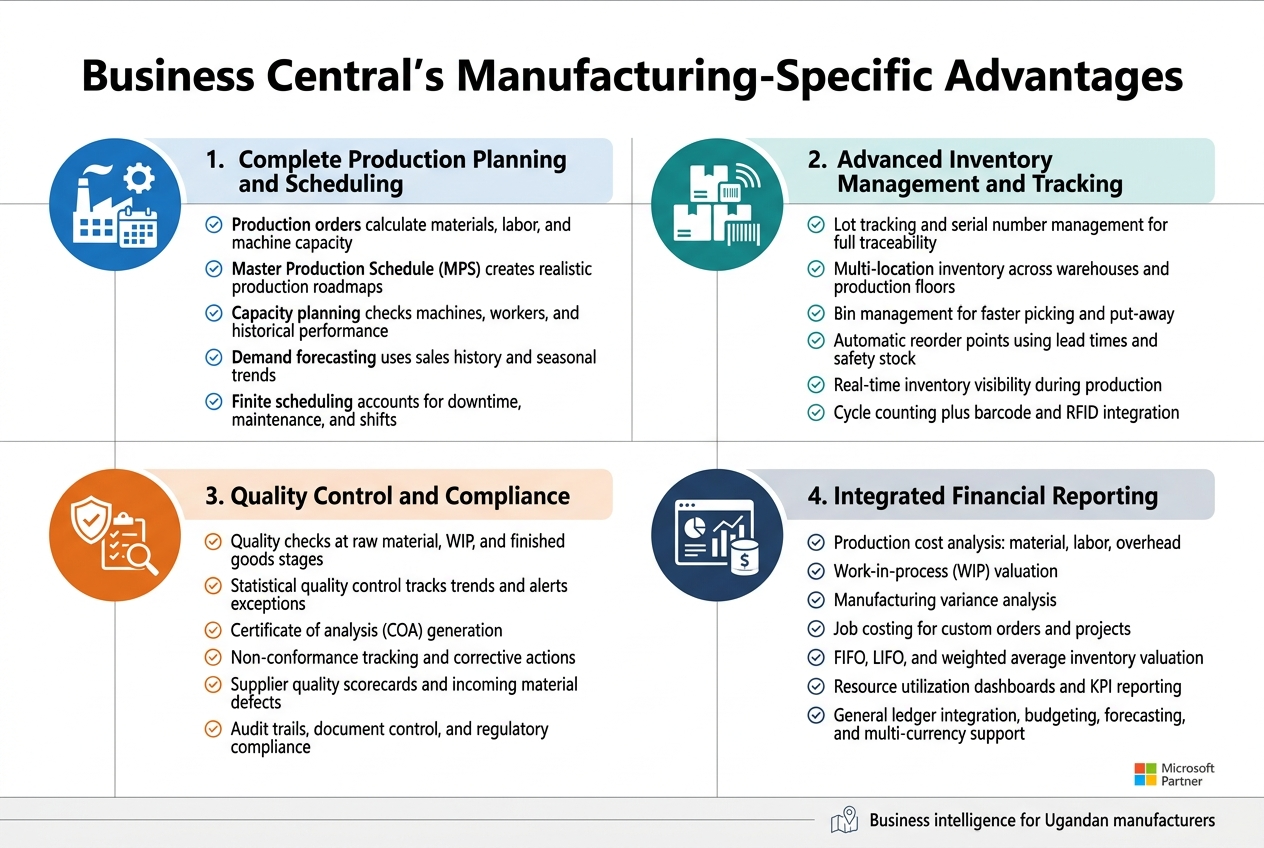
The production planning module in Business Central allows manufacturers to create comprehensive production orders that automatically calculate material requirements, labor needs, and machine capacity. This means you can plan your entire production cycle weeks or months ahead, ensuring raw materials arrive exactly when needed while avoiding costly stockouts or excess inventory sitting around your warehouse.
What sets Business Central apart is its Master Production Schedule (MPS) functionality, which creates a detailed roadmap for your manufacturing operations. The system considers your current inventory levels, pending customer orders, and available production capacity to generate realistic production schedules. This eliminates the guesswork that many Ugandan manufacturers face when using basic accounting software.
The capacity planning features help you understand exactly what your production lines can handle. Business Central analyzes your machine capabilities, worker availability, and historical performance data to create accurate capacity models. You’ll know immediately if a large order can be fulfilled on time or if you need to adjust timelines with your customers.
Demand forecasting capabilities use historical sales data and seasonal trends to predict future requirements. For manufacturers dealing with Uganda’s agricultural cycles or seasonal consumer patterns, this feature proves invaluable for planning production runs that align with market demand.
The system’s finite scheduling engine considers real-world constraints like machine downtime, maintenance windows, and worker shifts. Unlike simple scheduling tools, Business Central creates schedules that account for the realities of manufacturing operations, reducing the frustration of unrealistic production timelines.
Advanced Inventory Management and Tracking Systems
Inventory management represents one of the biggest pain points for Ugandan manufacturers using traditional accounting software. Business Central manufacturing transforms inventory control from a reactive process into a strategic advantage through advanced tracking and management capabilities.
The system implements sophisticated lot tracking and serial number management, giving you complete visibility into every component and finished product moving through your facility. This level of traceability becomes crucial when dealing with quality issues or regulatory compliance requirements that are increasingly important in Uganda’s manufacturing sector.
Multi-location inventory management allows you to track materials and products across multiple warehouses, production floors, and even supplier locations. Many growing Ugandan manufacturers operate from several sites, and Business Central provides a unified view of inventory levels across all locations, preventing the common problem of having stock in one location while experiencing shortages in another.
The bin management system optimizes warehouse operations by directing workers to specific storage locations for picking and putting away materials. This reduces time spent searching for components and minimizes errors in material handling. For manufacturers working with limited warehouse space, this optimization can significantly improve operational efficiency.
Automatic reorder point calculations consider lead times, safety stock requirements, and consumption patterns to trigger purchase orders before stockouts occur. The system learns from your actual usage patterns and adjusts reorder points dynamically, reducing the manual effort required to maintain optimal inventory levels.
Real-time inventory visibility means production planners always have accurate information about material availability. The system updates inventory levels instantly as materials are consumed in production, ensuring production schedules remain realistic and achievable.
The cycle counting functionality helps maintain inventory accuracy without shutting down operations for full physical counts. Business Central can schedule regular cycle counts for high-value or fast-moving items while allowing normal operations to continue.
Integration with barcode and RFID systems streamlines inventory transactions and reduces data entry errors. Workers can scan items during receiving, picking, and production processes, ensuring accurate real-time inventory information throughout your manufacturing operations.
Quality Control and Compliance Management Features
Quality control becomes increasingly important as Ugandan manufacturers compete in regional and international markets. Business Central manufacturing includes comprehensive quality management tools that help maintain consistent product quality while meeting regulatory requirements.
The quality order system allows you to define specific quality checks at various stages of the production process. You can create quality specifications for raw materials, work-in-process items, and finished goods, ensuring products meet your standards before moving to the next production stage or shipping to customers.
Statistical quality control features help identify trends and potential issues before they become major problems. The system can track quality metrics over time and alert quality managers when measurements fall outside acceptable ranges. This proactive approach prevents defective products from reaching customers and reduces waste in manufacturing operations.
Certificate of analysis (COA) generation provides professional documentation of quality testing results. For manufacturers exporting products from Uganda or working with customers requiring quality documentation, automated COA generation saves significant time and ensures consistent professional presentation.
Non-conformance management tracks quality issues and corrective actions throughout the manufacturing process. When quality problems occur, the system documents the issue, tracks investigation progress, and monitors corrective action implementation. This systematic approach helps prevent recurring quality problems.
Supplier quality management extends quality control beyond your facility to include vendor performance tracking. Business Central can monitor supplier quality metrics, track incoming material defects, and maintain supplier scorecards that help guide purchasing decisions.
Regulatory compliance tracking becomes increasingly important as Uganda implements stricter manufacturing standards. Business Central maintains audit trails for all quality-related activities, providing the documentation needed for regulatory inspections and compliance reporting.
The system’s document control features ensure quality procedures and work instructions remain current and accessible to production workers. Version control prevents outdated procedures from being used while providing complete change history for quality audits.
Integrated Financial Reporting for Manufacturing Operations
Manufacturing financial management requires sophisticated reporting capabilities that go beyond basic accounting functions. Business Central manufacturing provides integrated financial reporting specifically designed for manufacturing operations, giving Ugandan manufacturers insights that simply aren’t available with traditional accounting software.
Production cost analysis breaks down manufacturing costs into material, labor, and overhead components for each product and production order. This detailed cost visibility helps manufacturers understand true production costs and make informed pricing decisions. Many Ugandan manufacturers struggle with accurate costing using basic accounting systems, leading to pricing errors that impact profitability.
Work-in-process (WIP) valuation automatically calculates the value of partially completed products based on materials consumed and labor applied. This provides accurate financial reporting for manufacturing operations where products may spend weeks or months in production cycles.
Manufacturing variance analysis compares actual production costs to standard costs, highlighting areas where operations exceed or fall below expectations. The system can identify material price variances, labor efficiency variances, and overhead absorption variances, providing actionable insights for operational improvements.
Job costing capabilities track costs for custom manufacturing orders or specific customer projects. For Ugandan manufacturers handling made-to-order production, this functionality provides detailed profitability analysis for each job, helping identify the most profitable types of work.
Inventory valuation methods including FIFO, LIFO, and weighted average ensure accurate financial reporting that complies with local accounting standards. The system automatically calculates inventory values using your chosen method, eliminating manual calculations and reducing the risk of errors.
Resource utilization reporting shows how effectively you’re using production equipment, labor, and facilities. These reports help identify underutilized resources that could handle additional production or overloaded resources that might need additional capacity.
Manufacturing dashboards provide real-time visibility into key performance indicators including production output, quality metrics, and financial performance. Managers can quickly assess operational performance without waiting for end-of-month reports.
Integration with general ledger ensures manufacturing transactions automatically update financial records, eliminating duplicate data entry and ensuring consistency between operational and financial reporting. This integration provides manufacturing managers with immediate access to financial impacts of operational decisions while giving financial managers real-time visibility into manufacturing performance.
The system’s budgeting and forecasting capabilities help manufacturers plan future operations based on historical performance and market projections. You can create production budgets, material budgets, and labor budgets that align with overall business financial planning.
Multi-currency support becomes important for Ugandan manufacturers dealing with international suppliers or customers. Business Central handles currency conversions automatically and provides financial reporting in multiple currencies, simplifying international business operations.
These integrated reporting capabilities transform how Ugandan manufacturers understand their operations, moving beyond simple accounting to strategic business intelligence that drives operational improvements and business growth. The combination with expertise from Othware as an Official Microsoft Partner for Uganda ensures proper implementation and ongoing support for these sophisticated manufacturing features.
Enhanced Operational Efficiency Benefits
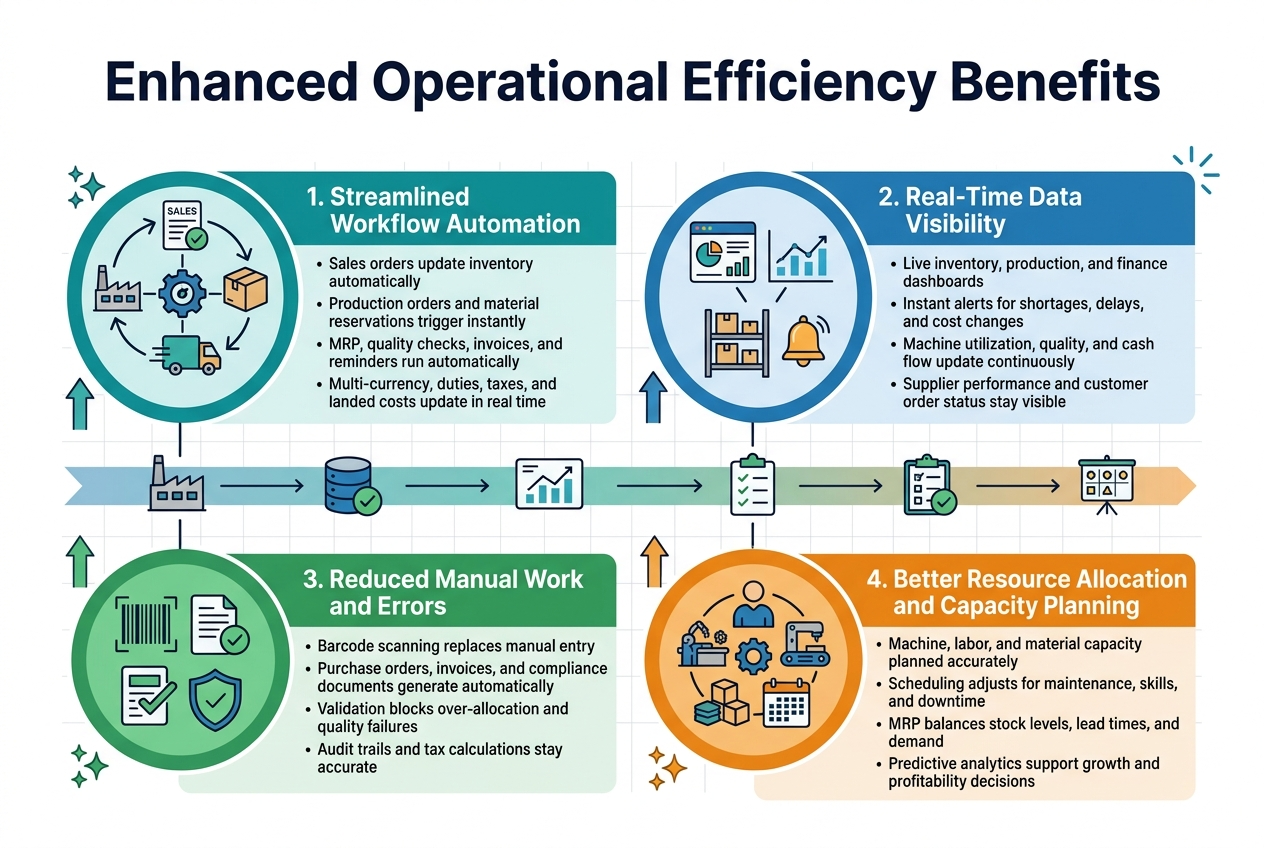
Streamlined workflow automation across departments
Ugandan manufacturing companies often struggle with disconnected departments where production, inventory, sales, and finance operate in silos. Business Central changes this completely by creating seamless workflows that connect every part of your operation. Unlike Tally or QuickBooks, which require manual data entry and constant switching between different systems, Business Central automates routine tasks and ensures information flows smoothly from one department to another.
When a sales order comes in, Business Central automatically checks inventory levels, creates production orders if needed, reserves materials, and updates delivery schedules. Your sales team doesn’t need to call the warehouse to check stock levels, and production planners receive immediate notifications about new orders. This automation eliminates the back-and-forth phone calls and emails that typically slow down operations in Ugandan manufacturing facilities.
The system’s workflow capabilities extend beyond basic order processing. Material requirements planning (MRP) runs automatically based on demand forecasts, generating purchase orders when stock levels hit predetermined thresholds. Quality control checkpoints trigger automatically at specific production stages, ensuring consistent product standards without manual oversight. Even routine administrative tasks like invoice generation, payment reminders, and compliance reporting happen without human intervention.
For Ugandan manufacturers working with international customers or suppliers, Business Central’s multi-currency automation proves invaluable. Exchange rate updates happen automatically, and the system calculates true landed costs including duties, taxes, and shipping charges. This level of automation would require multiple separate systems when using traditional accounting software, creating opportunities for errors and delays.
Manufacturing workflows become particularly powerful when dealing with complex products requiring multiple components or assembly stages. Business Central tracks each item through every production phase, automatically updating costs, allocating labor hours, and managing quality control documentation. The system knows which machines are available, which operators have the right skills, and which materials are ready for production.
Real-time data visibility for faster decision making
Quick decision-making separates successful Ugandan manufacturers from those struggling to compete. Business Central provides instant access to critical information across all business areas, enabling managers to spot problems early and capitalize on opportunities immediately. Traditional systems like Tally often require end-of-day batch processing, meaning yesterday’s data drives today’s decisions.
Real-time inventory visibility transforms how manufacturers manage their operations. Production managers see exact stock levels for every component, including items currently in transit or on order. When raw material shortages threaten production schedules, the system immediately alerts relevant personnel and suggests alternative suppliers or substitute materials. This immediate awareness prevents costly production delays that could affect customer delivery commitments.
Financial dashboards update continuously, showing actual costs against budgets, profit margins by product line, and cash flow projections. Ugandan manufacturers can track their performance against targets without waiting for monthly accounting reports. When material costs spike unexpectedly, managers receive instant notifications and can adjust pricing or sourcing strategies before profits erode.
Production monitoring becomes incredibly detailed with Business Central’s real-time capabilities. Managers track machine utilization rates, operator productivity, and quality metrics as they happen. When equipment efficiency drops or defect rates increase, supervisors receive immediate alerts and can investigate problems while they’re still manageable. This proactive approach prevents small issues from becoming expensive crises.
Customer service improves dramatically when representatives have instant access to order status, inventory availability, and production schedules. Instead of promising to “check and get back to you,” Ugandan manufacturers can provide accurate delivery dates and proactive updates about any potential delays. This transparency builds trust with customers and reduces the administrative burden on sales teams.
Supply chain visibility extends beyond your facility walls. Business Central tracks supplier performance, delivery times, and quality metrics in real-time. When vendors consistently deliver late or provide substandard materials, the system flags these issues immediately. Purchasing teams can address problems or switch suppliers before they impact production schedules.
Reduced manual processes and human error elimination
Manual data entry represents one of the biggest operational drains in Ugandan manufacturing operations. Traditional accounting systems require constant re-keying of information as it moves between departments. Sales orders get manually entered into production systems, inventory counts get typed into spreadsheets, and financial data gets transferred between multiple applications. Each manual step creates opportunities for costly mistakes.
Business Central eliminates most manual data entry through intelligent automation and integration. Barcode scanning captures inventory movements accurately, automatically updating stock levels and costing information. Production workers scan job cards to record their time, eliminating handwritten timesheets and calculation errors. Quality control data gets entered once and flows to relevant reports and compliance documents.
Document management becomes completely automated, reducing the paperwork burden that often overwhelms Ugandan manufacturers. Purchase orders generate automatically based on inventory requirements, and the system matches receipts with orders to flag discrepancies. Invoices process automatically when goods are shipped, and the system can even handle electronic payments to suppliers based on predefined terms.
Error detection happens automatically at every stage. When someone tries to allocate more materials than available inventory, the system blocks the transaction and suggests alternatives. If production costs exceed preset thresholds, supervisors receive immediate alerts. Quality control failures trigger automatic holds on affected inventory batches. These built-in safeguards prevent errors from propagating through your operation.
Compliance documentation generates automatically, reducing the manual effort required for regulatory reporting. Business Central maintains complete audit trails for every transaction, making it simple to provide documentation for tax audits, quality certifications, or customer inquiries. The system automatically calculates various taxes and duties applicable to Ugandan manufacturers, ensuring compliance without manual calculations.
Template-based processes ensure consistency across all operations. Purchase orders, production work orders, and quality control procedures follow standardized formats that reduce training requirements and prevent mistakes. New employees can follow established workflows without extensive manual procedure documentation.
Improved resource allocation and capacity planning
Effective resource management separates thriving Ugandan manufacturers from those struggling with inefficiencies. Business Central provides sophisticated tools for planning and allocating your most valuable resources: people, equipment, and materials. Traditional accounting systems offer limited visibility into resource utilization, making it difficult to optimize operations or plan for growth.
Capacity planning becomes precise with Business Central’s manufacturing capabilities. The system knows the exact capabilities of each machine, the skills of every operator, and the time required for each production step. When planning new orders, Business Central considers current workload, scheduled maintenance, and operator availability to provide realistic delivery dates. This accuracy helps manufacturers avoid overpromising to customers while maximizing facility utilization.
Machine scheduling optimization ensures maximum productivity from expensive equipment. Business Central considers setup times, changeover requirements, and maintenance schedules when sequencing production jobs. The system can automatically reschedule work when equipment breaks down or operators call in sick, minimizing disruption to overall production flow. This level of planning sophistication would be impossible with manual scheduling methods.
Material requirements planning (MRP) ensures you have the right components at the right time without excessive inventory investment. Business Central calculates exact material needs based on production schedules, considering lead times, minimum order quantities, and supplier reliability. The system suggests optimal ordering schedules that balance carrying costs against stockout risks.
Labor planning becomes strategic rather than reactive. Business Central tracks operator skills, certifications, and productivity rates, helping supervisors assign the right people to appropriate tasks. The system can predict when additional training might be needed or when temporary workers should be scheduled to meet peak demand. This planning capability helps Ugandan manufacturers maintain consistent quality while controlling labor costs.
Financial resource allocation improves dramatically with integrated planning tools. Business Central shows the profitability implications of different production scenarios, helping managers choose the most profitable product mix given current resource constraints. When evaluating new customer orders, the system calculates true profitability including all resource costs and opportunity costs from displaced production.
Bottleneck identification happens automatically as Business Central monitors resource utilization patterns. When certain machines or skilled operators consistently limit production capacity, the system highlights these constraints and suggests improvement strategies. This visibility helps manufacturers make informed decisions about equipment purchases, training investments, or process improvements.
Predictive analytics capabilities help Ugandan manufacturers plan for future growth. Business Central analyzes historical patterns to predict future resource requirements based on sales forecasts. The system can model different growth scenarios and their resource implications, helping manufacturers plan facility expansions, equipment purchases, or workforce development programs. This strategic planning capability transforms reactive operations into proactive, growth-oriented manufacturing enterprises.
Financial Management and Reporting Superiority
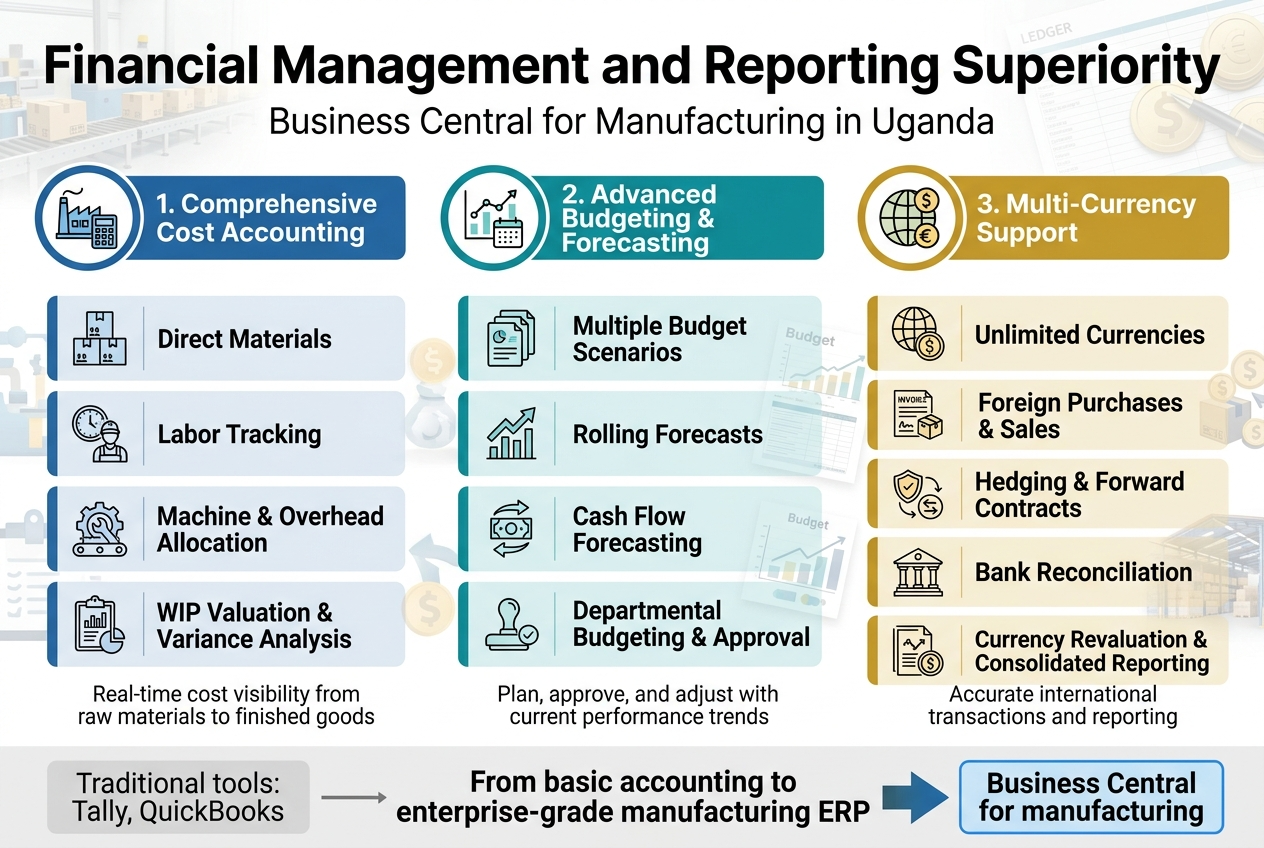
Comprehensive cost accounting for manufacturing processes
Manufacturing businesses in Uganda face unique challenges when it comes to tracking and managing costs across their production processes. Traditional accounting solutions like Tally or QuickBooks simply weren’t designed to handle the complexity of modern manufacturing operations. Business Central for manufacturing offers a revolutionary approach to cost accounting that transforms how Ugandan manufacturers understand and control their production expenses.
The system provides real-time visibility into every aspect of manufacturing costs, from raw material acquisition to finished goods delivery. Unlike basic accounting software that treats manufacturing as a black box, Business Central breaks down costs into granular components that managers can analyze and optimize. This level of detail proves invaluable for manufacturers who need to maintain competitive pricing while protecting profit margins in Uganda’s evolving industrial landscape.
Direct material costs receive sophisticated tracking through Business Central’s integrated inventory management system. The platform automatically calculates material consumption based on bill of materials (BOM) configurations, tracking every component used in production. When raw material prices fluctuate – a common occurrence in Uganda’s import-dependent manufacturing sector – the system instantly reflects these changes in cost calculations. This immediate update capability helps manufacturers make informed decisions about pricing and production scheduling without waiting for month-end reports.
Labor cost tracking extends far beyond basic payroll integration. Business Central captures direct labor hours at the operation level, allowing manufacturers to see exactly how much time workers spend on specific production activities. The system connects with shop floor data collection devices or mobile applications, ensuring accurate time recording without manual intervention. This precision becomes crucial for manufacturers competing on efficiency, especially those working with international clients who demand detailed cost breakdowns.
Machine and overhead cost allocation represents another area where Business Central excels compared to traditional manufacturing accounting software Uganda. The platform supports multiple allocation methods, from simple percentage-based distributions to sophisticated activity-based costing models. Manufacturers can assign costs based on machine hours, labor hours, material quantities, or custom formulas that reflect their specific operational characteristics. This flexibility allows each business to develop costing models that accurately represent their unique manufacturing processes.
Work-in-process (WIP) valuation becomes streamlined through Business Central’s manufacturing modules. The system continuously updates WIP values as materials are consumed and labor is applied, providing accurate financial pictures at any point in time. This real-time WIP tracking proves essential for manufacturers with longer production cycles or those producing high-value items where accurate valuation significantly impacts financial statements.
Standard costing capabilities help manufacturers establish benchmarks and identify variances quickly. Business Central maintains detailed variance analysis, comparing actual costs against standards across materials, labor, and overhead categories. These variance reports highlight areas where costs deviate from expectations, enabling proactive management intervention before small issues become major profit drains.
Product profitability analysis reaches new levels of sophistication with Business Central’s cost accounting features. Manufacturers can evaluate profitability at the item level, customer level, or sales order level, understanding which products and customers contribute most to bottom-line results. This insight proves particularly valuable for Ugandan manufacturers serving diverse markets with varying profit expectations.
Advanced budgeting and forecasting capabilities
Planning and forecasting represent critical success factors for Ugandan manufacturers navigating an increasingly competitive market environment. Business Central implementation Uganda provides advanced budgeting tools that far exceed the capabilities of traditional accounting solutions, enabling manufacturers to plan with confidence and adapt quickly to changing market conditions.
The platform’s budgeting framework supports multiple budget scenarios, allowing manufacturers to model different market conditions and operational assumptions. Companies can create optimistic, realistic, and pessimistic budget versions, comparing outcomes across various scenarios. This multi-scenario planning proves invaluable when dealing with Uganda’s dynamic economic environment, where currency fluctuations, regulatory changes, and market shifts can significantly impact manufacturing operations.
Rolling forecasts replace static annual budgets with dynamic planning tools that adjust as actual results become available. Business Central automatically updates forecasts based on current performance trends, providing forward-looking insights that help manufacturers anticipate challenges and opportunities. This continuous forecasting approach aligns with modern business practices where agility and responsiveness determine competitive advantage.
Cash flow forecasting integrates seamlessly with operational budgets, providing manufacturers with clear visibility into future liquidity needs. The system considers production schedules, supplier payment terms, customer collection patterns, and seasonal variations to generate accurate cash flow projections. For capital-intensive manufacturing operations, this cash flow visibility helps optimize working capital management and plan equipment investments strategically.
Budget allocation and approval workflows ensure proper financial governance while maintaining operational flexibility. Department managers can create detailed budgets for their areas of responsibility, while senior management maintains oversight through configurable approval processes. These workflows adapt to each organization’s management structure, supporting everything from centralized control to decentralized responsibility models.
Variance analysis capabilities extend beyond simple actual-versus-budget comparisons to provide actionable insights about performance drivers. Business Central identifies trends and patterns in budget variances, helping managers understand whether deviations represent temporary fluctuations or systematic changes requiring strategic adjustments. These analytics prove particularly valuable for manufacturers experiencing rapid growth or market evolution.
Integration with operational planning creates alignment between financial budgets and production schedules. Manufacturing resource planning (MRP) calculations consider budget constraints alongside demand forecasts, ensuring financial feasibility of production plans. This integration prevents disconnects between operational ambitions and financial realities that often plague growing manufacturers.
Departmental and cost center budgeting provides granular control over resource allocation while maintaining visibility into overall organizational performance. Manufacturing departments can plan their specific needs for materials, labor, and equipment while contributing to consolidated organizational budgets. This bottom-up planning approach often produces more accurate and achievable budget targets than top-down allocation methods.
Multi-currency support for international operations
Uganda’s manufacturing sector increasingly engages with international markets, whether sourcing raw materials from global suppliers or exporting finished goods to regional and international customers. Business Central scalability manufacturing includes robust multi-currency capabilities that transform how manufacturers manage international transactions and financial reporting.
The platform supports unlimited currencies with real-time exchange rate updates, ensuring accurate financial representation across all international operations. Exchange rates can be updated automatically through external data feeds or manually adjusted to reflect specific transaction rates. This flexibility accommodates different business practices while maintaining accuracy in financial reporting and analysis.
Purchasing operations benefit significantly from sophisticated multi-currency handling. When sourcing materials from international suppliers, Business Central automatically converts foreign currency amounts to local currency using appropriate exchange rates. The system maintains complete audit trails showing original transaction currencies alongside converted amounts, providing transparency for financial analysis and regulatory compliance.
Sales to international customers receive similar multi-currency treatment, with invoices generated in customer-preferred currencies while maintaining local currency records for reporting purposes. This dual-currency capability simplifies international sales processes while ensuring accurate revenue recognition and accounts receivable management. Customer statements and correspondence can be generated in appropriate currencies, enhancing professional relationships with international clients.
Hedging and forward contract management help manufacturers protect against currency fluctuation risks. Business Central tracks forward currency contracts and hedging positions, automatically applying predetermined rates to relevant transactions. This risk management capability proves essential for manufacturers with significant international exposure, providing protection against adverse currency movements that could eliminate profit margins.
Bank reconciliation processes accommodate multiple currencies seamlessly, handling foreign currency bank accounts and transactions with appropriate exchange rate applications. The system automatically identifies and posts exchange rate gains or losses, maintaining accurate financial records while simplifying monthly closing procedures.
Consolidated reporting across multiple currencies provides senior management with clear visibility into overall organizational performance. Business Central generates financial statements in any designated reporting currency while maintaining detailed transaction-level currency information. This reporting flexibility supports diverse stakeholder needs, from local management requiring Uganda shilling reports to international investors expecting US dollar or Euro presentations.
Intercompany transactions between international entities receive sophisticated multi-currency treatment, automatically generating matching entries in appropriate currencies for each legal entity. This capability proves valuable for manufacturers with multiple international locations or subsidiaries, eliminating manual reconciliation efforts while maintaining accurate separate entity accounting records.
Tax calculations and reporting adapt to multi-currency requirements, handling VAT and other tax obligations in appropriate currencies while maintaining compliance with local reporting requirements. Business Central supports complex tax scenarios involving currency conversions, ensuring accurate tax calculations and simplified compliance processes.
The ERP solutions Uganda provided through Business Central represent a significant advancement over traditional accounting systems in handling international manufacturing operations. While solutions like Tally or QuickBooks struggle with basic multi-currency transactions, Business Central provides enterprise-grade international capabilities that support sophisticated global manufacturing strategies.
Currency revaluation processes run automatically at period-end, adjusting foreign currency balances to current exchange rates and posting appropriate gains or losses. These automated processes eliminate manual calculations while ensuring compliance with international accounting standards and local regulatory requirements.
Performance analysis across multiple currencies helps manufacturers understand the true impact of international operations on overall profitability. Business Central provides currency-specific profitability analysis, showing how exchange rate movements affect margins and identifying opportunities for operational improvements or risk mitigation strategies.
Scalability and Growth Support Features
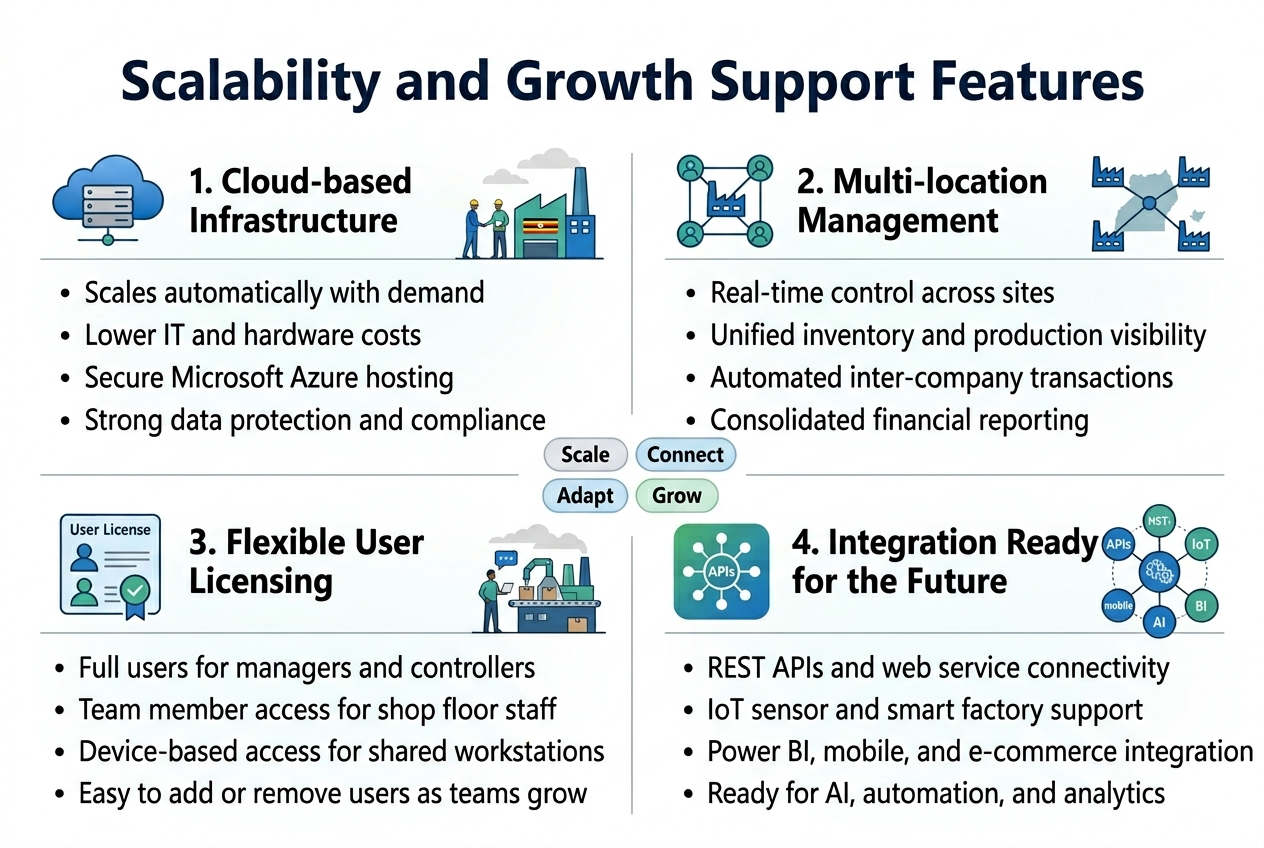
Cloud-based Infrastructure for Business Expansion
Ugandan manufacturers looking to break free from the constraints of traditional desktop solutions like Tally or QuickBooks will find that Business Central for manufacturing offers a revolutionary cloud-based approach that transforms how companies scale their operations. Unlike legacy systems that require expensive server hardware and complex IT infrastructure, Business Central operates entirely in Microsoft’s secure cloud environment, giving manufacturers the flexibility to expand their operations without worrying about technical limitations.
The cloud infrastructure advantage becomes crystal clear when comparing operational costs and capabilities. Traditional accounting solutions force manufacturers to invest heavily in server hardware, backup systems, and IT maintenance staff. A typical Ugandan manufacturing company might spend hundreds of thousands of shillings annually just maintaining their on-premise systems, not including the hidden costs of downtime, data loss risks, and limited accessibility. Business Central eliminates these concerns by providing enterprise-grade infrastructure through Microsoft Azure, which automatically scales resources based on demand.
Manufacturing ERP System in Uganda requirements vary dramatically across different industries and company sizes. A small textile manufacturer in Kampala might start with basic production tracking and financial management, while a large food processing company in Mbale could require complex multi-shift production planning, quality control workflows, and regulatory compliance reporting. Business Central’s cloud architecture accommodates these varying needs through its subscription-based model, where manufacturers pay only for the resources they actually use.
The real power of cloud infrastructure becomes apparent during peak production periods or seasonal demand fluctuations. Consider a beverage manufacturer preparing for the holiday season – with traditional systems, they would need to purchase additional server capacity months in advance to handle increased transaction volumes. Business Central automatically allocates additional processing power and storage during busy periods, then scales back during quieter months, ensuring optimal performance while controlling costs.
Security concerns often hold back Ugandan manufacturers from adopting cloud solutions, but Business Central’s infrastructure actually provides superior protection compared to most local IT setups. Microsoft invests billions of dollars annually in cybersecurity, employing thousands of security experts and maintaining compliance with international standards like ISO 27001 and SOC 2. This level of protection would be impossible for individual manufacturing companies to achieve with their own IT infrastructure.
Data sovereignty and compliance requirements specific to Uganda are handled through Microsoft’s regional data centers, ensuring that sensitive manufacturing and financial information remains within appropriate jurisdictions while still benefiting from global infrastructure capabilities. This approach satisfies both local regulatory requirements and international business needs for companies engaged in export manufacturing.
Multi-location Management Capabilities
Ugandan manufacturing software solutions must address the unique challenges of managing operations across multiple facilities, warehouses, and regional offices scattered throughout the country. Business Central’s multi-location capabilities far exceed what traditional solutions like Tally or QuickBooks can offer, providing real-time visibility and control across all manufacturing sites from a single, unified platform.
Manufacturing companies in Uganda often start with a single facility but quickly discover the need to establish multiple locations to optimize logistics, access different markets, or take advantage of regional incentives. A company might have their main production facility in Kampala, a secondary plant in Jinja for raw material processing, and distribution centers in Mbarara and Gulu. Managing inventory, production schedules, and financial reporting across these locations using traditional accounting software becomes a nightmare of spreadsheets, manual data entry, and reconciliation headaches.
Business Central transforms multi-location management through its integrated approach to inventory tracking, production planning, and financial consolidation. Each location operates as part of a connected ecosystem where inventory movements, production orders, and sales transactions automatically update across all relevant sites. When the Kampala facility receives a large order that exceeds local capacity, production planners can immediately see available capacity at the Jinja plant and automatically transfer materials and adjust production schedules accordingly.
Inter-company transactions between locations become seamless with Business Central’s automated posting and reconciliation features. Traditional systems require manual journal entries and complex reconciliation procedures when transferring goods or services between locations, creating opportunities for errors and requiring significant accounting staff time. Business Central automatically generates the appropriate journal entries, updates inventory levels, and maintains detailed audit trails for all inter-location transactions.
The financial reporting capabilities for multi-location operations represent another significant advantage over traditional manufacturing accounting software Uganda solutions. Business Central can generate consolidated financial statements that combine results from all locations while maintaining detailed breakdowns for individual sites. This dual perspective allows management to understand overall company performance while identifying specific locations that may require attention or represent growth opportunities.
Regional managers gain unprecedented autonomy and accountability through Business Central’s role-based security and reporting features. The Mbarara distribution center manager can access real-time inventory levels, sales performance metrics, and customer information specific to their region while remaining connected to the overall company system. This local empowerment, combined with centralized oversight, creates an optimal balance between operational efficiency and management control.
Supply chain coordination across multiple locations becomes dramatically more efficient with Business Central’s integrated procurement and inventory management features. Rather than each location maintaining separate supplier relationships and inventory buffers, the system can optimize purchasing decisions across all sites, consolidate orders to achieve better pricing, and automatically redistribute inventory based on demand patterns and production schedules.
Flexible User Licensing for Growing Teams
The journey from a small manufacturing operation to a large enterprise requires software that can accommodate rapid team growth without creating administrative burdens or budget surprises. Othware Official Microsoft Partner for Uganda helps manufacturers understand how Business Central’s flexible licensing model supports sustainable growth while maintaining cost predictability throughout the expansion process.
Traditional accounting solutions like Tally or QuickBooks create significant barriers to adding new users, often requiring expensive license purchases upfront or forcing companies to buy more capacity than they currently need. This approach puts growing manufacturers in an impossible position: either limit team access to critical business information or make large capital investments in software licenses that may not be fully utilized for months or years.
Business Central’s subscription-based licensing model eliminates these growth barriers through several distinct user types designed to match different roles and access requirements within manufacturing organizations. Full users receive complete access to all system functionality, making them ideal for production managers, financial controllers, and operations supervisors who need comprehensive visibility and control capabilities.
Team member licenses provide cost-effective access for employees who need limited system interaction, such as production line supervisors who only need to view work orders and record completion data, or quality control inspectors who primarily need to access inspection templates and record test results. This licensing tier ensures that critical operational staff can participate in the integrated system without requiring full user licenses that would strain growing companies’ budgets.
Essential users occupy a middle ground, offering access to core business functions without the advanced features that full users require. This licensing level works perfectly for department heads, customer service representatives, and procurement staff who need substantial system access but don’t require advanced financial reporting or system administration capabilities.
Device-based licensing provides another flexible option for manufacturing environments where multiple shifts share workstations or where temporary workers need system access. Rather than purchasing individual user licenses for every person who might occasionally need system access, companies can license specific terminals or tablets that multiple employees can use throughout different shifts.
Business Central scalability manufacturing requirements often include seasonal staffing fluctuations common in agricultural processing, textile manufacturing, and other industries influenced by weather patterns or market cycles. The ability to quickly add temporary user licenses during peak seasons, then scale back during quieter periods, provides significant cost advantages over traditional licensing models that require permanent capacity purchases.
Administrative overhead for user management remains minimal as teams grow, thanks to Business Central’s integration with Microsoft 365 and Azure Active Directory. New employees can be granted appropriate system access through familiar identity management tools, and their access automatically inherits security settings and permissions appropriate to their role. This integration eliminates the manual user management tasks that become increasingly burdensome as organizations grow.
Training and onboarding new users becomes more efficient through Business Central’s familiar Microsoft interface and extensive online learning resources. Employees already comfortable with Microsoft Office applications can quickly adapt to Business Central’s navigation and basic functions, reducing the training time and costs associated with bringing new team members up to speed on business systems.
Integration Readiness for Future Technology Adoption
Modern manufacturing success depends increasingly on the ability to incorporate new technologies and adapt to changing market conditions without completely replacing core business systems. Business Central implementation Uganda projects should prioritize future-proofing capabilities that ensure long-term value as companies adopt emerging technologies like IoT sensors, artificial intelligence, robotic process automation, and advanced analytics.
The integration architecture that separates Business Central from traditional accounting solutions becomes apparent when examining API capabilities and third-party connectivity options. While legacy systems typically require expensive custom programming or complex middleware solutions to connect with modern technologies, Business Central provides robust REST APIs, web services, and pre-built connectors that dramatically simplify integration projects.
Manufacturing companies increasingly rely on specialized equipment and software solutions for specific production processes, quality management, or regulatory compliance. A pharmaceutical manufacturer might need to integrate specialized batch tracking systems, while a food processor requires connection to automated packaging equipment and cold chain monitoring systems. Business Central’s open architecture accommodates these specialized requirements without forcing companies to replace their entire business system.
Internet of Things (IoT) integration capabilities represent a significant competitive advantage for manufacturers willing to embrace smart factory concepts. Production equipment fitted with sensors can automatically report performance metrics, maintenance requirements, and quality measurements directly to Business Central, eliminating manual data entry and providing real-time production visibility. This capability transforms traditional reactive maintenance approaches into predictive strategies that minimize downtime and optimize equipment utilization.
Dynamics 365 Developer in Uganda expertise becomes valuable when manufacturers want to create custom applications or unique business processes that leverage Business Central’s platform capabilities. The Power Platform integration allows companies to build custom applications, automated workflows, and advanced reporting solutions without requiring traditional software development skills or expensive consulting services.
Business intelligence and analytics integration prepare manufacturers for the increasing importance of data-driven decision making. Business Central connects seamlessly with Power BI, enabling sophisticated reporting and analysis capabilities that transform raw operational data into actionable insights. Production managers can identify efficiency trends, quality patterns, and cost optimization opportunities that would be impossible to discover using traditional reporting tools.
E-commerce integration capabilities become crucial as more manufacturers adopt direct-to-consumer sales channels or participate in online B2B marketplaces. Business Central’s built-in e-commerce connectors and APIs allow real-time inventory synchronization, automated order processing, and integrated customer management across multiple sales channels without requiring duplicate data entry or complex reconciliation procedures.
Mobile application development and integration support the growing need for remote access and field-based operations management. Sales representatives can access real-time inventory information and place orders directly from customer locations, while maintenance technicians can update work orders and parts requests from anywhere in the facility using mobile devices that sync automatically with the central system.
Cloud-based integration capabilities ensure that future technology adoption doesn’t create additional IT infrastructure requirements or security vulnerabilities. New applications and services can leverage the same secure Microsoft cloud environment that hosts Business Central, maintaining consistent security policies and backup procedures while enabling rapid deployment of new capabilities.
ERP solutions Uganda evaluation should consider how well different systems support emerging technologies like artificial intelligence and machine learning. Business Central’s integration with Microsoft’s Cognitive Services and AI platforms enables manufacturers to gradually incorporate intelligent automation, predictive analytics, and natural language processing capabilities without replacing their core business system or requiring specialized technical expertise.
Implementation Success Strategies for Ugandan Manufacturers
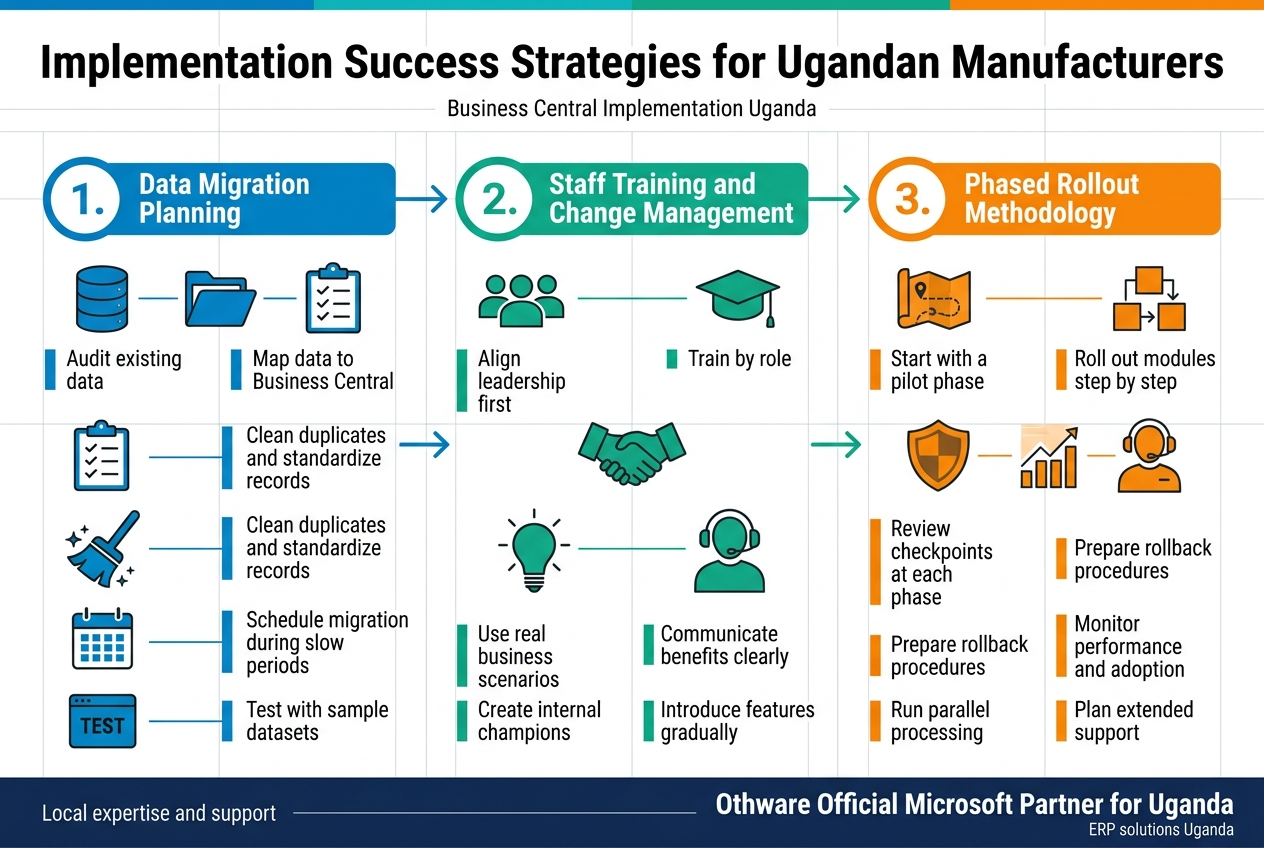
Data Migration Planning from Existing Systems
Moving from legacy accounting software like Tally or QuickBooks to Business Central requires careful planning to protect your manufacturing data and ensure business continuity. The success of your Business Central implementation Uganda largely depends on how well you handle this critical phase.
Start by conducting a comprehensive data audit of your existing systems. Document every data type currently stored, from basic accounting records to complex manufacturing specifications. This includes customer information, supplier databases, inventory records, bills of materials, routing information, financial transactions, and historical reporting data. Manufacturing companies often underestimate the volume and complexity of their operational data until they begin this exercise.
Create a detailed data mapping strategy that identifies which information transfers directly to Business Central and what requires transformation. Tally users frequently discover that their custom fields need restructuring to align with Business Central’s standardized format. QuickBooks users often find that their simplified manufacturing tracking requires expansion to take advantage of Business Central’s comprehensive production management capabilities.
Establish data quality standards before migration begins. Clean up duplicate entries, standardize naming conventions, and validate accuracy across all datasets. Manufacturing data tends to accumulate inconsistencies over time, particularly in inventory descriptions, vendor information, and product specifications. Address these issues during migration rather than carrying forward problematic data into your new system.
Develop a migration timeline that accounts for business cycles and seasonal demands. Avoid scheduling major data transfers during peak production periods or critical financial reporting deadlines. Most successful Ugandan manufacturers choose transition windows during slower operational periods, allowing time to address unexpected challenges without disrupting core business activities.
Test the migration process extensively using sample datasets before executing the full transfer. Create a parallel testing environment where you can validate data accuracy and system functionality. This testing phase often reveals integration requirements or customization needs that weren’t apparent during initial planning.
Staff Training and Change Management Approaches
Transitioning to Business Central for manufacturing represents a significant change for your workforce, requiring strategic training approaches that address both technical skills and organizational adaptation. Successful implementations recognize that technology adoption depends more on people than software capabilities.
Begin with leadership alignment to ensure management fully understands Business Central’s capabilities and can champion the change throughout the organization. When supervisors and department heads actively support the transition, employee acceptance increases dramatically. Leadership training should focus on how Business Central transforms manufacturing workflows and enables better decision-making through improved data visibility.
Develop role-specific training programs rather than generic overviews. Production floor workers need different Business Central knowledge than accounting staff or inventory managers. Create targeted training modules that focus on daily tasks and responsibilities specific to each role. Manufacturing supervisors benefit from training on production scheduling and capacity planning features, while warehouse staff need expertise in inventory tracking and materials management.
Implement hands-on training approaches using your actual business scenarios rather than generic examples. Create training datasets that mirror your real manufacturing environment, including your products, vendors, and typical transactions. This practical approach helps staff connect Business Central features to their daily responsibilities and reduces the learning curve significantly.
Establish internal champions within each department who receive advanced training and can provide ongoing peer support. These champions serve as first-line problem solvers and help maintain momentum after initial training concludes. Choose champions who are naturally helpful and have credibility with their colleagues, not necessarily the most technically skilled individuals.
Address change resistance proactively by communicating the benefits clearly and honestly. Many employees fear that new systems will make their jobs more difficult or threaten their job security. Explain how Business Central eliminates tedious manual tasks and provides tools that make their work more efficient and rewarding. Share specific examples of how the system improves their daily experiences.
Create a gradual learning approach that introduces Business Central capabilities progressively rather than overwhelming users with comprehensive training all at once. Start with basic functions that mirror current processes, then gradually introduce advanced features that leverage Business Central’s full manufacturing capabilities.
Phased Rollout Methodology for Minimal Disruption
A phased implementation approach reduces risk and allows for continuous refinement throughout the Business Central implementation Uganda process. This methodology proves particularly valuable for manufacturing companies that cannot afford operational disruptions during the transition.
Begin with a pilot phase focusing on one specific manufacturing area or product line. Choose a representative but manageable subset of your operations that includes key business processes without overwhelming complexity. This pilot phase allows you to validate system configurations, identify potential issues, and refine processes before broader implementation.
Structure the rollout around functional modules rather than attempting complete system deployment simultaneously. Start with core financial management features that replace your current accounting functions. Once financial processes operate smoothly, add inventory management capabilities, followed by production planning and scheduling modules. This sequential approach allows staff to master each component before moving to the next.
Plan module integration carefully to ensure seamless data flow between implemented and pending components. Manufacturing operations require tight integration between financial, inventory, and production systems. Design temporary interfaces or manual processes to bridge gaps between deployed and future modules while maintaining operational continuity.
Establish parallel processing during transition periods where critical business functions operate in both old and new systems temporarily. This redundancy provides security against unexpected issues while allowing real-world validation of Business Central processes. Manufacturing companies often run parallel inventory tracking for several weeks to ensure accuracy before decommissioning legacy systems.
Create checkpoint reviews at each phase to evaluate progress and make necessary adjustments before proceeding. These reviews should assess technical performance, user adoption rates, and business process effectiveness. Use feedback from each phase to refine subsequent rollout steps and address emerging challenges.
Develop rollback procedures for each phase in case serious issues arise that require temporary reversion to previous systems. While rollbacks should be rare with proper planning, having documented procedures reduces stress and provides confidence during the transition process.
Coordinate rollout timing with business cycles to minimize impact on critical operations. Avoid implementing new modules during busy production periods, month-end closing processes, or other high-stress operational times. Most Ugandan manufacturers find success scheduling major rollout phases during traditionally slower periods.
Monitor system performance and user adoption metrics throughout each phase. Track key performance indicators like transaction processing times, error rates, and user satisfaction levels. This monitoring identifies potential problems early and demonstrates tangible benefits that support continued change management efforts.
Plan for extended support during each rollout phase, providing additional technical assistance and user support as needed. Staff typically require more help during the first few weeks with each new module as they adapt to new processes and workflows. Budget for temporary additional support resources rather than overwhelming your regular IT staff.
Document lessons learned throughout the phased rollout to improve subsequent implementations and provide valuable reference material for future system expansions. This documentation proves particularly valuable if you later implement Business Central in additional locations or expand to new manufacturing operations.
Working with Othware Official Microsoft Partner for Uganda provides local expertise and support throughout the implementation process, ensuring your phased rollout addresses specific challenges common to Ugandan manufacturing environments. Their experience with ERP solutions Uganda implementations helps avoid common pitfalls and accelerates successful adoption across your organization.
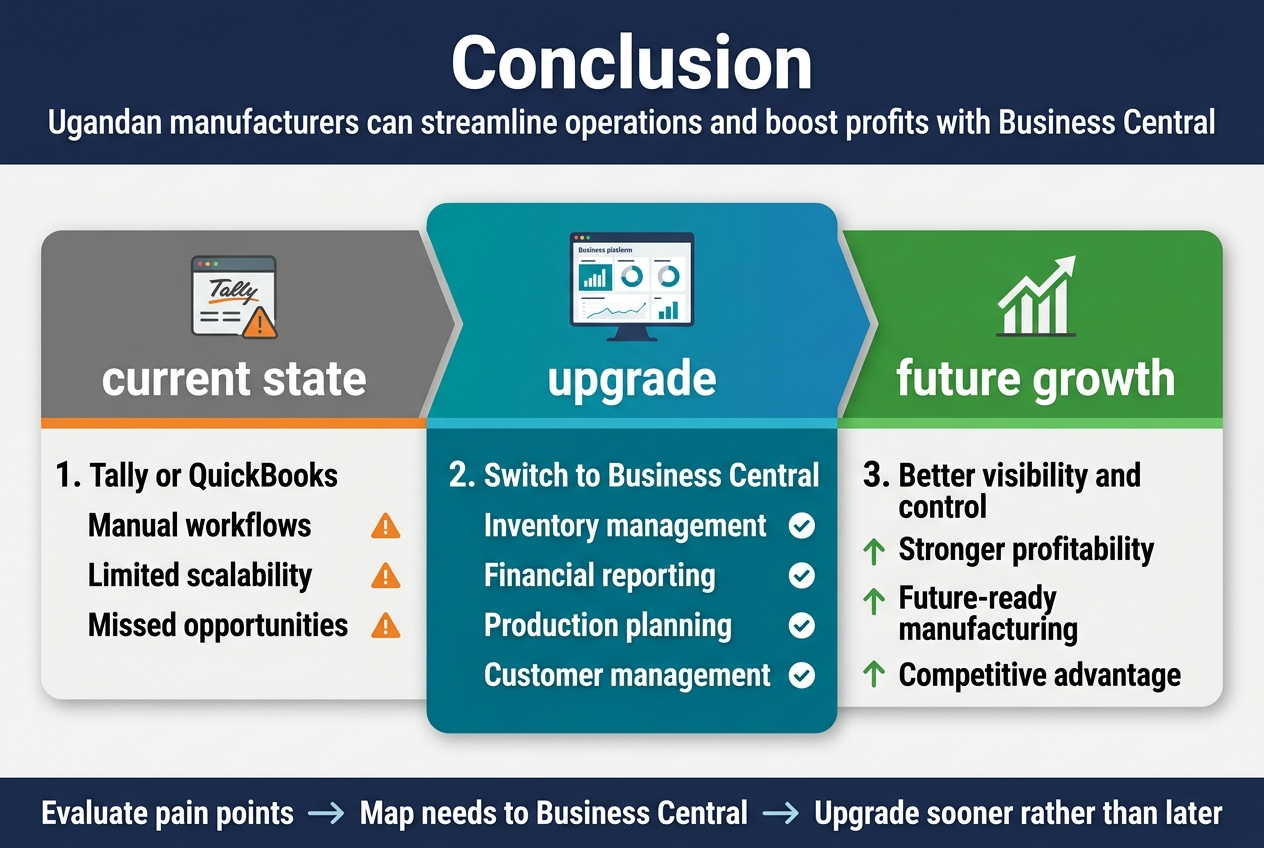
Ugandan manufacturers running on Tally or QuickBooks are missing out on serious opportunities to streamline their operations and boost profits. The data doesn’t lie – companies that switch to Business Central see dramatic improvements in everything from inventory management to financial reporting. While traditional accounting software might have worked when your business was smaller, the complex demands of modern manufacturing require a solution that can keep pace with your growth ambitions.
Making the jump to Business Central isn’t just about better software – it’s about positioning your manufacturing business for the future. The platform’s ability to integrate everything from production planning to customer management means you’ll finally have the visibility and control needed to compete in today’s market. Start by evaluating your current pain points and mapping them against Business Central’s capabilities. Your bottom line will thank you for making the upgrade sooner rather than later.

Tech Evangelist and Business Developer.
I love connecting with nature